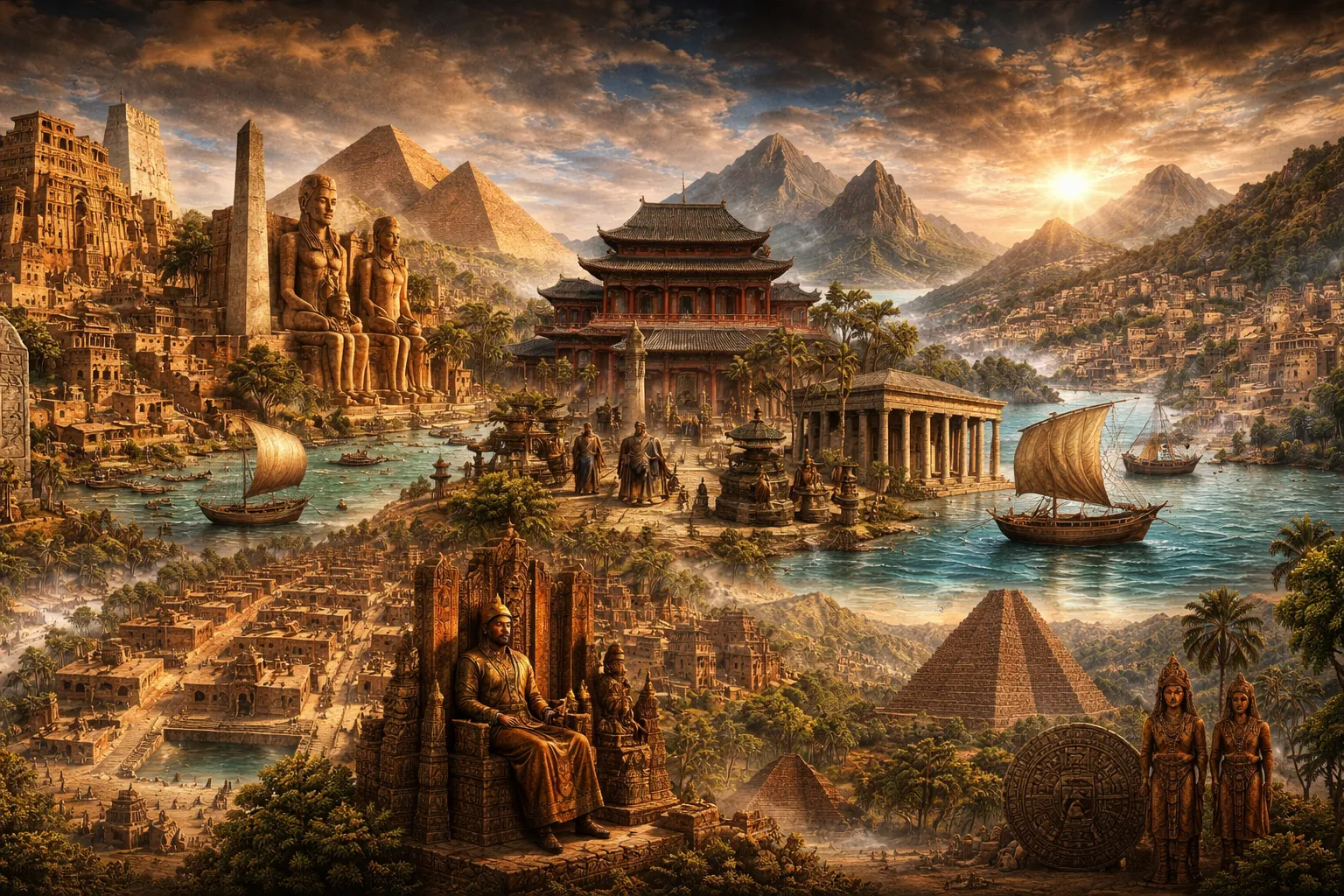
What Ancient Art Teaches Us to Look At
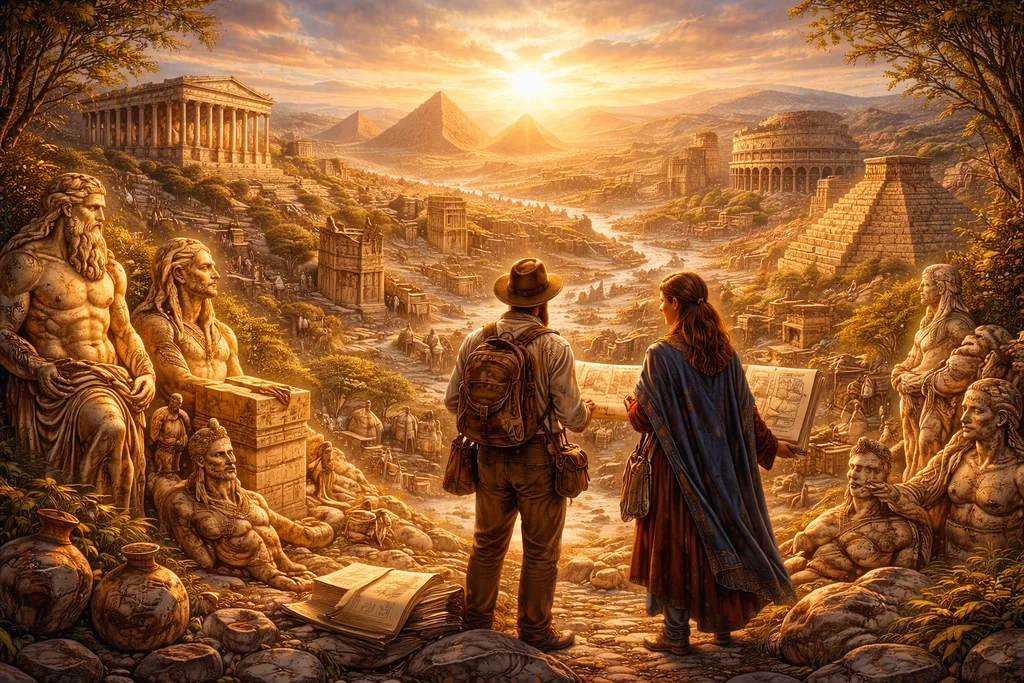
Introduction
At the end of this episode devoted to Antiquity, the goal is no longer simply to add a new theme, but to step back. The previous chapters explored centers of civilization, the invention of writing and the state, the relationships between power and the sacred, exchanges, major artistic traditions, bodies, spaces, decorations, narratives, survivals, and reinventions. We must now gather this journey together in order to understand what ancient art teaches us, not only about the past, but also about the way we look at works of art.
One of the major contributions of ancient art is that it forces us to move beyond our immediate visual habits. We are often tempted to judge an ancient work according to modern criteria:
- resemblance to reality;
- individual expression;
- anatomical realism;
- perspective;
- absolute originality;
- the autonomy of art from religion or politics.
Yet Antiquity shows us something else. It shows us arts in which the image is often linked to a function, a rite, a power, a memory, a cosmology, an order of the world. It therefore teaches us to look not only at what the work shows, but also at what it does.
The purpose of this final chapter is to offer a true synthesis of the episode. It is not simply a matter of summarizing, but of drawing out the major lessons of the journey. Studying ancient art, in the end, means learning to see differently: differently the body, differently space, differently narrative, differently symbol, differently the past itself.
Ancient Art Is Not a Single Block
The first major lesson is probably the most important: ancient art is not a homogeneous whole. There is not one single Antiquity, nor one single ancient style, nor one single ancient way of making images. Antiquity instead brings together:
- several centers of civilization;
- several systems of belief;
- several technical traditions;
- several regimes of power;
- several relations to the body, decoration, space, and narrative.
What must be remembered
- speaking of “ancient art” in the singular is practical, but simplifying;
- one must always keep in mind the plurality of ancient worlds;
- comparison is useful as long as it does not flatten differences;
- the unity of Antiquity is less an identity of forms than a vast field of organized ancient civilizations.
To learn to look at ancient art is therefore first of all to learn to look at diversity.
Moving Beyond the Eurocentric Reflex
Another essential lesson is the need to shift our gaze. For a long time, the history of ancient art was told as if it naturally led toward Greece and then Rome, as if those two centers alone summed up the whole period. Yet a careful study of Antiquity shows that such a reading is insufficient.
We must fully integrate:
- Mesopotamia;
- ancient Egypt;
- the Persian worlds;
- ancient India;
- ancient China;
- the ancient African worlds;
- the Mesoamerican and Andean worlds;
- without forgetting zones of contact and circulation.
What this changes
- one no longer takes a single tradition as the implicit norm;
- one understands better the plurality of artistic solutions;
- other centers of coherence and invention come into view;
- one restores to Antiquity its true global dimension.
To look at ancient art today therefore means learning to correct narratives that are too narrow.
Looking at a Work Means Looking at a Function
Ancient art also teaches us that works are not made only to be “beautiful” in the modern sense. Very often, they are conceived in order to act within a precise framework. An image may:
- protect;
- teach;
- glorify;
- accompany a rite;
- make present;
- assert a hierarchy;
- guard a threshold;
- transmit a memory;
- structure a space.
This means
- that one must always ask what the work is for;
- that an ancient image is often inseparable from its use;
- that beauty may be tied to symbolic efficacy;
- that art is not always autonomous, but deeply linked to religious, political, funerary, or social life.
Ancient art therefore teaches us to ask a simple but decisive question: what does this work do in the world in which it appears?
The Visible Is Often Linked to the Invisible
One of the major strengths of ancient arts is that they make visible what is not directly visible:
- the sacred;
- memory;
- power;
- protection;
- the afterlife;
- myth;
- cosmic order;
- danger;
- prestige;
- dynastic continuity.
A divine statue, a victory relief, a funerary decoration, a hybrid figure, or a ritual procession does not merely show forms. It gives access to structures of thought.
What must be remembered
- the ancient image is not only descriptive;
- it makes perceptible what exceeds immediate experience;
- it often acts as a mediation between several planes of reality;
- it calls for a symbolic reading as much as a visual one.
To look at ancient art is therefore to learn to read the invisible within the visible.
The Body Is Never Merely Anatomical
The chapters devoted to the body showed a fundamental point: the ancient body is not a simple object of anatomical observation. It is:
- hierarchized;
- idealized;
- codified;
- ritualized;
- politicized;
- symbolized.
The body may speak of:
- dignity;
- power;
- ideal youth;
- divine proximity;
- victory;
- function;
- status;
- the memory of a deceased person.
What this teaches us
- that a human figure is never merely “a body”;
- that one must look at posture, scale, clothing, gestures, and attributes;
- that resemblance is not always the main goal;
- that the image of the body is always a cultural construction.
Ancient art therefore teaches us never to reduce the human figure to its physical appearance alone.
Space Is Not Merely a Background
In the same way, ancient space must not be read as a simple backdrop. It is often constructed in order to:
- hierarchize;
- separate;
- guide;
- sacralize;
- frame the narrative;
- distinguish the center from the periphery;
- connect architecture, nature, and figures.
Space may be:
- frontal;
- symbolic;
- ordered by registers;
- processional;
- monumental;
- cosmological;
- funerary;
- political.
What must be remembered
- ancient space does not necessarily obey modern perspective;
- it may be perfectly coherent without being illusionistic;
- it has a strong intellectual and symbolic function;
- it structures reading as much as it situates figures.
To look at ancient art is therefore to learn to see space as a form of thought.
Decoration Thinks as Much as It Ornaments
Decoration is often underestimated when one looks at ancient works. Yet it plays an essential role. Vegetal, geometric, cosmic, or architectural motifs do not merely fill surfaces. They may:
- create rhythm;
- protect;
- distinguish;
- sacralize;
- connect a work to a tradition;
- assert an order;
- enrich the symbolic power of an image.
This means
- that decoration is not secondary;
- that it must be read as a language;
- that a border, a frieze, or a repeated motif often carries meaning;
- that ornament fully participates in the intelligence of the work.
Ancient art therefore teaches us to look at margins, surfaces, repetitions, and motifs with as much attention as the principal figures.
Narrative Does Not Belong Only to Text
Another major lesson of the journey concerns narration. Antiquity shows us that the image can tell powerfully without relying only on writing. It may do so:
- through condensation;
- through repetition;
- through sequence;
- through registers;
- through visual pathways;
- through recognition of known scenes.
Ancient visual narrative transmits:
- myths;
- victories;
- rites;
- genealogies;
- funerary memories;
- foundations;
- visions of the world.
What must be remembered
- narrative in images has its own logics;
- it does not simply imitate text;
- it engages the viewer’s memory;
- it transforms time into visible space.
To look at ancient art is therefore to learn to read stories in forms.
Ancient Art Is Inseparable from Memory
Whether it concerns the memory of gods, the dead, ancestors, dynasties, victories, or origins, ancient art is very often an art of memory. It preserves:
- names;
- gestures;
- lineages;
- rites;
- narratives;
- exemplary figures;
- political and religious orders.
This memory may be:
- funerary;
- civic;
- dynastic;
- religious;
- territorial;
- cosmological.
What this teaches us
- that an ancient work is often made to endure;
- that it inscribes something into the long durée;
- that it acts as a support of transmission;
- that it transforms absence or the past into visible presence.
Ancient art thus teaches us to look at works as instruments of survival.
Ancient Art Is Often an Art of Relation
An ancient work does not exist in isolation. It is frequently caught within a network of relations:
- relation to a place;
- relation to a rite;
- relation to a text;
- relation to an authority;
- relation to a dead person;
- relation to a divinity;
- relation to an initiated viewer;
- relation to other images within a larger whole.
This means
- that one must replace the work in its context;
- that a single image does not always say everything;
- that a temple, a tomb, a palace, or a ritual object often forms a system;
- that meaning also arises from relations between elements.
Ancient art therefore teaches us to look at works as nodes within a larger fabric.
Fragments Matter Too
We very often receive Antiquity in fragmentary form:
- mutilated statues;
- ruined temples;
- incomplete paintings;
- broken inscriptions;
- isolated objects.
But these fragments are not merely poor remains. They continue to speak. They force us to:
- reconstruct;
- compare;
- imagine cautiously;
- accept what is missing;
- understand that the past never arrives whole.
What must be remembered
- the fragment is part of the very experience of the antique;
- it does not cancel meaning, but makes it more demanding;
- it reminds us that art history is also a history of losses;
- it teaches us a form of humility in looking.
Ancient art therefore teaches us to see through absence as well.
Legacies Change the Way We Look at the Past
Finally, the journey through survivals and reinventions showed that we never look at Antiquity innocently. We look at it through:
- copies;
- ruins;
- museums;
- scholarly narratives;
- reuses;
- political uses;
- modern imaginaries;
- the filters of our own time.
This means
- that our Antiquity is always partly reconstructed;
- that one must distinguish between the ancient work and its later readings;
- that the same motif may have several lives;
- that looking at the antique also means reflecting on our own way of inheriting.
Ancient art therefore teaches us not only to look at the past, but to look at how we look at it.
What Antiquity Changes in Our Way of Seeing Art
If we bring all these lessons together, we may say that Antiquity profoundly modifies the way we think about art. It pushes us not to reduce a work:
- to its immediate aesthetics;
- to its realism;
- to its individual originality;
- to its merely decorative dimension;
- to a strictly modern reading.
It pushes us instead to look at:
- functions;
- uses;
- beliefs;
- hierarchies;
- contexts;
- systems of signs;
- long temporalities;
- the plurality of visual worlds.
In this sense, Antiquity teaches us
- to slow down our gaze;
- to read rather than merely see;
- to compare without hierarchizing too quickly;
- to recognize the diversity of artistic logics;
- to pay as much attention to symbol, rite, and memory as to form.
A School of Looking
In the end, ancient art may be considered a true school of looking. It teaches us:
- to observe forms with precision;
- to seek functions behind appearances;
- to place works back into their worlds;
- to recognize the historical thickness of images;
- not to impose our contemporary categories too quickly;
- to accept the plurality of artistic responses to the world.
This school of looking is precious because it is valid far beyond Antiquity. It can serve to read:
- medieval arts;
- religious arts;
- political arts;
- extra-European arts;
- ritual arts;
- arts of memory;
- and even contemporary images when they manipulate symbols, narratives, and powers.
What must be remembered
- Antiquity is not only an object of study;
- it is also a method of looking;
- it teaches us to think the image in all its density.
Why This Chapter Is Essential
This chapter is essential because it gives overall meaning to the entire episode. The point is not simply to have accumulated knowledge about ancient civilizations. The point is to have learned to look differently.
Thanks to this journey, one understands better:
- that ancient art is plural and global;
- that it is inseparable from power, the sacred, memory, and narrative;
- that it cannot be reduced to the question of realism alone;
- that it continues to act through its legacies and reinventions;
- that it forms an excellent school for learning to read works more deeply.
Studying ancient art, in the end, is not only about returning to old works. It is about training the gaze to become more attentive, more patient, more comparative, and more just.
Essential Ideas to Remember
- ancient art is not a single block, but a plurality of traditions;
- a non-Eurocentric approach is indispensable in order to understand it;
- ancient works must be read through their functions, uses, and contexts;
- the body, space, decoration, narrative, and symbol are always deeply constructed within it;
- the ancient image makes the invisible visible, preserves memory, and organizes time;
- fragments, transmissions, and reinventions are integral parts of our relation to Antiquity;
- the study of ancient art teaches us to look at all works with greater subtlety.
General Conclusion of the Antiquity Episode
Antiquity now appears not as a simple distant beginning, but as an immense laboratory of forms, beliefs, powers, narratives, and memories. It does not only teach us where certain images come from; above all, it teaches us to recognize that an image is never only what it shows. It is also what it transmits, what it protects, what it orders, what it makes present, what it makes one believe, what it makes one remember, and what it makes one see.
That is perhaps, in the end, the greatest lesson of the Art Chronicles devoted to Antiquity: learning to look at works as worlds.