Legacies, Rediscoveries, and Reinventions of Ancient Art
Introduction
After studying narrative in images in ancient art, we must now take a new step: understanding what becomes of ancient art after Antiquity itself. A civilization does not entirely disappear when its historical period comes to an end. Its forms, techniques, images, motifs, monuments, visual ideas, and ways of organizing the visible may survive, circulate, be forgotten, transformed, rediscovered, admired, imitated, or opposed.
Ancient art therefore never reaches us in a pure state, as an intact block passing through time without alteration. It reaches us through successive layers:
- direct transmission;
- reuse;
- copying;
- adaptation;
- partial destruction;
- archaeological rediscovery;
- scholarly interpretation;
- artistic reappropriation;
- political or cultural recovery.
This chapter is essential because it shows that Antiquity is not only a closed past. It continues to act within the history of art. Its forms never cease to reappear, but never in exactly the same way. Their meanings change according to the periods. A column, a god, a hero, a drapery, a profile, a type of monument, a decorative motif, an ideal of the body, or a narrative scene may be read very differently from one century to another.
To study the legacies, rediscoveries, and reinventions of ancient art is therefore to learn to see Antiquity not only as an origin, but as a reserve of forms constantly reinterpreted.
What Is an Artistic Legacy?
The word “legacy” may seem simple, but it covers diverse realities. An artistic legacy does not mean that a later period passively receives a set of ancient forms. Rather, it means that it enters into a relation with them.
This legacy may take several forms:
- preservation of works or monuments;
- transmission of techniques;
- maintenance of certain motifs;
- reuse of an architectural vocabulary;
- admiration for an ancient canon;
- reuse of antique objects;
- partial imitation;
- creative transformation.
What must be remembered
- inheriting does not mean repeating identically;
- a legacy always implies a reading, even if implicit;
- what is transmitted often changes function or value;
- Antiquity acts differently according to place, period, and milieu.
Artistic legacy is therefore less a perfect continuity than an active relation to the past.
Transmission Is Never Total
It is important to understand that not all ancient art has been transmitted equally. Some works disappeared, others were fragmented, while others were buried, displaced, destroyed, reused, or profoundly transformed. What later periods know of Antiquity therefore depends on:
- what materially survived;
- what was copied;
- what was judged worthy of preservation;
- what remained visible;
- what was rediscovered later;
- the religious, political, and cultural filters that shaped transmission.
This means
- that our image of ancient art is partial;
- that some civilizations or some media were transmitted better than others;
- that legacies do not always faithfully reflect the original richness;
- that one must distinguish real Antiquity from transmitted Antiquity.
The history of legacies is therefore also a history of losses.
Reuse: Surviving Through Transformation
One of the most concrete forms of survival of ancient art is reuse. Ancient elements are used again in other contexts:
- columns;
- capitals;
- sculpted stones;
- sarcophagi;
- reliefs;
- statues;
- decorative fragments;
- precious materials.
Reuse may be motivated by:
- the availability of already worked materials;
- the prestige of the ancient;
- the desire to inscribe oneself within a continuity;
- the symbolic appropriation of a prestigious past;
- the transformation of an old meaning into a new use.
What must be remembered
- an ancient work may survive without keeping its original function;
- reuse often transforms the meaning of forms;
- ancient material may continue to live within a world that no longer shares exactly the same beliefs.
Thus, Antiquity may survive not only as memory, but as a material presence reintegrated into other constructions.
Copying the Antique
Copying plays a major role in transmission. To copy does not only mean mechanically reproducing. It may mean:
- studying;
- learning;
- preserving;
- adapting;
- translating into another material;
- reformulating an admired model.
In many periods, artists copy the antique in order to:
- understand proportions;
- observe compositions;
- assimilate a vocabulary of the body or drapery;
- train themselves;
- revive an ideal;
- give their work cultural authority.
But copying the antique does not necessarily mean
- recovering the original exactly;
- respecting its initial context;
- sharing its religious or political functions.
Copying may therefore be faithful in form and very distant in meaning.
Forgetting Antiquity
Admiration for Antiquity is often emphasized, but it must also be recalled that Antiquity went through phases of forgetting, relative disinterest, or deep transformation of its legibility. Works may become misunderstood:
- because their cultic function disappears;
- because their language is no longer read;
- because their gods are no longer recognized;
- because their visual codes no longer speak directly;
- because monuments fall into ruin or change use.
Forgetting does not mean making something disappear entirely
A form may remain visible while becoming opaque. One may still see:
- a temple without fully understanding its cult;
- a statue without knowing the story it represented;
- an inscription without being able to read it;
- a motif without knowing its original meaning.
Forgetting is therefore an integral part of the history of legacies.
Rediscovering: Seeing Again
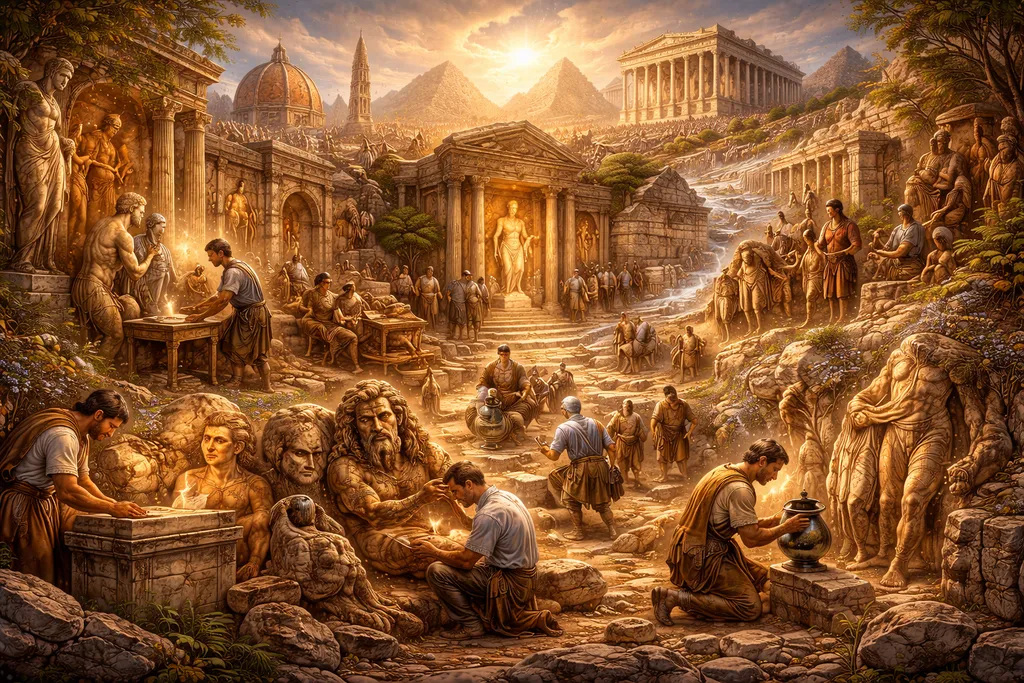
Rediscovery corresponds to the moment when ancient works, sites, forms, or bodies of knowledge become visible and meaningful again for later periods. This rediscovery may be gradual or spectacular. It passes through:
- excavations;
- clearing of ruins;
- collecting of objects;
- reading of inscriptions;
- study of ancient texts;
- circulation of drawings, surveys, or casts;
- formation of collections.
Rediscovering does not mean recovering intact
A rediscovery is always situated. It depends on:
- the expectations of the period that rediscovers;
- what it is looking for in Antiquity;
- what it does or does not understand;
- the aesthetic categories it projects onto the works.
Thus, to rediscover the antique is always also to reinterpret it.
Antiquity as a Model
Several times in history, ancient art has been elevated into a model. This means that it was seen as:
- an ideal of beauty;
- a balance;
- a measure;
- a formal authority;
- a source of cultural legitimacy;
- a prestigious language of power or civilization.
When Antiquity becomes a model, one may seek in it
- a canon of the body;
- an architectural order;
- a clarity of composition;
- a monumental grandeur;
- a nobility of narrative;
- a mastery of decoration.
But this raises an important question
Which antique becomes the model?
Often, only certain parts of Antiquity are valued:
- Classical Greece;
- Imperial Rome;
- certain famous monuments;
- certain better-preserved statues;
- certain texts better known than others.
Model-Antiquity is therefore often a selected Antiquity.
Antiquity as a Reservoir of Motifs
Even when it is not taken as an absolute norm, Antiquity continues to nourish the arts through its motifs:
- columns;
- pediments;
- profiles;
- laurels;
- chariots;
- winged victories;
- sphinxes;
- monsters;
- friezes;
- mythological figures;
- draperies;
- trophies;
- garlands;
- palmettes;
- meanders;
- ideal architectures.
These motifs may be reused:
- for their prestige;
- for their decorative force;
- for their symbolic power;
- to evoke a past of grandeur;
- to create a learned or heroic atmosphere.
What must be remembered
- an ancient motif may survive even outside its original context;
- it may become decorative, erudite, political, or poetic;
- the survival of a motif does not always imply the survival of its original meaning.
Reinventing the Antique
To reinvent the antique is not merely to quote it. It is to transform it actively in order to respond to new needs. A period may reinvent Antiquity:
- by modernizing its forms;
- by simplifying it;
- by dramatizing it;
- by fusing it with other traditions;
- by using it to think its own identity;
- by correcting what it believes to be its “lacks”;
- by projecting onto it its own ideals.
Some forms of reinvention
- an ancient god reinterpreted as an allegorical figure;
- an ancient monument transformed into a national emblem;
- an ancient hero used to exalt a new morality;
- an ancient architectural form adapted to a modern function;
- an old decorative motif integrated into a totally different aesthetic.
Reinvention is therefore not an accidental betrayal: it is one of the normal ways of keeping the past alive.
The Political Legacies of the Antique
Ancient art is not reinvented only out of aesthetic taste. It is also reinvented for political reasons. Later powers may draw from Antiquity in order to:
- legitimize themselves;
- present themselves as heirs to an empire;
- display grandeur, order, and stability;
- monumentalize their own authority;
- inscribe their rule within a prestigious historical continuity.
This may happen through
- official architecture;
- arches, columns, statues, and reliefs;
- idealized portraits;
- signs of victory;
- references to ancient empires;
- monumental urbanism.
What must be remembered
- Antiquity may be mobilized as a language of power;
- this mobilization often selects what best serves a present authority;
- the ancient past then becomes a political resource as much as an artistic one.
Scholarly and Erudite Legacies
The rediscovery of Antiquity does not pass only through artists or powers. It also passes through scholarly work:
- reading of texts;
- study of ruins;
- surveys;
- stylistic comparisons;
- excavations;
- classifications;
- restorations;
- collections;
- museums.
This work profoundly modifies the way the antique is seen. It produces:
- more precise knowledge;
- new categories;
- historiographical canons;
- sometimes also lasting biases.
For knowledge is not neutral
Scholars choose:
- what they study first;
- what they consider major;
- what they call “classical,” “archaic,” “decadent,” “pure,” or “mixed”;
- which civilizations they place at the center or at the margin.
The scholarly history of the antique therefore also forms part of its reinventions.
Fragmentary Antiquity
We very often encounter ancient art in fragmentary form:
- statues without arms;
- broken reliefs;
- ruined temples;
- incomplete paintings;
- incomplete inscriptions;
- objects isolated from their context.
This fragmentation has deeply influenced the way later periods imagined the antique. A fragment may become:
- an object of admiration;
- a model of unfinished beauty;
- a sign of lost grandeur;
- an invitation to reconstruct;
- a source of dream or melancholy.
What must be remembered
- transmitted Antiquity is often a fragmented Antiquity;
- these fragments have themselves produced powerful imaginations;
- the history of the reception of the antique is also a history of ruins.
The Role of Ruins
Ruins play a particular role in the perception of ancient art. They do not only show destruction. They also show:
- duration;
- survival;
- the power of time;
- past grandeur;
- the fragility of civilizations;
- the possibility of rediscovery.
An ancient ruin may be looked at:
- as a document;
- as a monument;
- as a landscape;
- as an object of study;
- as a philosophical symbol;
- as a source of artistic inspiration.
Ruins therefore do not transmit only forms: they also transmit an emotion of time.
Inheriting Several Antiquities
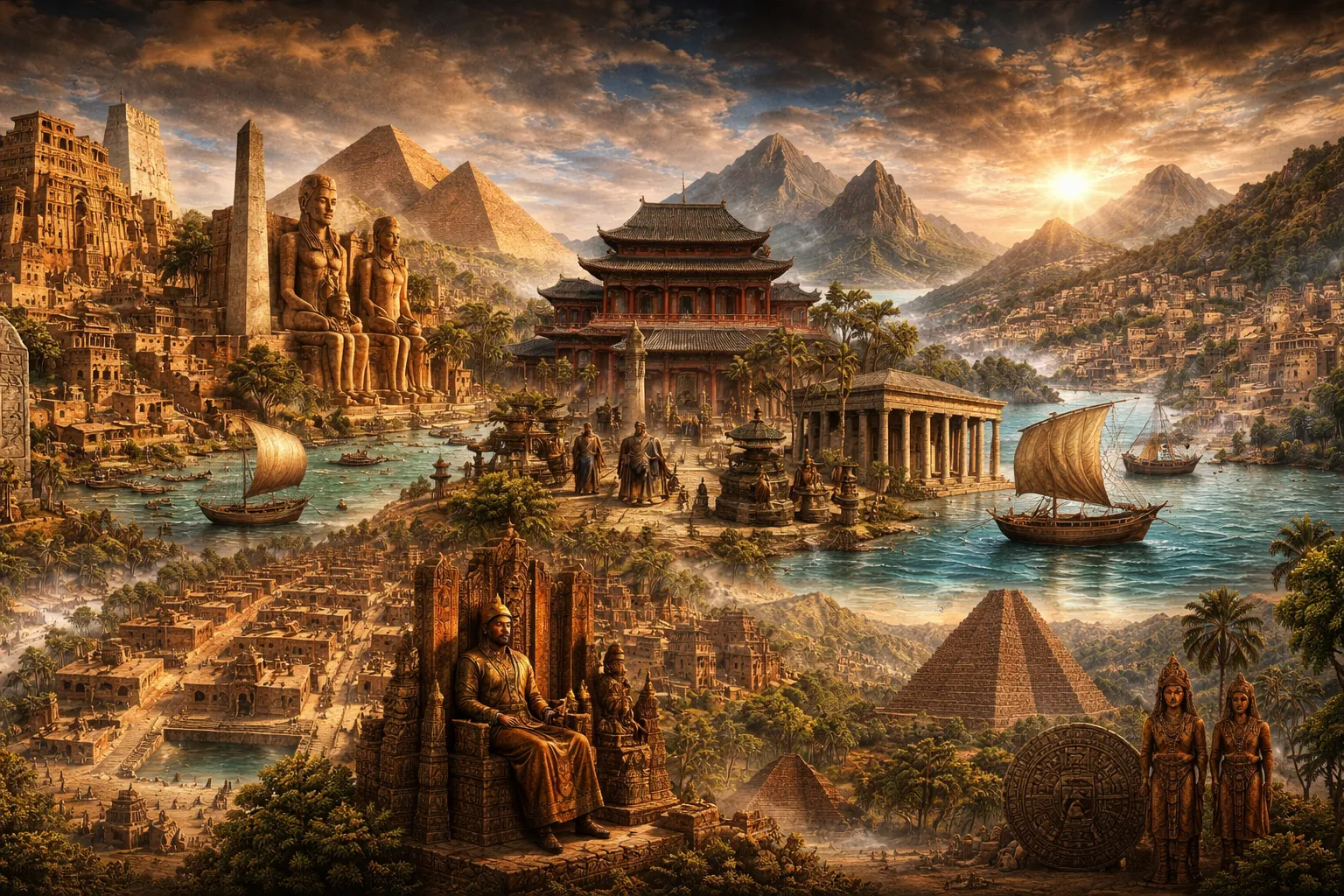
A final essential point must be emphasized: there is not a single legacy of “Antiquity,” because there is not a single Antiquity. Legacies may come from:
- Greco-Roman worlds;
- ancient Egypt;
- the ancient Near East;
- Persian worlds;
- ancient India;
- ancient China;
- ancient African worlds;
- Mesoamerican and Andean worlds.
This profoundly changes the perspective
- one does not inherit only a Mediterranean antique;
- several ancient centers may be rediscovered at different moments;
- some traditions were long marginalized in dominant narratives;
- a non-Eurocentric approach compels us to think the plurality of legacies.
What must be remembered
- one must speak of the legacies of Antiquity in the plural;
- not all ancient traditions were transmitted with the same visibility;
- the rediscovery of certain ancient worlds continues even today to transform our way of seeing.
The Antique in the Modern Imagination
Even without detailed scholarly knowledge, Antiquity continues to inhabit the modern imagination. It reappears in:
- painting;
- sculpture;
- architecture;
- literature;
- opera;
- cinema;
- comics;
- video games;
- illustration;
- design;
- decorative arts.
There it returns in the form of:
- heroes;
- ruins;
- myths;
- monumental settings;
- divine figures;
- battles;
- architectural motifs;
- archaizing or classicizing objects.
But here again, this modern presence is never neutral. It mixes:
- admiration;
- fantasy;
- simplification;
- erudition;
- invention;
- ideological projection.
Antiquity as a Question
Ultimately, the legacy of ancient art is not only a stock of available forms. It is also a permanent question posed to later periods:
- what is a model?
- what should be preserved from the past?
- how should one interpret a form whose original meaning has receded?
- can one admire without imitating?
- can one reinvent without betraying?
- how can one look at the ancient without enclosing it within our own categories?
These questions show that Antiquity remains active. It obliges every period to position itself in relation to it.
Why This Chapter Is Essential
This chapter is essential because it shows that the history of ancient art does not stop at the chronological end of Antiquity. Ancient works continue to live:
- through their material survivals;
- through their copies;
- through their ruins;
- through their reuse;
- through their rediscoveries;
- through their reinterpretations;
- through their political, scholarly, and artistic uses.
Through this perspective, one understands better:
- why Antiquity continues to matter in the history of art;
- why it reaches us in incomplete and reworked forms;
- how the same work or motif may change meaning over time;
- why speaking of a “return to the Antique” is always simplifying;
- in what sense Antiquity is less a fixed past than a field of successive reinventions.
To study the legacies, rediscoveries, and reinventions of ancient art is therefore to understand that Antiquity survives less as an intact presence than as an active, fragmentary memory constantly reread.
Essential Ideas to Remember
- ancient art is not transmitted in its entirety, but through selections, losses, fragments, and reinterpretations;
- inheriting the Antique never means repeating it identically;
- reuse, copying, ruin, rediscovery, and reinvention are major forms of survival;
- Antiquity may be taken as a model, a reservoir of motifs, a political tool, or an object of knowledge;
- the legacies of Antiquity must be thought of in the plural, from a non-Eurocentric perspective;
- ruins and fragments strongly shaped later perceptions of the Antique;
- ancient art continues to act as an active visual memory in later periods.
Transition to the Next Chapter
Once we understand how ancient art survives, transforms itself, and reappears after its historical period, one final question becomes essential: what, ultimately, does this whole episode on Antiquity teach us to look at in works and in the history of art?
The next chapter can therefore be the general conclusion of the Antiquity episode.