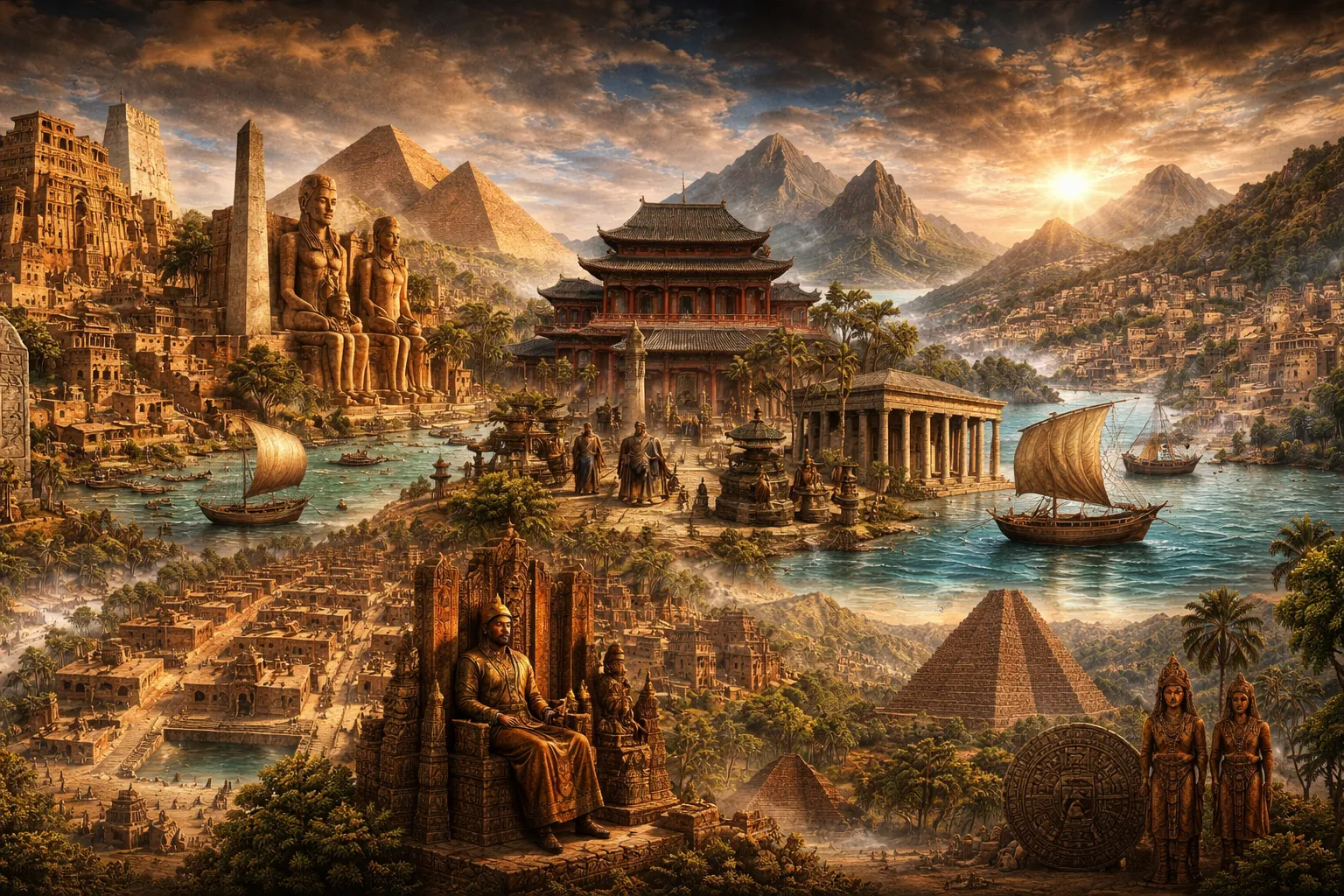
Divine Figures, Supernatural Beings, and the Visual Imagination of Antiquity
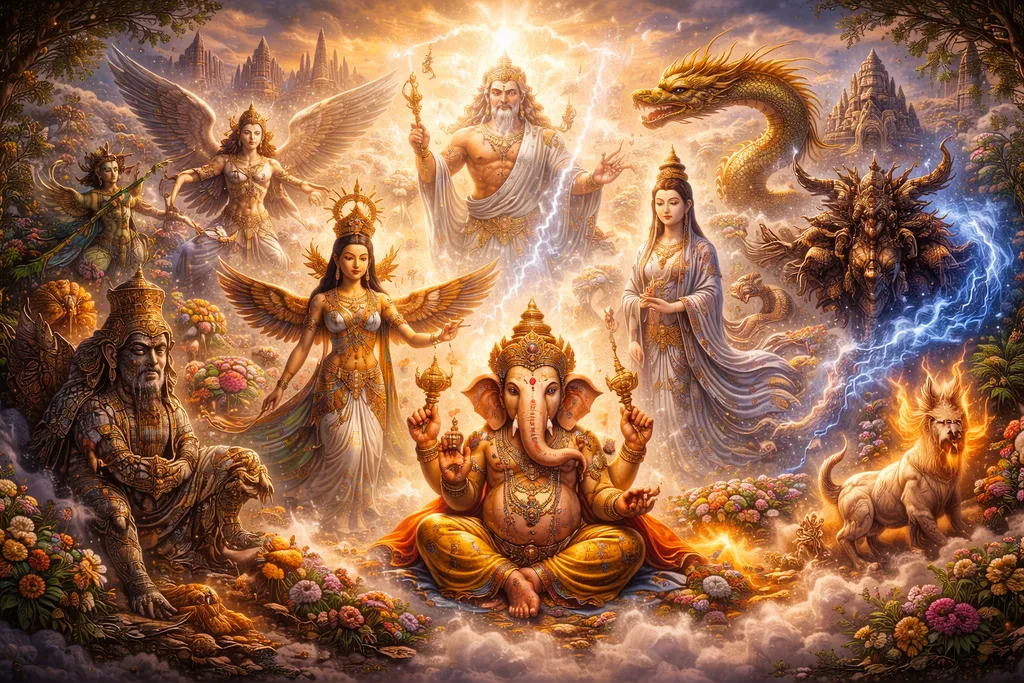
Introduction
After studying funerary arts and the memory of the dead, we must now turn to another fundamental domain of ancient art: the representation of what surpasses ordinary humanity. Ancient societies do not populate their images only with queens, kings, priestesses, priests, warriors, families, the dead, or familiar animals. They also bring forth gods, goddesses, powerful ancestors, spirits, protective genies, monsters, hybrids, guardians, astral powers, beings of chaos, and mediators between visible and invisible worlds.
These figures do not belong merely to a free or decorative imagination. They often express:
- a cosmology;
- a theology;
- a vision of power;
- a collective fear;
- a hope;
- a logic of protection;
- a way of thinking about the boundaries of the world;
- a reflection on the relations between order and disorder.
Ancient art is therefore inhabited by beings that do not belong only to visible reality. But this does not mean that they are “unreal” in the sense of being ineffective or functionless. In many cultures, supernatural beings are not thought of as simple inventions. They may be honored, feared, invoked, represented for protection, for making presence visible, for teaching, for impressing, for guiding, or for linking human beings to higher powers.
The aim of this chapter is therefore to show that the visual imagination of Antiquity cannot be reduced to the ornament of wonder. It constitutes a central dimension of thought in images. To study divine figures, supernatural beings, and the visual imagination of Antiquity is to understand how ancient societies gave form to the invisible, to radical otherness, to power, and to mystery.
Why Represent Non-Human Beings?
The presence of divine or supernatural figures in ancient art responds to several fundamental needs. Ancient societies seek to give form to what cannot be grasped directly:
- the forces of the cosmos;
- the origin of the world;
- the powers of nature;
- protection;
- danger;
- divine justice;
- fertility;
- war;
- death;
- order or chaos.
Representing such beings makes it possible:
- to make the invisible thinkable;
- to give power a face;
- to organize mythical narratives;
- to fix figures of worship;
- to materialize fear or hope;
- to structure religious and symbolic memory.
What must be remembered
- supernatural figures are not only decorative inventions;
- they serve to make visible an order of the world larger than the human;
- they may be religious, protective, political, cosmic, or narrative;
- their image gives a shareable form to what exceeds ordinary experience.
Gods and Goddesses: Making Power Visible
In many ancient civilizations, gods and goddesses do not remain without image. Even when the divine exceeds every form, societies give it visible signs. These representations are not all equivalent. Some show divinities in an idealized human form. Others place greater emphasis on attributes, associated animals, symbols, or functions.
A divinity may be represented through
- an idealized human body;
- a specific face or posture;
- recognizable attributes;
- a throne;
- a crown;
- a weapon;
- an animal companion;
- an astral sign;
- a sacred object;
- a partially abstract form.
Divine representation may serve to:
- make a presence visible;
- enable worship;
- distinguish the functions of different divinities;
- narrate myths;
- show the relation between god, world, and society.
What must be remembered
- representing a divinity does not always mean “showing it as it is”;
- the divine image is often a visible translation of functions, powers, and relations;
- the same divinity may receive several forms depending on context.
The Human, the Animal, and the Hybrid
One of the great features of the ancient visual imagination is the frequency of hybrid beings. Many cultures represent figures combining:
- a human body and an animal head;
- an animal body and a human face;
- wings added to human or animal figures;
- multiple combinations between species and powers.
These hybrids may carry several meanings:
- to manifest a power superior to the human;
- to express a specific function;
- to figure the boundary between worlds;
- to signify protection or threat;
- to condense several qualities into a single figure;
- to make visible the otherness of the sacred.
Why the hybrid is so important
- it makes it possible to exceed the limits of the ordinary body;
- it immediately signals that one is entering another register of reality;
- it combines intelligence, strength, speed, vigilance, fertility, or celestial power;
- it makes the image more memorable, more impressive, and denser.
The hybrid is therefore not a mere formal whim. It is a logic for composing the supernatural.
Protective Beings
A large part of the ancient imagination is linked to protection. Supernatural beings are placed:
- at the entrance of palaces;
- at the gates of cities;
- in temples;
- near tombs;
- on ritual objects;
- in domestic space;
- on seals, amulets, or jewelry.
These figures may be:
- guardian figures;
- apotropaic beings;
- threatening toward hostile forces;
- benevolent toward the persons or places they protect.
Their functions may be
- to repel evil;
- to watch over thresholds;
- to protect the dead;
- to defend the sanctuary;
- to accompany the living;
- to manifest the power of a god or a ruling authority.
What must be remembered
- some frightening figures are not necessarily negative;
- their visual violence may serve protection;
- the monstrous may be defensive as much as threatening.
Monsters, Chaos, and Hostile Powers
Alongside protective figures, ancient art also represents beings of danger and disorder. Sea monsters, gigantic serpents, aggressive demons, devouring creatures, disturbing hybrids, or mythical adversaries give form to what threatens the human world.
These figures may express:
- primordial chaos;
- the cosmic enemy;
- natural dangers;
- the fear of death;
- the transgression of limits;
- moral or ritual disorder;
- the power of what cannot be controlled.
Their role in the image
- to give anxiety a form;
- to dramatize mythical narratives;
- to magnify the victory of gods or heroes;
- to remind viewers of the fragility of order;
- to intensify the emotional and symbolic charge of works.
The ancient monster is therefore often a way of thinking about what threatens the balance of the world.
Guardians of Thresholds
Thresholds occupy an essential place in ancient worlds. Between outside and inside, between profane and sacred space, between life and death, between city and exterior, passages often have to be marked, protected, and qualified.
This is why one frequently finds there:
- guardian statues;
- monumental lions;
- sphinxes;
- winged beings;
- hybrid figures;
- terrifying masks;
- repeated protective motifs.
Why these thresholds are important
- they signal that one is changing the regime of space;
- they remind us that passage is never neutral;
- they place protection at the point of maximum vulnerability;
- they give architecture an intensified sacred or political dimension.
The supernatural figure then becomes a living boundary.
Intermediate Beings
Between supreme gods and ordinary humans, many ancient traditions populate the world with intermediate beings:
- genies;
- spirits;
- demons in the ancient sense of the word;
- messengers;
- guardians;
- psychopomps;
- beings linked to a place, an astral body, a spring, or a mountain.
These figures often fulfill mediating functions:
- to transmit;
- to protect;
- to guide;
- to watch over;
- to announce;
- to interpret divine will;
- to accompany the dead;
- to connect several planes of the world.
What must be remembered
- the ancient world does not always simply oppose humans and gods;
- it often imagines a complex hierarchy of beings;
- this diversity deeply nourishes the visual imagination.
Attributes: Recognizing the Invisible
In ancient art, divine or supernatural beings are often identifiable not only through their general form, but also through their attributes. These attributes are essential because they make it possible:
- to identify a figure;
- to specify its function;
- to distinguish it from another;
- to associate the image with a narrative, a cult, or a power.
Attributes may be
- weapons;
- scepters;
- crowns;
- solar disks;
- lunar crescents;
- associated animals;
- wings;
- instruments;
- plants;
- flames;
- ritual objects;
- specific gestures.
They play a decisive role in the legibility of the image. A divine figure does not always need accompanying text if its appearance and attributes are enough to recognize it within a given culture.
The Supernatural Body
Divine or fantastic beings are not represented like ordinary humans. Their bodies may be treated in a particular way:
- larger scale;
- extraordinary stability;
- reinforced symmetry;
- multiplication of wings, arms, or attributes;
- intensified frontal gaze;
- hieratic posture;
- hybridization;
- more stylized or more abstract treatment;
- a particular relation to space.
What this means
- the supernatural body immediately signals a difference of nature;
- it gives invisible power a particular visual density;
- it makes it possible to express what exceeds human norms.
The divine or fantastic body is therefore a laboratory of forms.
Wonder as a Visual Language
The ancient imagination loves wonder, but this wonder is not a simple pleasure in strangeness. It is often a language. It makes it possible to say:
- that the world is wider than ordinary experience;
- that some powers exceed every human measure;
- that founding narratives belong to another scale;
- that art can connect the visible to the invisible.
Visual wonder may be conveyed through:
- hybridization;
- monumentality;
- repetition of sacred signs;
- precious colors or materials;
- unusual compositions;
- fantastic creatures;
- cosmic or mythical scenes.
What must be remembered
- ancient wonder is not a simple entertainment;
- it may be religious, political, cosmological, or initiatory;
- it is often a tool of symbolic densification.
Myths in Images
Divine and supernatural figures often appear within narratives. Myths provide ancient art with an immense reservoir of images:
- cosmic battles;
- divine births;
- unions between worlds;
- journeys into the afterlife;
- foundations of cities;
- metamorphoses;
- heroic trials;
- punishments;
- cycles of death and rebirth.
Why myth is so important visually
- it gives narrative structure to the invisible;
- it makes memorable the relations between gods, humans, and monsters;
- it makes it possible to explain the origin of a religious, political, or cosmic order;
- it provides models of behavior, fear, victory, or transgression.
The mythical image is therefore not merely illustrative. It transmits a vision of the world.
The Diversity of Pantheons and Imaginations
It is important to insist on the plurality of ancient worlds. There is not one single way of representing the divine or the supernatural. Mesopotamian, Egyptian, Greek, Roman, Persian, Indian, Chinese, ancient African, Mesoamerican, and Andean traditions develop very different imaginations.
The differences concern:
- the form of the gods;
- the place of hybridization;
- the relation between human and divine;
- the place of sacred animals;
- the representation of hostile forces;
- the symbolic density of the image;
- the relation between cult, myth, and visible figure.
Yet common questions often recur
- how can an invisible power be made visible?
- how can the god be distinguished from the human?
- how can thresholds and the living be protected?
- how can chaos or alterity be represented?
- how can mystery be given form?
Comparing these traditions therefore makes it possible to see both shared logics and deeply singular answers.
Supernatural Figures in Objects and Decoration
The ancient visual imagination is not limited to large statues or large paintings. Divine or fantastic figures also appear on:
- ceramics;
- jewelry;
- seals;
- weapons;
- textiles;
- thrones;
- tableware;
- amulets;
- architectural reliefs;
- wall paintings;
- mosaics;
- cult objects.
This means
- that the supernatural is present at multiple scales;
- that it may accompany daily life as much as major rituals;
- that it circulates through domestic, political, religious, and funerary spaces;
- that the ancient visual imagination is diffuse and not limited to a few exceptional monuments.
Seeing the Invisible Without Reducing It
One of the great strengths of ancient art lies in the fact that it does not always seek to “explain” fully what it represents. A divine or fantastic figure may remain partially enigmatic. Its efficacy also lies in this share of mystery.
Two mistakes must therefore be avoided
- believing that every supernatural image would be purely symbolic and abstract;
- believing on the contrary that it would be a simple “illustration” of a perfectly fixed narrative.
Very often, the image acts in an in-between space:
- it makes visible without exhausting mystery;
- it identifies without explaining everything;
- it stabilizes a figure while leaving room for the power of the unknown.
The Visual Imagination as a Thought of the World
Ultimately, representing gods, hybrids, monsters, genies, or guardians does not simply enrich an iconographic repertoire. It means thinking the world in images. It means formulating:
- a cosmology;
- a hierarchy of beings;
- a theory of danger;
- a logic of protection;
- a map of the visible and the invisible;
- a vision of order, chaos, and mediation.
The ancient visual imagination is therefore not an addition. It is a fundamental way of organizing reality, myth, and the invisible.
Why This Chapter Is Essential
This chapter is essential because it shows that ancient art does not limit itself to representing what one sees in everyday life. It constantly ventures beyond. It gives form to powers, mysteries, fears, hopes, and other worlds. It helps societies think what exceeds them.
Through this perspective, one understands better:
- why hybrid figures are so numerous;
- why guardians, monsters, and genies have such varied functions;
- how attributes make the supernatural legible;
- in what sense gods are not simple characters but visible powers;
- why wonder is a central language of ancient art.
Studying divine figures, supernatural beings, and the visual imagination of Antiquity therefore means entering one of the spaces where art reveals most strongly its ability to give form to the invisible.
Essential Ideas to Remember
- divine and supernatural figures make visible what exceeds the human;
- the hybrid, the guardian, the monster, and the genie have major symbolic, religious, and protective functions;
- attributes are essential for identifying represented powers;
- the supernatural body is distinguished from the ordinary human body through specific treatments;
- myth provides ancient art with an immense reservoir of images;
- pantheons and visual imaginations vary greatly according to civilizations;
- ancient wonder is a central visual language, not a simple ornament of strangeness.
Transition to the Next Chapter
Once we understand how Antiquity represents the divine and the supernatural, another question becomes essential: how do ancient works narrate, transmit, and structure stories, myths, exploits, and collective memories?
The next chapter can therefore focus on narrative in images in ancient art.