Funerary Arts and the Memory of the Dead in Antiquity
Introduction
After studying artistic circulations, influences, and hybridizations in Antiquity, we must now turn to a major domain where art, belief, memory, and matter come together with particular intensity: the relationship to the dead. In a great many ancient civilizations, death does not merely mark the end of an individual life. It opens onto a whole set of gestures, rites, constructions, images, and objects intended to accompany the deceased, protect their memory, affirm their rank, preserve a presence, or give form to the afterlife.
Funerary art therefore cannot be reduced to tomb decoration. It may fulfill several functions at once:
- honoring the deceased;
- protecting their passage;
- ensuring symbolic continuity;
- maintaining a link between the living and the dead;
- inscribing a lineage into duration;
- giving visible form to beliefs about the other world;
- affirming social hierarchy even after death.
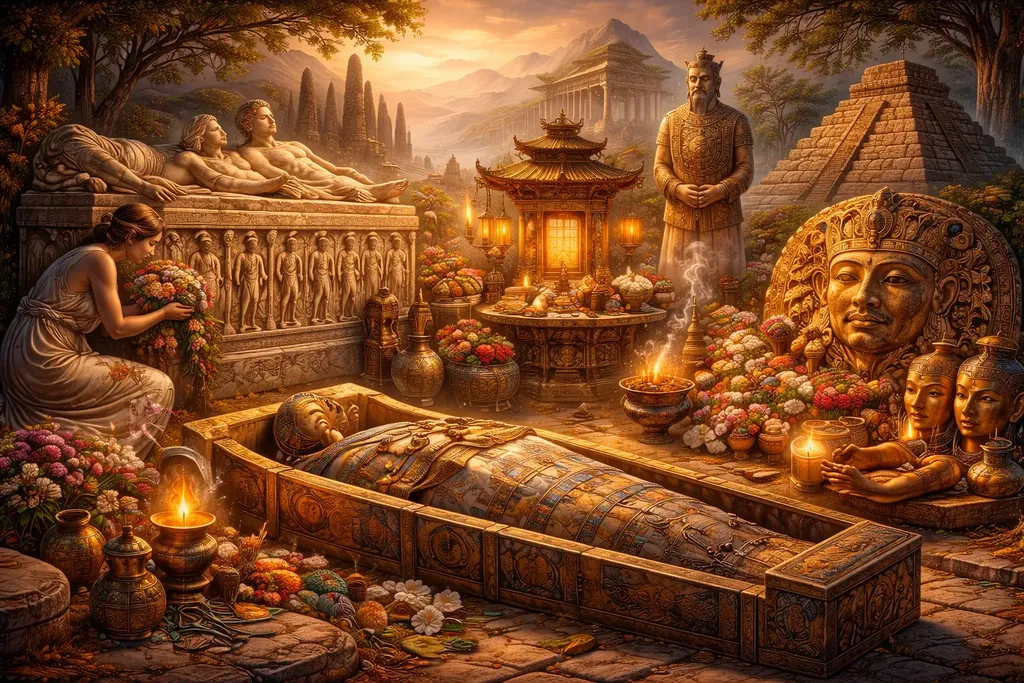
The tomb, the stele, the sarcophagus, the wall painting, the funerary mask, the effigy, the object placed beside the dead, or the architecture of burial must therefore never be considered simple accessories. They form a true language. They tell us how a society thinks the person, survival, remembrance, ancestral presence, and posthumous destiny.
This chapter therefore aims to show that funerary arts occupy an essential place in the history of ancient art. To study tombs, images of the dead, and objects of mourning is to understand how ancient societies attempted to make visible what escapes the eye: passage, absence, survival, memory, and the hope of another state.
Death as an Artistic and Ritual Moment
In Antiquity, death often gives rise to an important artistic mobilization. This does not mean that all societies invest the same means, nor that they produce the same forms. But very often, death requires:
- a particular space;
- specific gestures;
- chosen objects;
- codified images;
- a staging of separation;
- an inscription of the deceased into durable memory.
Art intervenes at several levels:
- in the preparation of the burial;
- in the arrangement of the tomb;
- in images of the deceased;
- in signs of protection;
- in deposited objects;
- in visible monuments intended for the living.
What must be remembered
- death is not only a biological event, but also a social, ritual, and visual fact;
- funerary art helps organize the transition between presence and absence;
- it shapes the relationship between the living and the dead;
- it expresses emotion, belief, hierarchy, and memory at once.
Why Funerary Art Is So Important
Funerary art is one of the richest domains for understanding an ancient civilization because it concentrates several essential dimensions:
- the representation of the person;
- the conception of the body;
- the place of the name and of memory;
- beliefs about the afterlife;
- social hierarchy;
- the relation between family, lineage, and community;
- the link between image, protection, and symbolic survival.
It is also important because it often preserves a great deal of archaeological evidence. Tombs, stelae, sarcophagi, urns, inscriptions, funerary chambers, paintings, and objects accompanying the deceased constitute major documentation for ancient history.
Funerary art helps us understand
- how a society defines a “good death”;
- how it distinguishes social statuses even in burial;
- how it imagines survival, soul, judgment, or the other world;
- how it transforms absence into visible memory.
The Tomb: More Than a Place of Burial
The tomb is not only a place where a body or remains are deposited. It may be conceived as:
- a dwelling;
- a threshold;
- a place of passage;
- a protected space;
- a point of contact between worlds;
- a monument of memory;
- a durable marker in the landscape.
Depending on the civilization, the tomb may take very diverse forms:
- simple pit;
- tumulus;
- mastaba;
- pyramid;
- hypogeum;
- rock-cut tomb;
- mausoleum;
- funerary chamber;
- monumental burial;
- stele marking a more modest place.
The form of the tomb often depends on
- social rank;
- religious beliefs;
- available resources;
- local traditions;
- conceptions of the body and the afterlife;
- the role of family or state in funerary rites.
The ancient tomb must therefore be understood as a space constructed with meaning, not as a simple container.
The Tomb as a House of the Dead
In several ancient traditions, the tomb symbolically functions as a house. This idea may be more or less explicit depending on the culture, but it recurs often. The dead are not always thought of as completely absent: they continue to require a place, a shelter, sometimes goods, sometimes ritual nourishment, sometimes lasting protection.
This logic explains:
- the presence of funerary furniture;
- the interior decoration of certain tombs;
- the arrangement of chambers;
- the representation of banquet scenes, domestic life, or prestige;
- the construction of spaces intended for visits, offerings, or commemorations.
What this means
- the bond with the deceased is not immediately broken;
- the tomb becomes a relational space;
- funerary art serves not only to mark a disappearance, but to maintain a transformed presence.
The Body of the Deceased: Preserving, Transforming, Replacing
A central question runs through ancient funerary arts: what should be done with the body? Depending on the cultures, the body may be:
- preserved;
- buried;
- burned;
- fragmented;
- wrapped;
- placed in a container;
- accompanied by images or objects that prolong its presence.
The answers differ profoundly. Some traditions seek to preserve bodily integrity as much as possible. Others accept that the body will materially disappear, but compensate for that disappearance through signs, images, or rituals.
Art intervenes here in several ways
- through preparation of the body;
- through funerary containers;
- through masks;
- through effigies;
- through images that replace or prolong the body;
- through objects accompanying its transformation.
Funerary art therefore deals not only with the memory of the dead, but also with their bodily status after death.
The Funerary Mask and the Effigy
In some civilizations, the face of the deceased receives particular attention. The funerary mask or effigy allows one to:
- preserve a visible identity;
- protect the face;
- give the deceased a stable appearance;
- symbolically replace lost presence;
- inscribe the person into a form of eternity.
The mask may be:
- realistic or idealized;
- precious or modest;
- linked to a religious function;
- intended to accompany the dead into the afterlife;
- intended also for the survivors as a support of recognition.
What must be remembered
- the face concentrates memory, dignity, and presence;
- the mask or effigy is not always a portrait in the modern sense;
- it may aim less at exact resemblance than at symbolic permanence.
The Sarcophagus, the Urn, and Containers of the Dead
The container of the deceased is often itself a work of art. Sarcophagus, coffin, cremation urn, chest, funerary wrapping, or ritual container are not simple utilitarian objects. They may be:
- sculpted;
- painted;
- engraved;
- inscribed;
- decorated with protective motifs;
- enriched with religious, narrative, or symbolic scenes.
These containers may serve to
- protect the body or remains;
- signal the status of the deceased;
- inscribe their name;
- show beliefs about the afterlife;
- surround death with a prestigious formal language;
- make the container itself into a miniature monument.
The sarcophagus or urn thus becomes a surface of memory.
Images of the Deceased
Funerary art often represents the deceased. But this representation may take very different forms. The deceased may appear:
- alone;
- with their family;
- at a banquet;
- in prayer;
- in a posture of dignity;
- in a scene of hunting, prestige, or daily activity;
- facing the gods;
- already integrated into the afterlife.
These images may have several functions
- maintaining memory of the person;
- recalling their rank;
- showing their virtues;
- inscribing their family belonging;
- accompanying them ritually;
- affirming that they continue to exist in another form.
One mistake must be avoided
Representing the deceased does not always mean “showing exactly what they looked like.” Very often, funerary image combines:
- identity;
- idealization;
- status;
- convention;
- posthumous hope.
Stelae: Visible Memory in Public or Family Space
The stele is one of the great supports of ancient funerary art. Erected, engraved, sometimes sculpted or painted, it marks a place and inscribes a memory. It may contain:
- a name;
- a genealogy;
- a dedication;
- a prayer formula;
- an image of the deceased;
- a religious sign;
- a reminder of rank or profession.
The stele fulfills several functions
- marking the burial place;
- making memory visible;
- allowing passersby or relatives to identify the dead;
- inscribing the individual within a social and family order;
- linking writing, image, and remembrance.
It is often a meeting point between private memory and collective visibility.
Funerary Painting and Tomb Decoration
In several ancient traditions, the interior of tombs receives elaborate decoration. This decoration is not gratuitous. It may:
- protect;
- guide;
- narrate;
- offer the dead a symbolic environment;
- reproduce goods or activities;
- show rites;
- depict the other world;
- transform the tomb into a total space.
Funerary paintings may represent:
- banquet scenes;
- processions;
- offerings;
- divinities;
- idealized landscapes;
- agricultural or domestic activities;
- passages toward the afterlife;
- signs of rebirth or prosperity.
What must be remembered
- funerary decoration is not only commemorative;
- it may be operative, protective, and symbolically active;
- it transforms the tomb into a visual world intended for the deceased as much as for the living.
Offerings and Deposited Objects
Ancient tombs often contain objects placed beside the dead. These objects may be:
- jewelry;
- tableware;
- weapons;
- tools;
- textiles;
- figurines;
- food;
- perfumes;
- amulets;
- personal objects;
- ritual objects;
- miniature models.
These deposits may have several meanings
- accompanying the deceased;
- showing their status;
- symbolically providing them with resources;
- protecting their passage;
- signaling their identity;
- maintaining an affective or ritual bond.
What this shows
- death is not everywhere conceived as an absolute rupture;
- the deceased often continues to be treated as a person in need of relation, prestige, or protection;
- funerary objects extend existence socially and symbolically.
The Afterlife in Images
Ancient funerary art often serves to give form to what, by definition, is not directly visible: the other world. Ancient societies imagine in very diverse ways:
- a realm of the dead;
- a journey;
- a judgment;
- a rebirth;
- an integration among the ancestors;
- a symbolic survival linked to the name or cult;
- a transformation of the being.
These conceptions profoundly influence funerary images. One may find there:
- paths;
- gates;
- psychopomp divinities;
- scenes of weighing, judgment, or reception;
- symbols of regeneration;
- paradisiacal or sacred landscapes;
- monsters or guardians;
- signs of passage between two worlds.
Funerary art thus makes thinkable and visible what escapes ordinary experience.
The Memory of the Dead and the Memory of Lineages
Funerary art does not concern only the individual. It also concerns families, lineages, dynasties, elites, and sometimes the collective memory of a city or kingdom. A tomb or funerary monument may serve to:
- recall ancestry;
- affirm dynastic continuity;
- make visible the prestige of a household;
- durably inscribe a name in the landscape;
- make the dead into a support point of family or political memory.
This is especially visible in
- monumental tombs;
- organized necropolises;
- mausoleums;
- groups of stelae;
- genealogical inscriptions;
- images of couples, families, or ancestors.
The dead are therefore not only mourned persons: they may become pillars of social continuity.
Social Hierarchies in the Face of Death
Even if death may be conceived as a common destiny, ancient funerary arts show very clearly that not all the dead receive the same treatment. Social hierarchy often continues through:
- the size of the tomb;
- the quality of materials;
- the richness of decoration;
- the presence or absence of images;
- the number of deposited objects;
- the monumentality of the monument;
- the quality of inscription.
This means
- death does not automatically erase social differences;
- funerary art is also an art of prestige;
- elites use the tomb to prolong their visibility;
- modest forms are nonetheless important for understanding the diversity of funerary experience.
Funerary Arts and Ancestors
In several ancient worlds, the dead do not completely disappear into a closed elsewhere. They may become:
- protective ancestors;
- figures of active memory;
- mediators;
- foundations of the lineage;
- presences honored regularly.
Funerary art then participates in that continuity. It no longer addresses only the moment of burial, but also the duration of cult or commemoration. An image, a stele, an altar, an engraved name, or a visited tomb allows the dead to remain within the horizon of the living.
What must be remembered
- funerary art may extend into ancestor art;
- the tomb may become a place of durable relation;
- memory is not only affective, but also ritual and social.
Variety of Funerary Traditions in the Ancient World
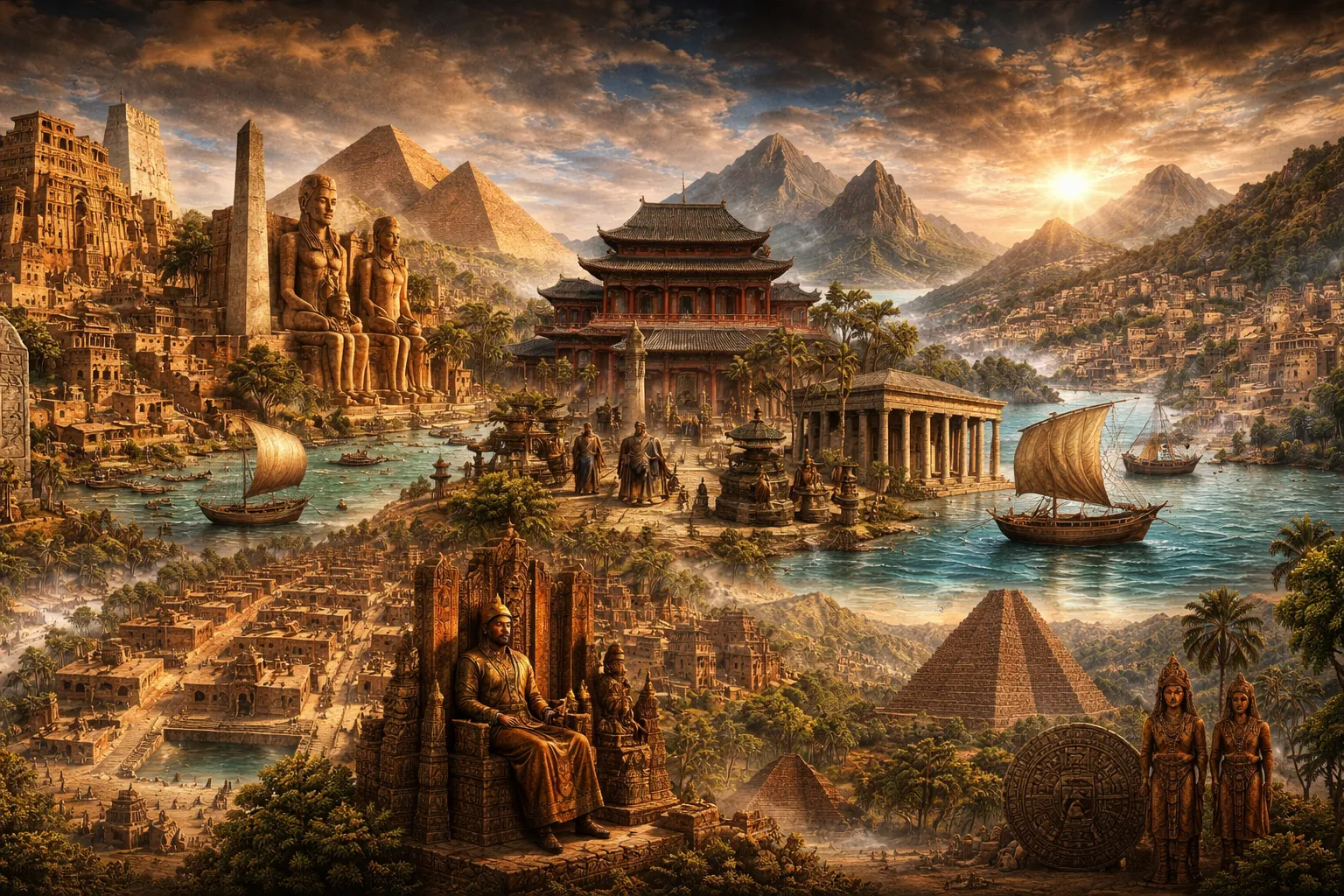
One fundamental point must be emphasized: there is not one single ancient way of treating the dead. Mesopotamian, Egyptian, Greek, Roman, Persian, Indian, Chinese, ancient African, Mesoamerican, or Andean funerary traditions differ profoundly in:
- treatment of the body;
- form of tombs;
- place of the image;
- relation to the name;
- conception of the afterlife;
- presence of objects;
- role of family and cult.
But comparable questions often recur
- how to accompany the dead?
- how to preserve their memory?
- how to protect their passage?
- how to articulate body, image, name, and ritual?
- how to give visible form to absence?
Comparing funerary arts therefore makes both strong differences and great shared concerns appear.
The Tomb as a Total Work
In some cases, ancient funerary art reaches a form of totality. The tomb or funerary complex brings together:
- architecture;
- sculpture;
- painting;
- writing;
- furniture;
- ritual objects;
- vegetal or geometric decoration;
- organization of movement through space;
- light and darkness;
- sometimes even the staging of gestures.
This totalization is important
- it shows that funerary art is not a secondary domain;
- it gathers several media around the same function;
- it makes the tomb a complete space of memory, protection, and meaning;
- it reveals the deep bond between art and belief in Antiquity.
Why This Chapter Is Essential
This chapter is essential because it shows that ancient art does not serve only to represent gods, queens, kings, living bodies, or mythical narratives. It also serves to face death. It helps societies accompany absence, think continuity, protect the dead, maintain memory, and give visible form to what follows life.
Through this perspective, one understands better:
- why tombs are major artistic sites;
- why the image of the deceased is so important;
- why the name, body, object, and funerary space are closely linked;
- how beliefs about the afterlife influence visual forms;
- in what sense funerary art is at once an art of loss, memory, and survival.
Studying funerary arts and the memory of the dead in Antiquity is therefore to enter one of the domains where art most directly touches the fundamental questions of existence.
Essential Ideas to Remember
- ancient funerary art organizes the relationship between the living and the dead;
- the tomb is a space of memory, protection, passage, and sometimes durable presence;
- mask, effigy, sarcophagus, stele, painting, and deposited objects fulfill complementary functions;
- funerary images do not always seek exact resemblance, but often dignity, continuity, and symbolic survival;
- beliefs about the afterlife profoundly influence artistic forms;
- social hierarchy often continues to express itself in burials;
- there is great diversity among funerary traditions in the ancient world, which must be compared without being made uniform.
Transition to the Next Chapter
Once the role of funerary arts is understood, a new question becomes essential: how do ancient societies represent gods, supernatural beings, hybrid creatures, and invisible powers in images?
The next chapter can therefore focus on divine figures, supernatural beings, and the visual imagination of Antiquity.