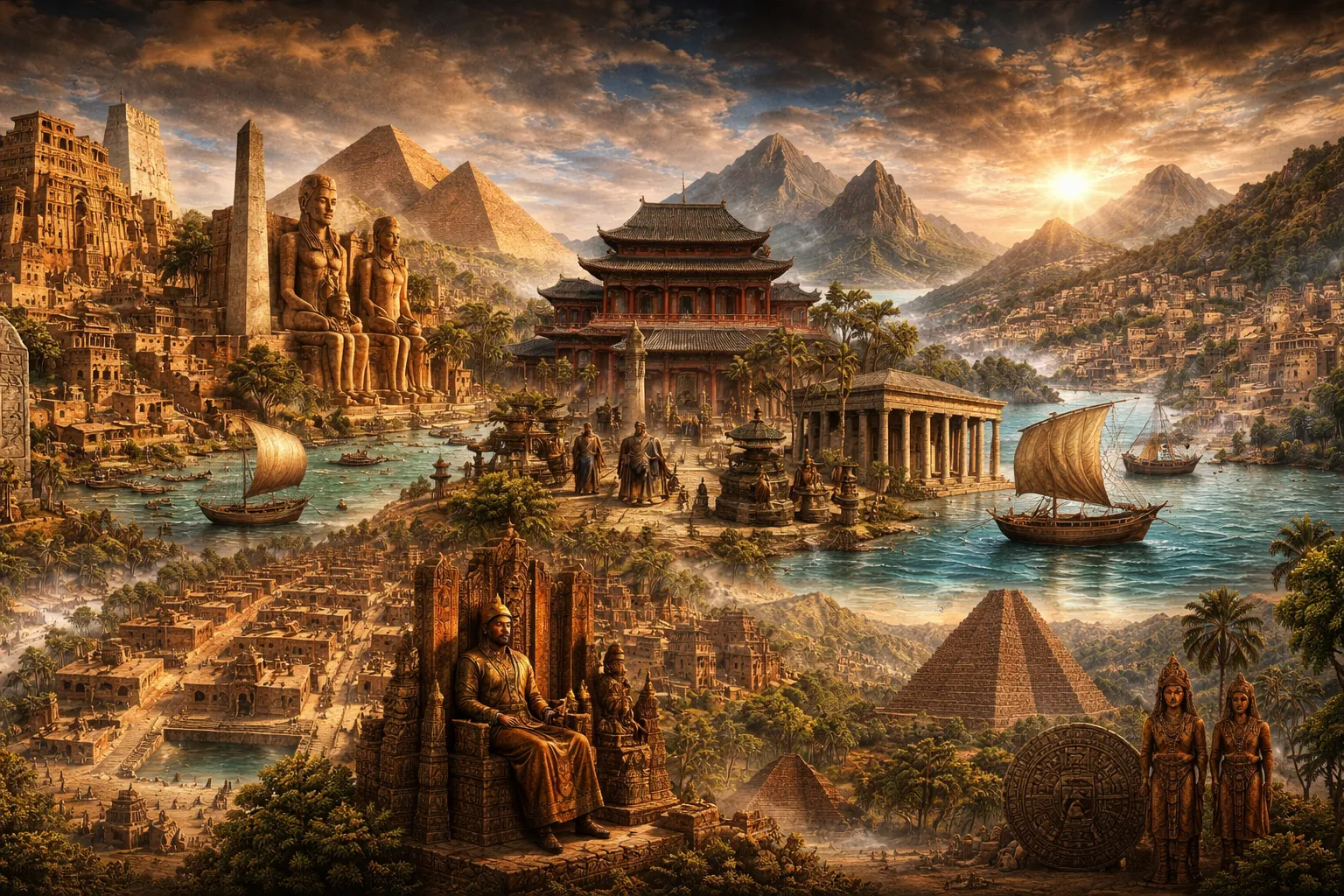
Artistic Circulations, Influences, and Hybridizations in Antiquity
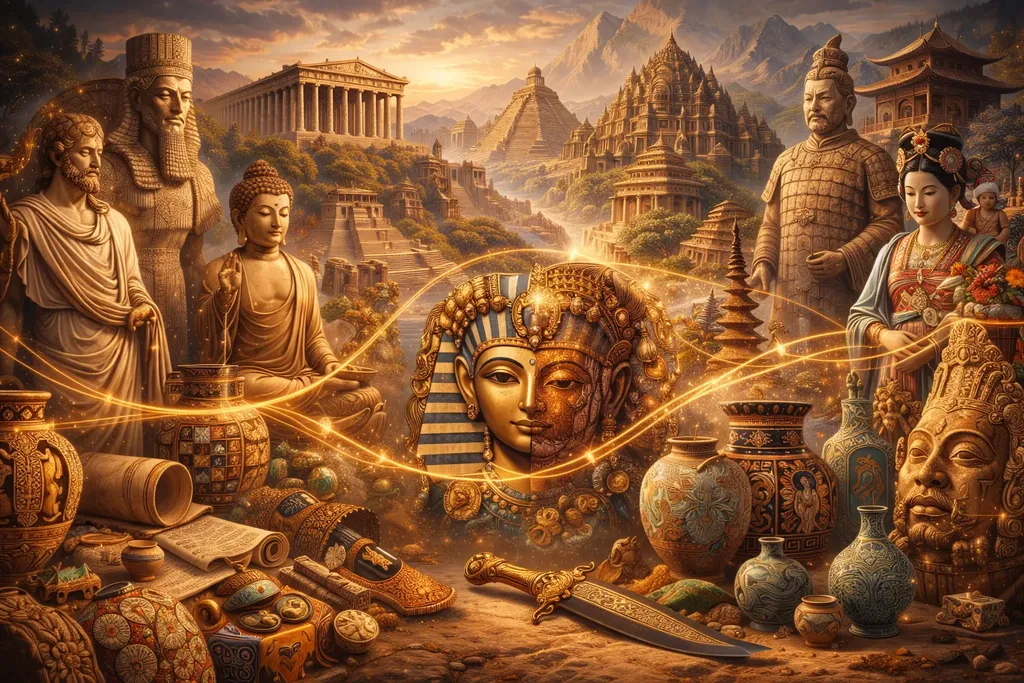
Introduction
After studying the major artistic traditions of Antiquity, a new question becomes essential: did these visual worlds remain separate, or did they circulate, exchange, borrow, and transform their forms through contact with one another? The answer is clear: Antiquity is not a set of totally isolated artistic blocks. Even if some traditions developed for a long time according to their own internal logics, works, motifs, materials, techniques, artisans, precious objects, beliefs, and forms of power traveled.
These circulations do not mean that all civilizations merged into a single style. Rather, they produced varied phenomena:
- diffusion;
- adaptation;
- imitation;
- selection;
- local translation;
- partial blending;
- reinterpretation;
- hybridization.
In other words, a form coming from elsewhere is almost never received passively. It is reworked according to the needs, beliefs, materials, tastes, and structures of the society that receives it. A foreign motif may change meaning. An imported technique may be integrated into an older tradition. An image of power may be imitated while being redirected toward a new legitimacy.
The purpose of this chapter is therefore to show that Antiquity is also a history of artistic contact. To study circulations, influences, and hybridizations is to understand that ancient styles live not only through internal stability, but also through movement, encounter, and transformation.
Ancient Arts Do Not Circulate in a Vacuum
To understand artistic circulations, one must first remember that a work never travels entirely on its own in the abstract. What circulates usually passes through concrete frameworks:
- trade;
- diplomacy;
- conquest;
- pilgrimage;
- migration;
- movement of artisans;
- exchange of prestigious gifts;
- religious expansion;
- imperial control over varied territories.
This means that a motif, a form, a material, or a technique always arrives within a context. It may be carried by:
- a trade route;
- political domination;
- a cultic network;
- an alliance between courts;
- the mobility of a workshop;
- the movement of precious objects.
What must be remembered
- artistic exchanges are linked to material and historical realities;
- the circulation of forms often depends on routes, powers, and networks;
- art travels with people, objects, beliefs, and techniques;
- artistic contacts are an integral part of ancient history.
Artistic influence is therefore not an abstraction. It has supports, paths, and specific conditions.
What Is an Artistic Influence?
The word “influence” is useful, but it must be used with caution. It does not necessarily designate the complete domination of one tradition over another. It may refer to very different phenomena:
- borrowing a motif;
- adopting a technique;
- reusing a posture;
- importing a material;
- transforming an architectural type;
- adapting a decoration;
- assimilating an imperial or religious visual language.
Influence may be:
- direct;
- indirect;
- strong;
- occasional;
- superficial;
- deep;
- claimed;
- discreet;
- filtered through several intermediaries.
What must be avoided
- imagining that resemblance alone always proves influence;
- believing that influence means servile copying;
- forgetting local capacities for invention;
- reducing a culture to what it receives from outside.
What must be remembered
- an influence does not necessarily erase the receiving tradition;
- it may stimulate an original reformulation;
- it must be placed back into precise contexts;
- it has meaning only if one also observes what is preserved, refused, or transformed.
Borrowing Is Never Pure Reproduction
When a civilization takes up a form from elsewhere, it almost never reproduces it exactly. It filters it. It inserts it into its own visual system. It redefines it according to its own priorities.
A borrowing may undergo several kinds of transformation:
- change of material;
- change of scale;
- change of function;
- change of religious or political context;
- simplification or decorative enrichment;
- combination with local motifs;
- symbolic reinterpretation.
Some examples of this mechanism
- an imported architectural form may be adapted to a climate, a religion, or a local practice;
- a decorative motif may be visually preserved while losing its original meaning;
- an imperial-style portrait may be reused to legitimize an entirely different dynasty;
- a foreign artisanal technique may be integrated into an older local repertoire.
The history of ancient arts must therefore not only identify resemblances: it must observe the transformations that give borrowing its true significance.
Trade and the Circulation of Objects
One of the great vectors of artistic circulation is trade. In Antiquity, objects traveled over long distances:
- metals;
- precious stones;
- ivory;
- textiles;
- ceramics;
- glassware;
- perfumes;
- pigments;
- luxury objects;
- religious images or ritual objects in certain cases.
These circulations have several artistic consequences:
- they spread forms and motifs;
- they make foreign styles visible;
- they create desires for imitation;
- they introduce new materials into certain workshops;
- they modify the tastes of elites and sometimes of broader groups.
What an imported object may produce
- fascination with a rare material;
- prestige linked to distant origin;
- local imitation;
- technical adaptation;
- emergence of new formal associations.
Trade therefore spreads not only goods, but also visual ideas.
Diplomacy, Gifts, and Prestige
Diplomatic relations also play an essential role. Ancient courts often exchange prestigious gifts:
- precious tableware;
- refined textiles;
- sculpted objects;
- worked metals;
- jewelry;
- rare animals;
- ritual objects;
- luxury products accompanied by their decoration or iconography.
These gifts are not neutral. They carry a visual and symbolic world. They show:
- the level of refinement of a court;
- the wealth of a kingdom;
- the technical mastery of a workshop;
- the prestige of a power.
Diplomatic gifts may lead to
- admiration and emulation;
- the importation of luxurious forms;
- the creation of workshops able to meet new demands;
- the reuse of prestigious symbols within another political framework.
Art therefore also circulates through the diplomacy of prestige.
Conquest and Empire: Diffusion Through Domination
Conquest is another major vector of circulation. When an empire expands, it carries with it forms of power, techniques, monumental models, and visual languages of sovereignty. It sometimes imposes, but it also absorbs.
Imperial domination may produce:
- the implantation of official architectures;
- the diffusion of royal or imperial images;
- the circulation of artisans within conquered territories;
- the integration of local motifs into an imperial language;
- the creation of mixed styles in the provinces.
Empire Does Not Only Unify
It selects, hierarchizes, and reorganizes. It may:
- impose a visual center;
- tolerate local forms;
- recover regional symbols;
- create new syntheses;
- transform the periphery into a site of artistic experimentation.
Thus, political expansion encourages both the diffusion of dominant models and the birth of hybrid forms.
Artisans and Workshops as Mediators
Artistic forms also circulate because people circulate. Artisans, sculptors, painters, bronze workers, builders, decorator-scribes, or workshop specialists may be displaced, recruited, invited, captured, or attracted by new commissions.
These mobilities have considerable impact:
- they transmit techniques;
- they spread ways of doing things;
- they introduce new tools or processes;
- they create zones of encounter between several traditions;
- they make concrete hybridization possible within workshops.
What must be remembered
- the workshop is a place of cultural contact;
- the circulation of people is as important as the circulation of objects;
- techniques often travel with the hands that master them;
- the transformation of styles may come from concrete cooperation between specialists from different traditions.
Land, Maritime, and River Routes
Artistic circulations depend on routes. These are not only commercial in the economic sense. They are also cultural.
Land routes make possible
- the passage of caravans;
- the transport of precious objects;
- the circulation of motifs and materials;
- the gradual diffusion of court styles or religious forms.
Maritime routes make possible
- denser exchanges in certain zones;
- the rapid diffusion of ceramics, metals, glassware, and textiles;
- the linking of ports, islands, coastal kingdoms, and urban centers.
River routes make possible
- the visual unification of a territory;
- the internal circulation of materials and images;
- the concentration of workshops along major axes.
Circulation routes do not automatically create hybridization, but they make it possible. They are the material networks of contact.
Religious Circulations
Religions also make forms travel. A sacred image, an architectural type, a way of representing a divinity, a ritual object, or a decorative program may spread with a cult, a sanctuary, pilgrims, priests, monks, merchants, or displaced communities.
What religious circulation may spread
- divine iconographies;
- votive objects;
- sanctuary types;
- protective motifs;
- ritual gestures associated with certain objects;
- visual narratives linked to myths or doctrine.
But here again, reception is never mechanical. A religious image adopted elsewhere may:
- change in appearance;
- combine with local beliefs;
- be integrated into a new pantheon;
- lose part of its original meaning;
- gain a new function.
Religious exchanges are therefore a powerful motor of artistic transformation.
Hybridization: When Several Visual Languages Meet
The term “hybridization” refers to the moment when several traditions do more than coexist: they combine within a single object, monument, decoration, workshop, or iconographic program.
A hybridization may concern:
- the form of a body;
- the treatment of clothing;
- architectural decoration;
- ornamental motifs;
- the relation between image and text;
- the choice of materials;
- the political or religious function of the work.
A hybrid work may bring together
- a technique coming from one world;
- a subject coming from another;
- a local decorative framework;
- a ritual use specific to the receiving context.
What must be remembered
- hybridization is not a confused mixture;
- it may be highly coherent;
- it often reveals zones of intense contact;
- it shows that artistic cultures are not closed in on themselves.
Imperial Styles and Their Local Translations
Some artistic forms circulate with such force that they become almost imperial languages. This is especially visible when empires extend their control over vast territories. Yet even in such cases, the provinces do not always reproduce the center exactly.
What is often observed
- maintenance of the major official signs of power;
- adaptation to local traditions;
- insertion of regional materials;
- transformation of decorative details;
- coexistence between imperial forms and older visual memories.
This produces
- original provincial artistic centers;
- regional variations within the same empire;
- compromises between political loyalty and cultural continuity.
Imperial unity is therefore rarely uniform. It unfolds in several visual accents.
Imitation: Admiration, Competition, Appropriation
To imitate is not only to copy. In Antiquity, imitation may stem from:
- admiration;
- prestige;
- competition between courts;
- the desire to appropriate a sign of power;
- the will to speak a recognized visual language.
An elite may want to possess:
- objects “in the manner of” something else;
- buildings inspired by another prestigious center;
- images of sovereignty comparable to those of a neighboring empire;
- decorations recalling famous foreign forms.
But imitation often leads to
- simplification;
- adaptation;
- displacement of meaning;
- involuntary innovation;
- creation of local variants.
Ancient imitation is therefore often creative.
Visible and Invisible Circulations
Not all circulations leave the same traces. Some are very visible:
- almost identical motifs;
- clearly imported materials;
- attested new techniques;
- foreign objects found far from their place of origin.
Others are more discreet:
- slow transformation of taste;
- adaptation of compositional principles;
- indirect diffusion through successive intermediaries;
- convergence between traditions without certain direct contact.
One must therefore distinguish
- what can be proven;
- what can reasonably be proposed;
- what remains hypothetical.
Studying ancient influences requires rigor. One must neither deny contacts nor multiply them without caution.
The Role of Contact Centers
Certain regions play a particular role because they are crossroads. They concentrate:
- commercial exchanges;
- encounters between populations;
- imperial administrations;
- frequented sanctuaries;
- cosmopolitan workshops;
- markets for precious objects;
- religious and cultural translations.
These zones of contact often become artistic laboratories. One observes there:
- diversity of materials;
- coexistence of styles;
- objects of multiple origins;
- local inventions born from the crossing of several traditions.
What must be remembered
- border zones are not always secondary;
- crossroads may become major creative centers;
- artistic hybridization often occurs in spaces of intense contact.
Resistances to Influences
It must also be remembered that a culture does not receive everything that reaches it. There are resistances:
- refusal of certain motifs;
- deliberate maintenance of older traditions;
- very partial selection of what is imported;
- reaffirmation of identity in the face of foreign domination;
- minimal adaptation without deep transformation.
Why these resistances matter
- they show that reception is active;
- they prevent us from overestimating uniformization;
- they reveal what a society considers essential to preserve;
- they remind us that visual identity is also built through refusal.
The history of artistic circulations must therefore include both borrowings and the limits of those borrowings.
Can We Speak of “Globalized” Art in Antiquity?
Exaggeration must be avoided. Antiquity knew vast circulations, but this is not globalization in the modern sense. Not all worlds were connected in a continuous, rapid, and symmetrical way. Exchanges were:
- unequal;
- discontinuous;
- sometimes indirect;
- dependent on routes and powers;
- denser in some zones than in others.
However, one may say that
- several regions of Antiquity were strongly interconnected;
- artistic forms circulated over very long distances;
- ancient arts already participated in complex transregional networks;
- the history of ancient art cannot be written as if each civilization lived in isolation.
Why This Chapter Is Essential
This chapter is essential because it shows that ancient arts are not only traditions rooted in a territory. They are also forms in motion. They travel, transform themselves, meet, confront one another, blend, and sometimes profoundly redefine themselves.
Thanks to this perspective, one understands better:
- why certain resemblances exist between distant regions;
- why an imported form does not always have the same meaning in its new context;
- how empires, routes, and workshops modify visual landscapes;
- why ancient styles must also be thought of as histories of contact;
- in what sense hybridization is one of the motors of artistic invention.
To study circulations, influences, and hybridizations in Antiquity is therefore to learn to see works not only as products of a culture, but also as points of encounter between several worlds.
Essential Ideas to Remember
- ancient arts circulate through trade, diplomacy, conquest, religions, and human mobility;
- an influence is never a simple copy, but almost always a transformation;
- objects, artisans, techniques, and motifs are all vectors of circulation;
- hybridization appears when several visual languages combine within the same production;
- empires diffuse common forms, but these are translated locally;
- certain contact regions become major artistic laboratories;
- the history of ancient art must think together local rootedness and transregional circulation.
Transition to the Next Chapter
Once the artistic circulations of Antiquity are understood, another question becomes essential: how do ancient societies use art to accompany the dead, preserve their memory, and give form to the afterlife?
The next chapter can therefore focus on funerary arts and the memory of the dead in Antiquity.