Styles, Codes, and Major Artistic Traditions of Antiquity
Introduction
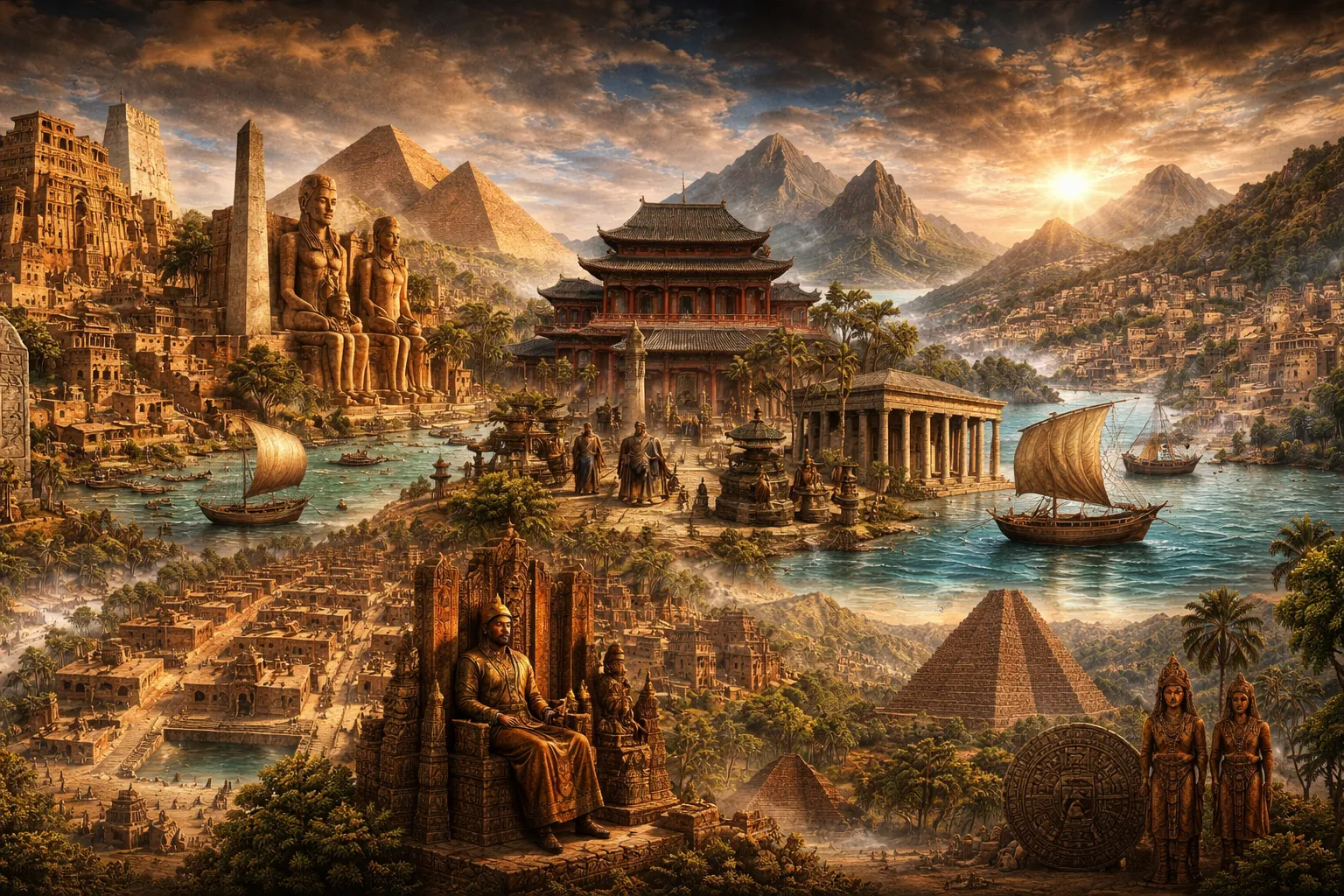
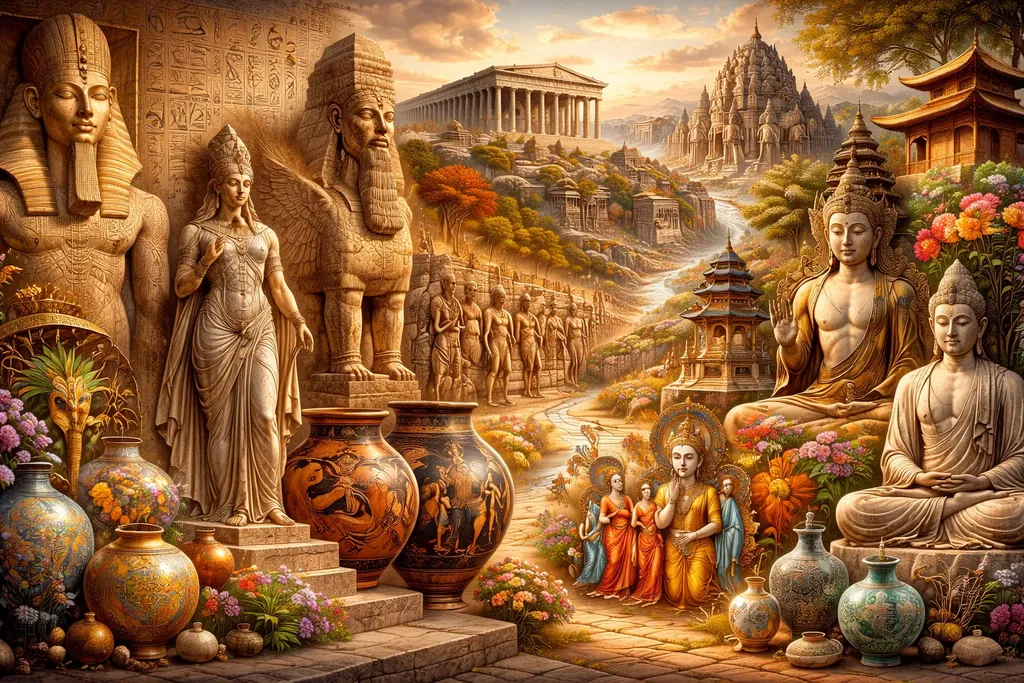
After studying space, nature, and decoration in ancient art, we must now take a decisive step: comparing the major artistic traditions of Antiquity on a global scale. Until now, we have dealt with functions, materials, bodies, power, cult, and visual environments. But all these dimensions take different forms depending on the civilization. Each ancient world develops particular ways of representing, building, decorating, organizing the image, hierarchizing figures, treating matter, and giving meaning to forms.
Speaking of ancient “styles” nevertheless requires caution. It is not a matter of reducing each civilization to a fixed aesthetic formula. A style is neither a simple label nor a total summary of a world. Rather, it refers to a set of recurring choices: treatment of the body, relation to decoration, place of architecture, use of materials, relation to the sacred, to power, to movement, to space, and to narration. These choices produce recognizable visual coherences, even if they evolve over time and vary by region.
The purpose of this chapter is therefore to offer a non-Eurocentric overview of the major artistic traditions of Antiquity. It is not about establishing a ranking, nor about measuring all forms against a single ideal. On the contrary, it is about understanding how several centers of civilization produced powerful, original, coherent, and durably influential visual languages. To study these styles and codes is to learn to recognize the plurality of ancient ways of creating image, monument, decoration, and presence.
What Do We Mean by a Style in Ancient Art?
Before examining the major traditions, we must clarify what is meant by “style.” In the context of ancient art, style may refer to:
- a recurring way of representing the body;
- a particular organization of space;
- a specific relation between figure and decoration;
- a preference for certain materials or media;
- a way of hierarchizing forms;
- a set of visual conventions recognized within a culture;
- a coherence linking art, religion, power, and society.
Style is therefore not reducible to “what is beautiful” or to a simple surface appearance. It involves deep choices. A civilization may privilege:
- frontality;
- stability;
- monumentality;
- continuous narration;
- decorative stylization;
- observation of movement;
- rhythmic abstraction;
- strict codification of figures.
What must be remembered
- style is a coherent visual organization;
- it depends on the values of a society;
- it must not be separated from religious, political, or funerary functions;
- it evolves over time without necessarily losing its major principles.
Why a Global and Non-Eurocentric Reading Is Necessary
For a long time, the history of ancient art was told as though it naturally led toward Classical Greece and then Rome. This way of seeing gave immense importance to the Greco-Roman world, sometimes at the expense of other major traditions. A global reading makes it possible to correct this imbalance.
It reminds us that:
- Mesopotamia develops major visual systems of power and the sacred very early;
- ancient Egypt builds an exceptionally coherent plastic tradition over the long term;
- the Persian worlds elaborate original imperial forms;
- ancient India develops specific relations between image, rhythm, symbol, and presence;
- ancient China builds an aesthetic universe strongly articulated with ritual, writing, and order;
- several ancient African worlds invent powerful forms too often marginalized;
- the Mesoamerican and Andean worlds produce complex visual systems outside the Mediterranean axis.
What this approach changes
- it shifts the center of the narrative;
- it avoids making one particular style the universal norm;
- it allows comparison without artificial hierarchy;
- it restores the true density of the ancient world.
Mesopotamia: Order, Power, Narration, and Presence
The Mesopotamian tradition is one of the oldest and most structured of Antiquity. It is characterized by an art strongly linked to power, the sacred, writing, and administration. The image is often conceived as an instrument of presence, memory, and domination.
Major traits
- frequent frontality;
- highly legible visual hierarchies;
- importance of narrative relief;
- strong articulation between image and inscription;
- central place of the sovereign, the god, the temple, and the palace;
- taste for guardian figures, powerful animals, processions, and scenes of victory.
Relation to the body
The body is often:
- codified;
- stable;
- hierarchized;
- less focused on naturalistic anatomy than on status and presence.
Relation to space
Mesopotamian space is often:
- structured;
- sequential;
- narrative;
- organized to serve legibility and authority.
What must be remembered
Mesopotamia develops very early an art of order, narrative, and visible sovereignty. Its style does not primarily seek illusion, but symbolic efficacy.
Ancient Egypt: Permanence, Clarity, and Cosmic Order
Egyptian art is probably one of the most coherent ensembles in all Antiquity. It rests on remarkably stable principles, even though real evolutions exist. This stability is not an absence of invention, but a profound choice: maintaining a formal order linked to the order of the world.
Major traits
- frontality and profiles combined according to precise conventions;
- clarity of reading;
- hierarchy of scale;
- strong articulation between image, writing, and ritual;
- funerary and cultic monumentality;
- importance of tomb and temple decoration;
- close relation between image, survival, and presence.
Relation to the body
The Egyptian body is often:
- ideally regulated;
- legible;
- codified according to a logic of visual completeness;
- less individualized than functionally meaningful.
Relation to the sacred
The image serves to:
- perpetuate;
- protect;
- accompany;
- make present;
- inscribe the dead or the god in duration.
What must be remembered
Egyptian style rests on permanence, legibility, and the relation between image and cosmic order. It is an art of active stability, not of empty repetition.
The Aegean Worlds: Movement, Decoration, and Dynamism
The Minoan and Mycenaean worlds offer other visual solutions in ancient art. Without forming a single block, they are often distinguished by a more marked taste for movement, animated surfaces, certain forms of decorative fluidity, and scenes of life, nature, or ritual.
Major traits
- dynamic frescoes;
- interest in the rhythms of body and animal;
- marine, vegetal, and ritual motifs;
- strong relation between palatial architecture and decoration;
- taste for curve, ornament, and visual energy.
What must be remembered
These traditions show that Antiquity does not everywhere reduce itself to monumental frontality. They introduce other sensibilities: movement, fluidity, living ornament.
Ancient Greece: Body, Proportion, Variation, and Formal Research
Greece occupies a major place in the history of ancient art, but it must be placed among other traditions without being transformed into an absolute norm. Its importance comes notably from the way it develops a formal reflection on the body, proportion, movement, figured narration, and sculpted space.
Major traits
- great attention to the human body;
- search for proportions and balances;
- strong evolution between Archaic, Classical, and Hellenistic periods;
- importance of sculpture, architecture, painted ceramics, and relief;
- richness of mythological, civic, and funerary scenes.
Major tendencies
- Archaic: strong codification, conventional smile, stability;
- Classical: balance, mastery, measured idealization;
- Hellenistic: movement, pathos, variety, dramatic effects.
What must be remembered
Greece develops a very influential tradition, focused in part on the body, measure, and expressive variation. But it is not the mandatory starting point of all art history.
Rome: Power, Appropriation, Portrait, and Diffusion
Roman art takes up, transforms, and diffuses many forms coming from other worlds, especially Greek ones. Its strength lies not only in pure invention, but in the capacity to integrate, adapt, monumentalize, and territorialize varied visual languages.
Major traits
- art of imperial power;
- importance of portraiture;
- civic and political monumentality;
- historical and narrative relief;
- wall decoration and mosaic;
- strong articulation between image, urbanism, and territorial domination.
Relation to portraiture
Roman portraiture may be:
- individualized;
- political;
- dynastic;
- idealized or marked by a certain hardness of authority.
What must be remembered
Rome makes art into a tool of imperial presence on a large scale. It combines inheritance, propaganda, selective realism, and the monumentalization of politics.
The Persian Worlds: Majesty, Empire, and Ordered Composition
Ancient Persian traditions, particularly Achaemenid ones, develop a very powerful imperial visual language. Power is expressed through mastery, ordered repetition, procession, symmetry, and the representation of a sovereign center dominating an organized world.
Major traits
- court monumentality;
- processional reliefs;
- controlled hierarchy without excessive agitation;
- importance of guards, delegations, tribute, and protective animals;
- strong relation between palatial architecture and representation of power.
Visual style
- calm;
- ordered;
- majestic;
- repetitive in a structuring sense;
- less centered on drama than on stable sovereignty.
What must be remembered
Ancient Persian art produces an imperial style of dignity, order, and centrality. It offers another way of monumentalizing empire than Greek or Roman traditions.
Ancient India: Rhythm, Symbol, Presence, and Transformation
Ancient India develops rich and diverse visual traditions, which must be approached with caution because they evolve according to periods, religions, and regions. One may nevertheless observe a particularly strong relation between image, sacred presence, narration, formal rhythm, and the symbolic transformation of the body.
Major traits
- importance of relief and sculpture;
- narrative density in certain ensembles;
- very strong relation to the sacred;
- attention to gesture, posture, and attribute;
- richness of signs and motifs surrounding figures.
Relation to the body
The body may be:
- rhythmic;
- stylized;
- charged with symbolic energy;
- conceived less as a closed anatomical mass than as an inhabited presence.
What must be remembered
Ancient India develops forms in which body, sacredness, movement, and symbolic density are strongly intertwined. Style is often as much a matter of rhythm as of form.
Ancient China: Ritual, Sign, Order, and Continuity
Ancient China builds a visual universe deeply linked to ritual, writing, social hierarchy, and cosmic order. Forms are often thought in relation to function, matter, sign, and place within a broader system.
Major traits
- importance of ritual bronzes;
- strong relation between decoration, sign, and use;
- taste for ordering, symmetry, and certain powerful stylizations;
- articulation between art, power, ritual, and ancestry;
- marked visual continuity across historical transformations.
Relation to decoration
Ancient Chinese decoration may be:
- dense;
- codified;
- symbolic;
- closely linked to the material of the object.
What must be remembered
Ancient China develops an aesthetic of ritual, sign, and order. The object is often at once functional, sacred, symbolic, and formally controlled.
Ancient African Worlds: Diversity, Formal Power, and Presence
One must speak of ancient African worlds in the plural. There is not one single ancient African style, but several traditions, often insufficiently integrated into classical narratives. Some privilege monumental architecture, others the arts of metal, terracotta, the body, ornament, ritual objects, or power.
Essential points
- very great regional diversity;
- strong link between art, ritual, power, and memory;
- importance of local materials and specialized skills;
- forms sometimes more synthetic, more symbolic, or more intensely present than descriptive;
- richness of traditions still unequally documented.
What must be remembered
A non-Eurocentric approach must fully recognize the artistic density of ancient African worlds, without measuring them against external criteria of naturalism or Mediterranean monumentality.
The Mesoamerican Worlds: Symbolic Density, Cosmology, and Graphic Power
The ancient Mesoamerican worlds develop extremely dense visual systems, in which image, sign, decoration, ritual, and power are deeply linked. Art willingly articulates body, cosmic order, sacredness, politics, and the calendar.
Major traits
- strong symbolic density;
- importance of stone, relief, polychromy, ritual objects, and ceremonial architectures;
- taste for powerfully stylized forms;
- close integration of image with cosmology;
- articulation between sovereignty, sacrifice, time, and world order.
What must be remembered
Ancient Mesoamerican art proposes visual languages of great graphic and sacred intensity, which cannot be understood through Mediterranean classical categories alone.
The Ancient Andes: Geometry, Material, Textile, and Symbolic Order
The ancient Andean worlds develop yet other logics, often strongly linked to textiles, geometric motifs, architecture, ritual, landscape, and the symbolic structuring of space.
Major traits
- central place of textile in visual culture;
- power of rhythmic and geometric motifs;
- strong link between decoration, territory, and hierarchy;
- articulation between architecture, landscape, and ceremonial order;
- use of synthetic and strongly structured forms.
What must be remembered
Andean traditions forcefully remind us that the history of ancient art cannot be reduced to carved stone or the naturalistic body. Textile, geometry, and the symbolic organization of space may be central.
Comparing Traditions Without Reducing Them
Comparing the major artistic traditions of Antiquity is essential, but such comparison must remain cautious. It is not about saying:
- that one would be “more advanced”;
- that another would be “more realistic” and therefore better;
- that a third would be “more decorative” and therefore secondary.
Comparison should instead seek to understand:
- which functions dominate;
- which materials are privileged;
- what relation is established between image and power;
- what status is given to the body;
- how space and decoration are organized;
- what place the sacred occupies;
- how forms are codified or transformed.
What must be avoided
- making naturalism a universal norm;
- reading all traditions through Greece alone;
- confusing formal stability with absence of invention;
- underestimating the arts of decoration, textile, object, or sign.
Major Criteria of Comparison
To better read the major traditions, one may retain a few simple axes.
1. Relation to the body
- hierarchized body;
- ideal body;
- rhythmic body;
- individualized body;
- symbolic body.
2. Relation to space
- frontality;
- registers;
- relative depth;
- ritual space;
- narrative space;
- monumental space.
3. Relation to decoration
- structuring decoration;
- secondary decoration;
- cosmological decoration;
- vegetal or geometric decoration;
- more or less dense ornamentation.
4. Relation to power
- royal glorification;
- imperial monumentality;
- dynastic memory;
- civic diffusion;
- ritualized power.
5. Relation to the sacred
- image of presence;
- narrative image;
- ritual object;
- tomb and afterlife;
- relation between visible and invisible.
These criteria do not confine works, but they help compare without crushing differences.
Styles Evolve, Even When They Seem Stable
Another essential point must be stressed: ancient traditions evolve, even when their coherence is strong. Egypt, Mesopotamia, Greece, Rome, China, India, or the ancient American worlds do not remain identical to themselves over centuries.
Styles change through:
- political transformations;
- religious evolutions;
- cultural exchanges;
- technical innovations;
- shifts in centers of power;
- new commissions;
- internal reinterpretations.
What must be remembered
- stability does not exclude variation;
- tradition does not exclude invention;
- ancient styles are not motionless;
- coherence and transformation must be thought together.
Circulations, Influences, and Hybridizations
Major artistic traditions do not live in isolation. They exchange, encounter one another, observe one another, imitate one another, reinterpret one another. Motifs circulate, materials travel, artists and craftswomen or craftsmen move, empires integrate several inheritances, and conquests provoke hybridizations.
These circulations may produce
- decorative borrowings;
- local adaptations;
- new imperial forms;
- mixtures of iconographic codes;
- transformations of portrait, dress, relief, or architecture.
One must therefore avoid thinking of each tradition as a pure block. The history of ancient art is also a history of contacts.
Why This Chapter Is Essential
This chapter is essential because it finally makes it possible to have a true overview of the history of ancient art. It shows that Antiquity does not have a single style, a single center, or a single legitimate way of making image or monument. It is a set of powerful visual traditions, comparable on some points, yet irreducible to one another.
Thanks to this overview, one understands better:
- why ancient art is plural;
- how each civilization constructs its visual coherence;
- why the same functions can produce very different forms;
- how to compare without artificially hierarchizing;
- in what sense a global history of ancient art is more accurate than a narrative centered on a single Mediterranean axis.
Studying the styles, the codes, and the major artistic traditions of Antiquity therefore means learning to recognize several ways of organizing beauty, presence, power, sacredness, narrative, and space.
Essential ideas to remember
- there is not one single ancient style, but a plurality of major artistic traditions;
- style must be understood as a visual coherence linked to a culture, not as a simple appearance;
- Mesopotamia, Egypt, the Persian worlds, India, China, ancient African worlds, and ancient American worlds must be fully integrated into the overall view;
- Greece and Rome are major, but they do not summarize Antiquity;
- each tradition articulates body, space, decoration, power, and sacredness differently;
- comparison must avoid any simplistic hierarchy based on realism;
- ancient styles evolve, circulate, and hybridize.
Transition to the next chapter
Once the major artistic traditions of Antiquity have been recognized, a new question becomes central: how do works, motifs, techniques, and styles circulate from one world to another, and how do these contacts transform forms?
The next chapter can therefore focus on artistic circulations, influences, and hybridizations in Antiquity.