Space, Nature, and Decoration in Ancient Art
Introduction
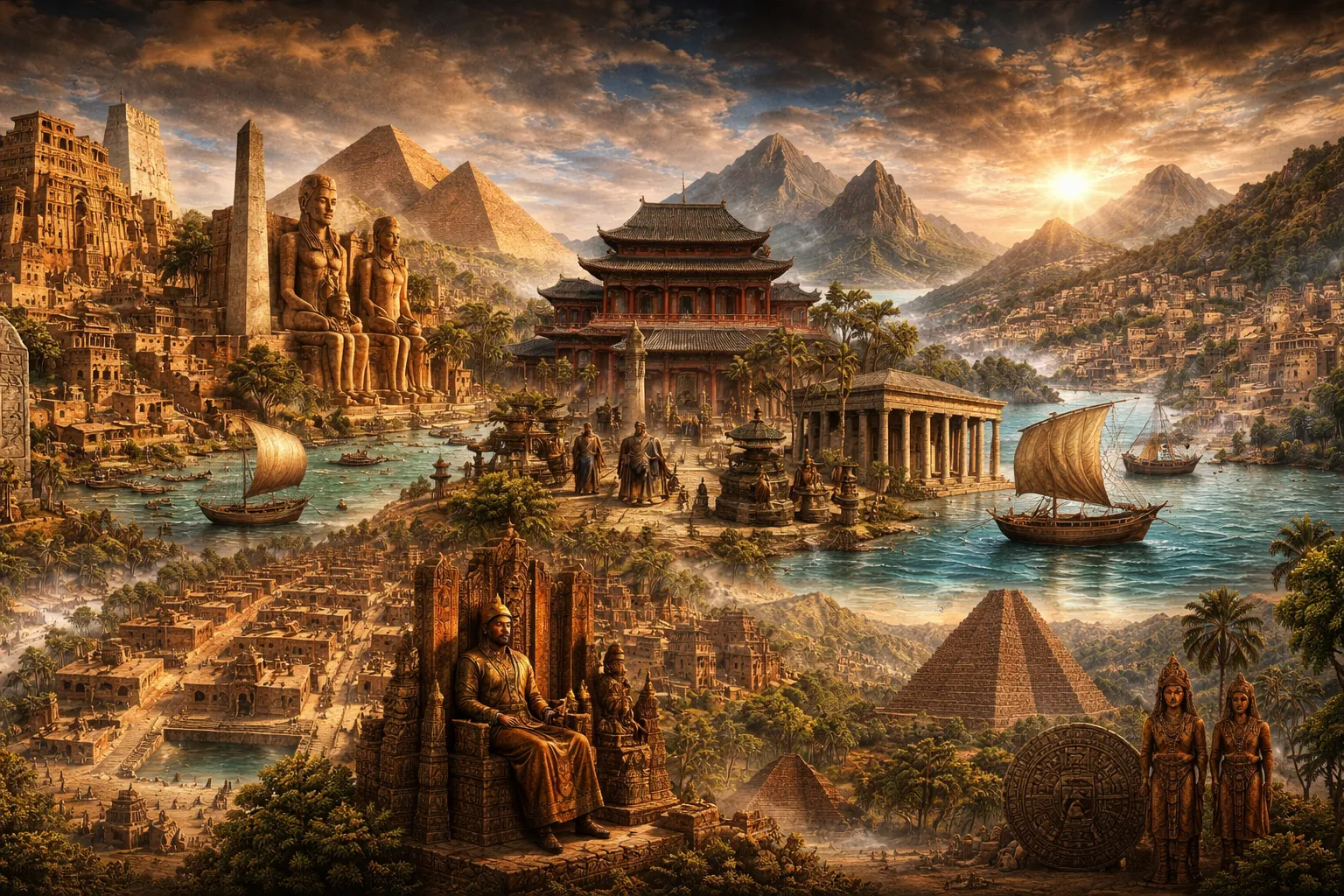
After studying the human body in ancient art, we must now broaden our gaze toward what surrounds that body: space, nature, landscape, animals, architectural backgrounds, vegetal motifs, geometric forms, borders, friezes, and everything often grouped under the word “decoration.” But this term must be handled with caution. In Antiquity, decoration is not merely what beautifies around the main subject. It may structure space, organize reading, produce an atmosphere, express a cosmic order, distinguish places, sacralize a surface, frame a narrative, or symbolically extend the meaning of the image.
Represented ancient space is not always realistic in the modern sense. It may be hierarchical, symbolic, fragmented, synthetic, or rhythmically structured by architectural or natural elements rather than built according to coherent optical depth. Likewise, nature is not always represented for its own sake. It may be a sacred setting, a sign of fertility, a territorial marker, a mythical place, a stylized environment, or a reservoir of visual motifs.
The aim of this chapter is therefore to show that ancient art does not think only in terms of figures, but also in terms of environments. It visually organizes the world around beings. Studying space, nature, and decoration in ancient art means understanding how ancient societies gave form to their visible, imagined, symbolic, and constructed surroundings.
Represented Ancient Space Is Not Modern Space
One of the first points to understand is that space in ancient art should not be judged only through modern visual habits. Ancient societies do not always seek to reproduce a continuous, homogeneous, and optically credible depth. They may prefer other logics:
- juxtaposition;
- superposition;
- hierarchy;
- frontality;
- separation of registers;
- combination of several points of view;
- symbolic organization of place.
This does not mean that ancient artists were “less advanced” or “less developed” in spatial representation. It means that they answered different objectives. Space serves first of all to:
- make a scene readable;
- hierarchize elements;
- distinguish zones of action;
- provide a symbolic framework;
- make an ordered world exist rather than a perfect optical illusion.
What must be remembered
- ancient space can be coherent without being naturalistic;
- depth is not always the main objective;
- readability, hierarchy, and symbolic function often matter more;
- one must avoid measuring all traditions against modern perspective.
Space as an Organization of Meaning
In ancient art, space is not only a container. It participates in meaning. It organizes the relationships between figures, objects, buildings, gods, the dead, animals, or signs. A religious, political, funerary, or domestic scene does not use space in the same way, because it does not express the same relationships.
Space may serve to:
- separate worlds;
- bring figures closer together or farther apart;
- distinguish the sacred from the profane;
- place the sovereign at the center;
- guide the gaze;
- inscribe a narrative into a visual path;
- create an atmosphere of stability, violence, abundance, or recollection.
Some frequent means
- horizontal registers;
- central axes;
- symmetries;
- architectural framings;
- thresholds and doors;
- mountains or trees acting as separators;
- processional lines;
- thrones, altars, or platforms.
Ancient space is therefore a mode of intellectual and symbolic organization of the visible.
Nature Is Not Only a Background
In many ancient works, nature is not a simple passive background. It may have religious, political, cosmic, territorial, or poetic value. A river, a mountain, a tree, a garden, a desert, a marsh, or a sea does not merely say “where” the scene takes place. It also says something about its meaning.
Nature may be:
- a place of origin;
- a sacred space;
- a sign of fertility;
- a controlled territory;
- a setting for hunting or war;
- a mythical environment;
- a motif of prosperity;
- a cosmic presence.
What it may express
- abundance;
- the order of the world;
- the power of the gods;
- the wealth of a territory;
- the frontier;
- ordeal;
- journey;
- peace.
One must therefore avoid reducing ancient nature to a secondary decorative background. It is often laden with meaning.
Rivers, Mountains, Seas: Great Symbolic Environments
Certain natural elements recur with particular force in many ancient traditions, because they are at once real, vital, and symbolic.
The river
It may represent:
- life;
- fertility;
- circulation;
- frontier;
- a local divinity;
- the stability of a civilization.
The mountain
It may evoke:
- elevation;
- contact with the divine;
- power;
- protection;
- a distant or mythical place;
- a sacred origin.
The sea
It may signify:
- openness;
- trade;
- danger;
- the unknown;
- travel;
- maritime power.
These great environments are not only observed. They are thought. Their representation often condenses a cosmology, an economy, and a collective memory.
Landscape: Relative Rarity, Real Presence
It is sometimes said that landscape does not really exist in Antiquity. This statement is too blunt. It is true that many ancient traditions do not develop autonomous landscape in the modern sense of an image whose main subject would be nature itself. But that does not mean that the environment is not represented.
There are, on the contrary, diverse forms of landscape:
- landscape integrated into a scene;
- sacred landscape;
- funerary landscape;
- garden landscape;
- hunting landscape;
- mythical landscape;
- decorative landscape;
- architecturally framed landscape.
What must be remembered
- ancient landscape is often linked to a function;
- it is rarely entirely separated from narrative, cult, or decoration;
- it may be stylized, fragmented, symbolic, or very attentive to certain natural details;
- one should speak of forms of landscape rather than of pure and simple absence.
Antiquity therefore does not ignore landscape: it thinks it differently.
Gardens, Orchards, and Ordered Nature
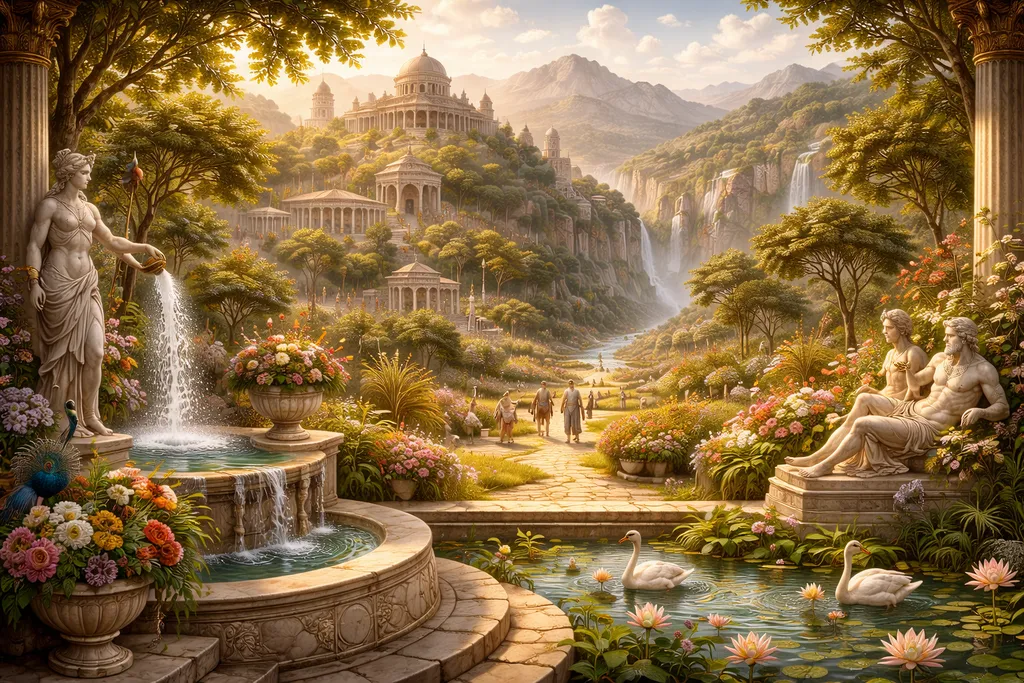
Gardens occupy an important place in certain ancient cultures, whether they are real, represented, or idealized. They constitute a particular form of nature: a nature that is ordered, worked, mastered, sometimes sacred, sometimes royal, sometimes domestic.
The garden may combine:
- water;
- trees;
- flowers;
- shade;
- paths;
- enclosure;
- pavilions;
- basins;
- animals;
- fragrances.
In the image, it may signify
- abundance;
- peace;
- prestige;
- order;
- proximity to the sacred;
- cultivated beauty;
- harmony between human beings and environment.
The garden is a particularly interesting motif, because it lies between nature and culture. It shows how ancient societies transformed the living world into a meaningful space.
Animals: Real, Symbolic, Mythical Presences
Represented ancient space is often inhabited by animals. These may be shown as elements of reality, but also as signs of power, divine attributes, figures of fertility, hunting partners, emblems, guardians, or fantastic creatures.
Animals may have several statuses
- everyday animals;
- prestige animals;
- sacred animals;
- threatening animals;
- animals mastered by the sovereign;
- symbolic animals;
- hybrid or fantastic animals.
They may serve to express
- domination over nature;
- the wealth of a territory;
- the force of a god;
- the nobility of hunting;
- the violence of the world;
- the passage between the visible and the invisible.
The animal is therefore not simply “added” to the scene. It fully participates in the construction of meaning and atmosphere.
Architecture and Represented Space
In ancient art, space is often structured by architecture. Columns, doors, thrones, canopies, walls, sanctuaries, palaces, stairways, porticoes, or pavilions serve to situate figures and to hierarchize the scene.
Represented architecture may have several functions:
- locating the action;
- indicating the status of the place;
- framing a figure;
- monumentalizing a presence;
- separating interior and exterior;
- organizing the approach to the sacred or to power;
- giving a visual rhythm to the composition.
What it brings to the image
- a geometric order;
- a framing effect;
- a structured depth;
- a spatial hierarchy;
- a monumental dignity.
Ancient space is therefore often a mixed space, in which nature and architecture answer one another, oppose one another, or balance one another.
Decoration as Frame and as Language
Decoration is sometimes presented as accessory. In reality, it is often fundamental. Borders, friezes, rosettes, palmettes, lotus motifs, meanders, interlaces, star motifs, repetitive vegetal motifs, colored bands, painted or sculpted frames do not merely serve to fill empty spaces. They organize the surface and give it a logic.
Decoration may:
- separate zones;
- mark transitions;
- frame a main image;
- sacralize a surface;
- create rhythmic repetition;
- connect a work to a visual tradition;
- produce a stylistic identity.
What must be remembered
- decoration is not necessarily secondary;
- it may be structuring;
- it participates in readability;
- it creates visual regimes specific to each culture.
The history of ancient art must therefore give real attention to decorative motifs and not only to the main figures.
Vegetal Motifs: Life, Abundance, Renewal
Among the most widespread decorations are vegetal motifs. Leaves, flowers, stems, palms, vines, lotuses, papyrus, branches, stylized trees, or garlands play a major role in many traditions.
These motifs may express
- fertility;
- growth;
- regeneration;
- prosperity;
- the natural order;
- the link with a region or a cult;
- the beauty of stylized living forms.
They appear in:
- architecture;
- precious objects;
- textiles;
- paintings;
- reliefs;
- borders;
- funerary decorations;
- arts of power.
Decorative vegetation is therefore not a simple ornament. It often carries a vision of the cycle of life and abundance.
Geometric Motifs: Order, Rhythm, Mastery
Geometric motifs are also very important. Lines, checkerboards, spirals, chevrons, meanders, circles, grids, repeated bands, or symmetrical compositions fulfill several functions.
They may express
- order;
- measure;
- mastery;
- stability;
- rhythm;
- the separation of zones;
- visual harmony.
The geometric works differently from the figurative. It does not necessarily narrate, but it structures. It produces a mental framework as much as a visual effect.
Its importance shows that
- ancient art does not value only the human figure;
- decorative abstraction has real power;
- a civilization may say a great deal through rhythm and repetition.
Geometric decoration is therefore a form of visual thought in itself.
Cosmic Decoration
In certain contexts, represented or decorated space refers to a broader vision of the world: sky, stars, heavenly bodies, directions, cosmic order, cycles of time. Decoration can then become cosmological.
This may happen through:
- star motifs;
- solar disks;
- lunar crescents;
- circular repetitions;
- quadripartite organization;
- decorated vaults;
- associations between sky, earth, and power.
These devices serve to
- inscribe a scene within the universe;
- connect power or cult to a higher order;
- suggest the totality of the world;
- give space a sacred or cosmic significance.
Ancient art can therefore transform a decorated surface into a condensed image of the cosmos.
Framing, Separating, Guiding the Gaze
Decoration and spatial organization also serve to guide the eye. An ancient work may orient the gaze without resorting to the same means as more recent arts. It uses:
- internal frames;
- repetitions;
- processional lines;
- symmetries;
- alternations of motifs;
- color contrasts;
- central figures;
- architectural thresholds;
- trees or columns as separators.
These devices make it possible to
- indicate what is principal;
- separate scenes;
- hierarchize information;
- create a rhythm of reading;
- make the gaze circulate between center and periphery.
Thus, space and decoration are also techniques of visual reading.
Funerary Space, Sacred Space, Political Space
Not all represented spaces have the same function. One must distinguish several major spatial regimes.
Funerary space
It may be:
- enclosed;
- protected;
- oriented toward the afterlife;
- populated with signs of memory;
- structured to accompany the deceased.
Sacred space
It may be:
- hierarchized;
- centered on an image or an altar;
- marked by thresholds;
- separated from the ordinary;
- saturated with protective signs.
Political space
It may be:
- monumental;
- axial;
- ordered;
- designed to impress;
- linked to paths of domination.
What must be remembered
- each type of space produces a type of decoration and representation;
- the function of the place influences visual forms;
- represented space is always socially and symbolically qualified.
Stylized Nature and Observed Nature
One must avoid opposing stylized nature and observed nature too rigidly. In ancient art, both logics may coexist. A plant may be identifiable while being strongly ordered. An animal may be carefully observed while serving a symbolic program. A landscape may evoke a real place without seeking exact transcription.
This means that
- stylization is not ignorance of reality;
- observation does not abolish convention;
- represented nature is almost always interpreted.
This point is essential in order to avoid simplistic judgments. A repeated vegetal form is not “poor” because it is not naturalistic; it may answer to a very strong decorative or sacred logic.
Space, Decoration, and Cultural Identity
Choices of decoration, motifs, spatial composition, and treatment of nature contribute strongly to the visual identity of a civilization. Some traditions privilege:
- densely ornamented surfaces;
- more neutral backgrounds;
- geometric frames;
- specific floral motifs;
- architectured spaces;
- symbolic landscapes;
- stylized animals;
- highly codified court or sanctuary decorations.
What this shows
- decoration is a major cultural marker;
- it often allows one to recognize a visual tradition;
- it links works together beyond their represented subjects;
- it participates in the coherence of an artistic world.
The history of ancient art therefore cannot separate the “great subjects” from their decorative regimes.
Why This Chapter Is Essential
This chapter is essential because it shows that ancient art is not limited to human figures, gods, or sovereigns. It also gives form to environments, surfaces, frames, rhythms, and settings. It thinks visually about the relationship between beings and the world around them.
Thanks to this perspective, one understands better:
- why decoration is often more important than one thinks;
- why ancient nature is charged with meaning;
- how space structures the reading of images;
- in what way vegetal, geometric, or cosmic motifs participate in visual thought;
- why artistic traditions are also distinguished by their surface regimes and environmental settings.
Studying space, nature, and decoration in ancient art therefore means learning to look not only at what is represented, but also at the visual world in which it takes place.
Essential ideas to remember
- represented ancient space should not be judged only according to modern perspective;
- nature is often symbolic, religious, political, or territorial as much as descriptive;
- landscape exists in Antiquity, but often in forms linked to narrative, cult, or decoration;
- animals, plants, architecture, and decorative motifs fully participate in meaning;
- decoration structures the surface, guides the gaze, and qualifies space;
- vegetal, geometric, and cosmic motifs are visual languages in their own right;
- each civilization develops spatial and decorative regimes that contribute to its artistic identity.
Transition toward the next chapter
Once one understands how ancient societies organize space, nature, and decoration, a new question becomes essential: what are the great styles, the great formal codes, and the great artistic traditions of Antiquity on a world scale?
The next chapter can therefore focus on the styles, the codes, and the great artistic traditions of Antiquity.