Art, Power, and Visual Propaganda
Introduction
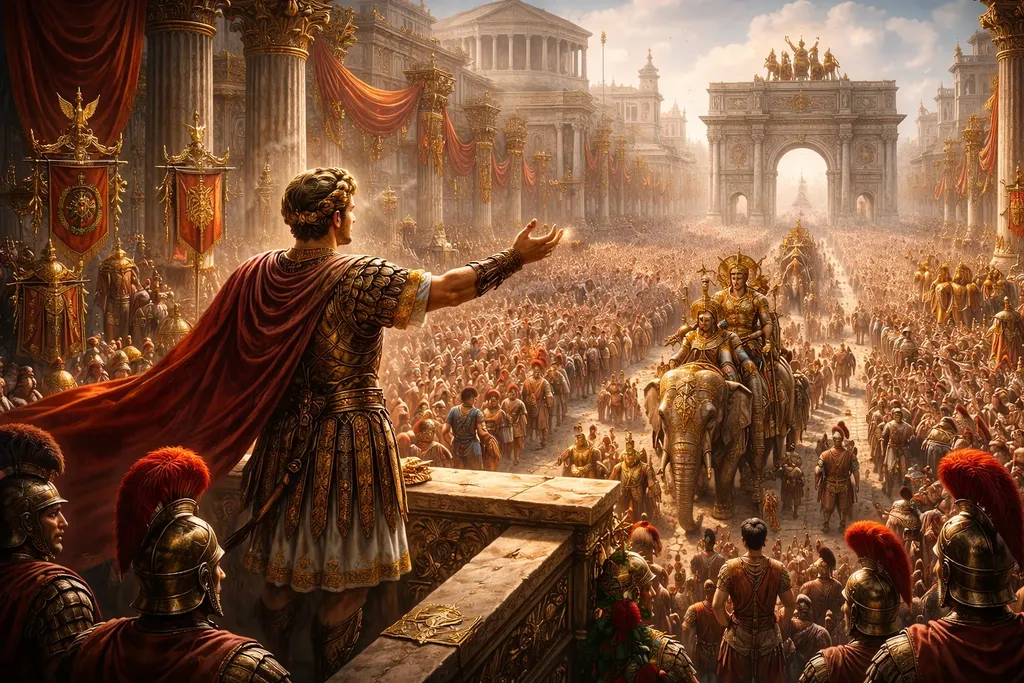
After studying the links between art, cult, and the invisible world, we must now turn to another fundamental use of images and forms in Antiquity: their role in staging power. Ancient societies do not govern only through military force, law, taxation, or religion. They also govern through what they show. They construct images of authority, victory, stability, grandeur, and legitimacy. They give power a face, a body, a scale, a setting, a memory, and a visibility.
The word “propaganda” must be used with caution, because it is modern and may suggest media systems very different from those of the ancient worlds. Yet it remains useful if it is understood in a broad sense: the whole set of visual, monumental, and symbolic means by which a power seeks to make itself credible, impressive, natural, glorious, or inevitable. In Antiquity, this takes shape through statues, reliefs, palaces, temples, inscriptions, processions, emblems, coins, garments, prestige architectures, and great decorative programs.
The purpose of this chapter is therefore to show that ancient art is not only a religious or aesthetic domain. It is also an instrument of visual domination. It makes power present in space, organizes the memory of victories, hierarchizes bodies, monumentalizes sovereignty, and diffuses images of the political world that populations are meant to see, recognize, fear, admire, or internalize.
Power Needs to Be Seen
In the ancient worlds, power cannot remain abstract. It must manifest itself. The queen, king, dynasty, dominant city, empire, or elite must make its authority perceptible. This is all the more important because ancient societies often extend over vast territories, unite diverse populations, and depend on material relays to circulate their presence.
Image, object, and monument play an essential role here. They allow power:
- to appear even in the physical absence of the sovereign;
- to occupy space symbolically;
- to remind people who commands;
- to inscribe domination in duration;
- to transform political authority into visual evidence.
What Must Be Remembered
- ancient power shows itself;
- it seeks to be recognized as much as obeyed;
- visibility is part of authority;
- art is not secondary in this staging: it is one of its central tools.
To see power, in Antiquity, is already to enter its order.
Representing the Sovereign: Human Figure and Superior Figure
One of the most obvious forms of the art of power consists in representing the queen or king. But this representation is never neutral. It is not simply a matter of showing an identifiable individual. It is also a matter of producing a figure of authority.
The sovereign’s body may be shown as:
- larger than the others;
- calmer;
- more frontal;
- more stable;
- more richly dressed;
- closer to the divine;
- more idealized;
- surrounded by attributes of power.
In some traditions, the sovereign appears as military leader, guarantor of order, judge, founder, protector, or mediator with the sacred. In others, the sovereign takes on an almost superhuman, cosmic, or divine dimension. The image therefore does not seek only to say “here is this person,” but “here is what authority is.”
The Representation of the Sovereign May Serve To
- legitimize a reign;
- affirm dynastic continuity;
- distinguish the body of power from the ordinary body;
- make visible a social and cosmic hierarchy;
- make the sovereign a visual and symbolic center.
Political art thus transforms a human body into an image of command.
The Hierarchy of Sizes, Positions, and Gestures
Ancient art of power often uses very clear visual codes to show hierarchy. Among them, the size of figures is especially important. In many civilizations, a larger figure is not only “closer” or more “visible”: it is also more important.
This hierarchy may pass through:
- scale;
- central position;
- elevation;
- frontality;
- majestic stillness;
- richness of costume;
- presence of insignia;
- architectural or decorative framing.
These Codes Serve To
- distinguish the sovereign from subjects;
- oppose victors and vanquished;
- make hierarchy immediately legible;
- naturalize relations of domination;
- impose a visual order even before any speech.
The image of ancient power is therefore often a coded image of openly assumed inequality.
The Monument as an Assertion of Power
Ancient power likes to build on a grand scale. Monumentality is not a gratuitous luxury. It has a political function. A vast palace, a monumental gate, a colossal statue, a temple associated with the dynasty, a great ceremonial avenue, an impressive wall, or a large-scale relief all produce an effect of domination.
Monumentality acts through:
- scale;
- duration;
- visibly difficult technical achievement;
- the capacity to mobilize considerable resources;
- the impression of order and mastery;
- the centrality it imposes upon the landscape.
What a Monument of Power Says
- we are capable of building larger than others;
- we master materials, people, and territory;
- our presence is lasting;
- our authority exceeds the individual scale;
- our power deserves to be inscribed in stone and memory.
The political monument is therefore at once an act of architecture, prestige, and symbolic domination.
Palaces, Capitals, and Court Architectures
Power does not show itself only through isolated images. It also unfolds in complete architectural ensembles. Palaces, royal residences, imperial capitals, monumental courtyards, audience halls, ceremonial staircases, guarded gates, columns, thrones, and ordered gardens all participate in a scenography of command.
These spaces are not simple places of dwelling or administration. They are designed to:
- impress;
- hierarchize access;
- ritualize the approach to the center;
- distinguish power from the rest of the world;
- stage wealth, order, and mastery.
Court Architecture May Produce
- distance;
- solemnity;
- a sense of exception;
- a gradation in access to the sovereign;
- an almost sacred perception of the political center.
To enter a palace, a court, or a monumental capital is often already to undergo the material experience of domination.
Victory, War, and Visual Memory
One of the great themes of ancient political art is victory. Power very often represents itself in the act of conquering. Reliefs, stelae, paintings, statues, inscriptions, trophies, scenes of battle or triumphal procession fix military superiority in the image.
These images may show:
- the sovereign striking the enemy;
- captive prisoners;
- enemies crushed or kneeling;
- seized weapons;
- tribute being brought;
- chariots, horses, ordered armies;
- gods supporting the victory;
- subjected territories.
Why Victory Is So Visually Important
- it justifies power;
- it transforms violence into legitimate glory;
- it intimidates enemies;
- it reassures subjects;
- it inscribes expansion into collective memory;
- it makes the sovereign a figure of protection and power.
The ancient image of war is therefore not only descriptive. It is an official narrative of domination.
The Vanquished as Political Figures
To glorify power, ancient art also often represents the vanquished. These are not shown at random. Their image serves to construct, by contrast, that of the dominant center. They may appear:
- bound;
- kneeling;
- smaller;
- half-naked;
- disordered;
- bringing tribute;
- subjected to the sovereign’s victorious gesture;
- characterized by signs of otherness.
The vanquished thus becomes a political and visual figure. They materialize the superiority of the dominant power.
This Representation Serves To
- make victory legible;
- hierarchize peoples;
- fix the memory of a submission;
- define the center by opposition to the outside;
- transform the other into proof of power.
Political art therefore shows not only who rules, but also over whom that rule is exercised.
Inscription: Seeing and Reading Power
In many ancient worlds, visual power is accompanied by text. The inscription reinforces the image, specifies it, prolongs it, or makes it official. It may name the sovereign, recall a victory, fix a foundation, consecrate a monument, state titles, establish a lineage, or recount an exploit.
The association of text and image allows power:
- to make itself visually present;
- to formulate itself explicitly;
- to bind memory, authority, and duration;
- to give the image a verbal frame;
- to fix an official version of events.
Political Inscription May Serve To
- name;
- date;
- glorify;
- threaten;
- legitimize;
- celebrate;
- stabilize a memory.
Ancient power therefore makes itself seen, but also read. Stone, metal, or wall become surfaces of sovereignty.
The Image of Power on Mobile Objects
Ancient visual propaganda is not limited to great immobile monuments. It also circulates through smaller, more mobile, and sometimes more widely distributed objects. Among them:
- coins;
- seals;
- prestige tableware;
- ceremonial weapons;
- jewels of power;
- standards;
- ceremonial textiles;
- diplomatic objects.
These supports are essential because they carry the image of power beyond its immediate center.
Coinage, for Example, May
- diffuse a sovereign portrait;
- recall a titulature;
- circulate a dynastic symbol;
- associate political power, economy, and image;
- make the sovereign present in everyday exchanges.
Mobile Objects Make Possible
- a broader diffusion of the signs of power;
- a symbolic presence in provinces or peripheries;
- an inscription of politics into daily life;
- a circulation of legitimacy on a small scale.
Ancient power is therefore not only monumental: it is also portable.
Costume, Attributes, and the Iconography of Authority
The art of power also rests on immediately recognizable signs. Crowns, scepters, thrones, weapons, diadems, headdresses, cloaks, belts, jewels, shoes, codified gestures, or emblematic animals all contribute to the iconography of authority.
These attributes have several functions:
- distinguishing the sovereign from others;
- making status immediately identifiable;
- associating the person with a function;
- connecting power to a tradition, a dynasty, or a cosmic order;
- stabilizing an official image.
Some Effects of Attributes
- they condense political meaning;
- they make authority visible even in a very codified image;
- they allow recognition at a distance;
- they participate in the theatricality of power.
Ancient power is therefore shown not only through the body, but also through everything that surrounds and visually qualifies it.
Official Art and the Making of a Narrative
Power rarely seeks to show reality in all its complexity. It produces rather an oriented visual narrative. Official works select what must be remembered: victory, prosperity, piety, order, foundation, continuity, protection, abundance. They often leave aside defeats, tensions, revolts, or fragilities.
Official Art May Construct the Image Of
- peace guaranteed by the sovereign;
- prosperity under the reign;
- loyalty of subjects;
- harmony between power and the gods;
- dynastic continuity;
- the natural legitimacy of the center.
This does not mean that the image “lies” in the simplest sense. It produces rather a framing. It gives form to the version of the world that power wishes to stabilize.
What Must Be Remembered
- the art of power selects;
- it orders memory;
- it transforms events into a lasting narrative;
- it is not a neutral mirror of history.
Ancient political works must therefore always be read both as images and as positions.
Power, Religion, and Visual Authority
In Antiquity, politics and religion are often closely linked. The image of power may therefore borrow part of its legitimacy from the sacred. The sovereign sometimes appears:
- protected by the gods;
- chosen by them;
- in their presence;
- in the act of offering or praying;
- associated with cosmic symbols;
- endowed themself with a sacred or semi-divine status.
This articulation considerably reinforces the visual force of authority. Power no longer appears only as human domination, but as part of a higher order.
What This Fusion Makes Possible
- sacralizing authority;
- making disobedience more serious;
- inscribing sovereignty into the cosmos;
- giving political image a religious dimension;
- making the sovereign a mediator between human and divine worlds.
Ancient political art is therefore often also an art of sacred legitimation.
Decorative Programs as Systems of Power
In many cases, political art does not function through isolated works, but through an overall program. A palace, a dynastic sanctuary, a royal tomb, a monumental avenue, or a civic space may bring together:
- architecture;
- reliefs;
- statues;
- inscriptions;
- colors;
- ritual objects;
- furniture;
- circulation paths;
- carefully organized viewpoints.
The effect of power then comes from the coherence of the system. Everything contributes to producing an experience of authority.
The Decorative Program Makes It Possible To
- frame the gaze;
- repeat the signs of domination;
- associate several media;
- unify political message and lived space;
- make power omnipresent.
The art of power is therefore often a total art, or at least an art integrated into a larger dispositif.
Seeing Power in Everyday Life
It would nevertheless be reductive to think that political art addresses only great ceremonies. In some societies, signs of power may also be seen in ordinary life:
- on coins;
- in public buildings;
- on official objects;
- in prestige garments;
- in repeated processions;
- in places of market, administration, or worship.
This regular presence helps to normalize authority while strengthening it. Power becomes familiar without ceasing to be superior.
This Means That
- visual propaganda may be continuous;
- it acts through repetition;
- it gradually shapes a habit of the gaze;
- it brings hierarchy into the everyday landscape.
Ancient power therefore shows itself as much in exception as in repetition.
Destroying, Replacing, Reusing: The Struggle for Images
If images of power are so important, it is also because they may be destroyed, replaced, hammered out, displaced, or reused. Changing a dynasty, erasing a name, taking over a statue, reinscribing a monument, or breaking an effigy are deeply political acts.
These Gestures Serve To
- erase a rival memory;
- impose a new power;
- redirect the interpretation of a place;
- neutralize the visual authority of a predecessor;
- reappropriate an ancient glory.
The history of the art of power therefore concerns not only the creation of images, but also their transformation, erasure, and successive uses.
Diversity of Visual Political Traditions
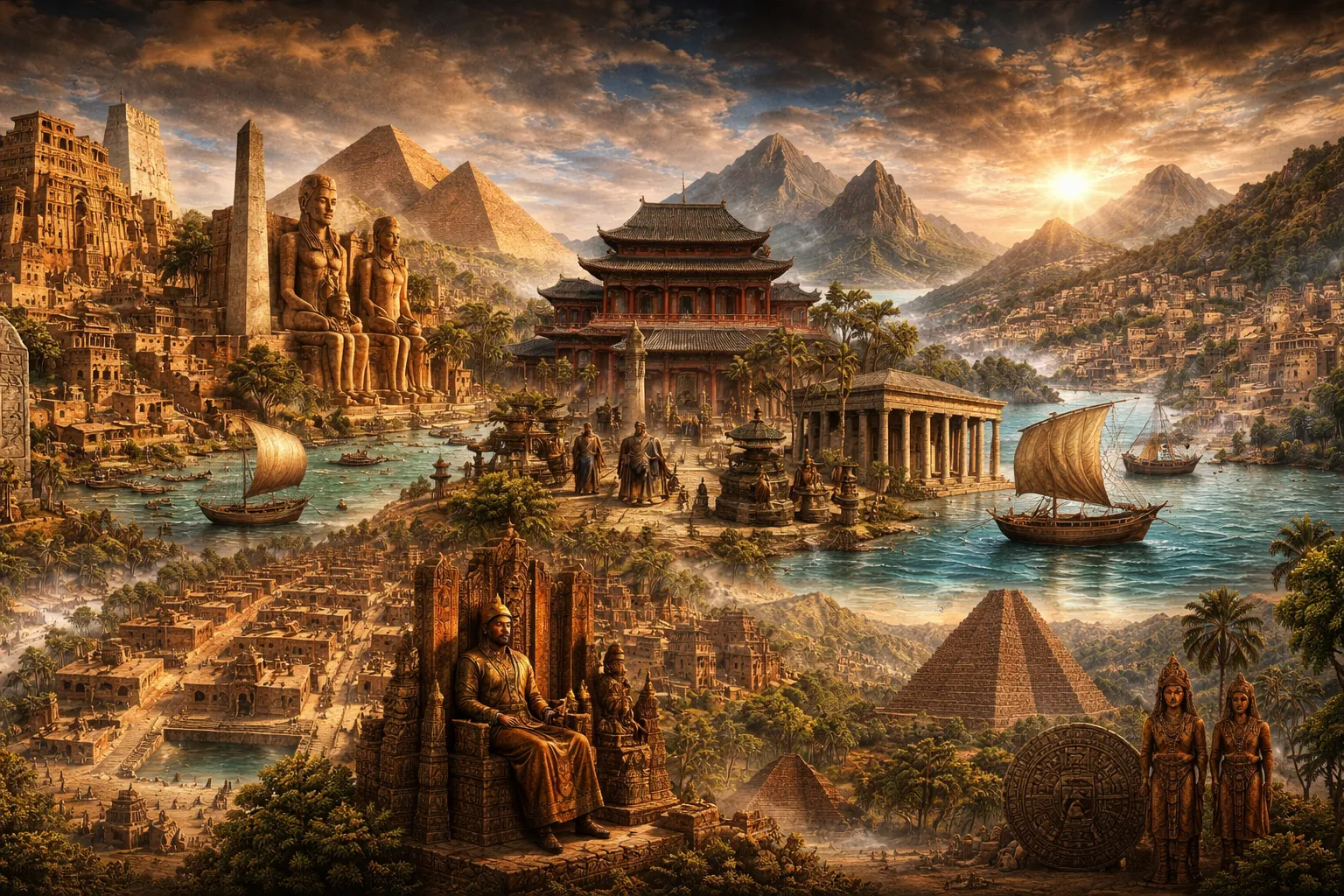
Finally, it must be remembered that there is no single ancient way of showing power. Mesopotamian, Egyptian, Persian, Greek, Roman, Indian, Chinese, ancient African, or ancient American traditions all develop different visual solutions.
The differences concern:
- the relation between sovereign and divine;
- the degree of idealization of the body;
- the use of monumentality;
- the place of inscription;
- the representation of war;
- the relation between center and peripheries;
- the broader or narrower diffusion of images of power.
We Must Therefore Compare Without Uniformizing
- certain functions are comparable;
- formal codes vary;
- political systems produce different iconographies;
- works must always be replaced in their own visual culture.
This diversity prevents ancient political art from being reduced to a single model.
Why This Chapter Is Essential
This chapter is essential because it shows that ancient art is not only made to believe, honor, or embellish. It also serves to govern. It constructs the visibility of command, organizes official memory, produces legible hierarchies, makes domination perceptible, and inscribes power into stone, metal, space, and objects.
Through this perspective, we better understand:
- why queens and kings are so often represented;
- why victory is a central theme;
- why monuments of power seek scale, duration, and effect;
- how mobile objects prolong political presence;
- why destroying an image may be an act of conquest or revolution.
To study art, power, and visual propaganda is therefore to understand how ancient societies make authority visible in order to make it stronger, more stable, and more memorable.
Essential Ideas to Remember
- ancient power needs to be seen;
- art serves to construct images of authority, victory, and legitimacy;
- hierarchy of scale, monumentality, inscriptions, and attributes make domination legible;
- monument, palace, statue, coin, and relief all participate in visual propaganda;
- official art produces an oriented political narrative;
- religion often reinforces the visual legitimation of power;
- images of power may also be erased, replaced, or reused.
Transition to the Next Chapter
Once we understand how ancient art stages power, another question becomes essential: how do ancient societies represent the human body, between idealization, hierarchy, identity, and presence?
The next chapter can therefore focus on the human body in ancient art.