Art, Cult, and the Invisible World
Introduction
After studying the materials, techniques, and major media of ancient art, we must now turn to one of its most fundamental domains: its link with the sacred. In a great many ancient civilizations, image, object, architecture, decoration, and form do not belong only to the human visible world. They also participate in the relationship between human beings and invisible powers: gods, goddesses, ancestors, spirits, cosmic forces, sacred principles, or protective powers.
One of the great modern misunderstandings is to look at ancient religious works as simple symbolic representations, or as illustrations of beliefs. Very often, they have a much stronger function. They do not serve only to show the divine: they also help make it present, honor it, provide it with a support for manifestation, organize the rite, structure sacred space, and inscribe the community within a living relationship to the invisible world.
The purpose of this chapter is therefore to show that ancient art, in its religious dimensions, cannot be reduced to an aesthetics of the sacred. It is often a cultic operator, a mediator between planes of the world, a support for ritual efficacy, and a language of presence. To study art, cult, and the invisible world is to understand that in Antiquity, seeing, showing, consecrating, honoring, and making present are deeply linked acts.
The Sacred Is Not Separate from Form
In many ancient worlds, there is no clear separation between image, rite, sacred place, offering, ritual speech, and divine presence. Visible form is not external to religious life: it is part of it. A divine statue, a cult relief, a funerary painting, a votive stele, a ritual mask, a precious object deposited in a sanctuary, or even certain decorative motifs may play an active role in the relationship to the sacred.
This means that the work must not be analyzed only as an “image of.” It may be:
- a support of presence;
- a consecrated object;
- an instrument of cult;
- a protection;
- a materialization of an invisible power;
- a mediation between humans and divinities;
- a symbolic center around which a rite is organized.
What Must Be Remembered
- ancient religion does not rest only on ideas or texts;
- it unfolds through material forms;
- the image is not always conceived as a simple representation;
- the beauty, matter, scale, and placement of a work may all participate in its sacred efficacy.
Ancient sacred art therefore does not merely decorate religion: it acts within it.
Representing or Making Present?
One of the most important questions for understanding ancient religious art is the following: does the image serve to represent a divinity, or to make it present? The answer varies according to cultures, contexts, and uses, but in many cases, the second dimension is essential.
A divine image may be conceived not only as the appearance of a god, but as:
- a place of manifestation;
- a point of contact;
- a ritual support;
- a form invested with power;
- a stabilized presence in a sanctuary or rite.
This does not mean that the object “is” mechanically the divinity in the simplest sense. Oversimplifications must be avoided. But we must understand that, in many ancient traditions, the relationship between image and presence is much stronger than in a modern conception in which the image would be only a visual sign detached from what it signifies.
This Distinction Changes Everything
- the statue is no longer seen only as a plastic work;
- it becomes easier to understand why it must be consecrated, clothed, washed, carried, or honored;
- it also becomes clearer why its destruction, capture, or profanation may have immense religious and political significance.
The cult image may therefore be less an imitation of the divine than an anchoring point of its power.
The Divine Statue: Visible Body of an Invisible Power
In many ancient civilizations, the divine statue occupies a central place. It gives form to what would otherwise remain difficult to grasp within human space. It does not necessarily make the god visible in its absolute essence, but it offers the god a readable, locatable, and honored presence.
The divine statue may be:
- monumental or modest;
- fixed in a sanctuary or at times mobile in a procession;
- made of stone, wood, metal, clay, or composite materials;
- adorned with garments, jewelry, crowns, or attributes;
- associated with an altar, a cella, offerings, and a specific architecture.
Frequent Functions of the Divine Statue
- receiving honors;
- marking the presence of the god in a place;
- centralizing ritual;
- serving as a focal point for procession or festival;
- protecting a city, a temple, or a community;
- making visible a hierarchy of the sacred world.
In some cases, the statue is kept in a reserved interior space. In others, it appears publicly on certain occasions. Its accessibility or withdrawal participates in its power.
What Must Be Remembered
- the divine statue is not a simple illustration;
- it organizes the space of worship;
- it may be treated as a being endowed with a form of presence;
- its material, scale, posture, and placement are essential.
The Ritual Object: When Art Enters Cultic Action
Ancient religious art is not limited to statues. Very many objects participate in ritual action:
- offering vessels;
- censers;
- lamps;
- libation instruments;
- altars;
- standards;
- masks;
- processional objects;
- sacred chests;
- ritual textiles;
- priestly insignia;
- cult furniture.
These objects are not merely utilitarian. Their form, decoration, material, and handling fully participate in the rite. A censer in precious metal, a decorated cup, an engraved altar, or an elaborately made lamp produces sensory effects that reinforce the solemnity, hierarchy, and sacred quality of the gesture.
The Ritual Object May Serve To
- offer;
- purify;
- burn;
- illuminate;
- consecrate;
- contain;
- transport;
- manifest the dignity of the cult;
- structure the stages of the rite.
The history of ancient art must therefore fully include these objects of action, not only the great monumental images.
The Sanctuary: A Space Shaped for the Invisible
The invisible world is not evoked only by objects; it is also organized spatially. The sanctuary, the temple, the sacred place, or the ritual tomb are not simple containers. They are themselves symbolic constructions intended to make possible a particular relationship between humans and invisible powers.
Sacred space may include:
- a marked entrance;
- a progression toward a more reserved zone;
- an altar;
- a divine statue;
- offering rooms;
- votive deposits;
- inscriptions;
- protective motifs;
- a meaningful orientation;
- spaces for ritual circulation.
Why Sacred Architecture Is Essential
- it hierarchizes access;
- it separates the profane from the consecrated;
- it guides bodies and gazes;
- it stages the approach to the divine;
- it frames the presence of image and offering;
- it durably inscribes the cult into the territory.
The sacred place is therefore not a simple setting for the image. It is part of the religious mediation itself.
Offering an Image, Offering an Object: The Votive Gesture
In Antiquity, many religious works are offered. A figurine, plaque, stele, small statue, jewel, vessel, or symbolic object may be deposited in a sanctuary as an offering. This votive gesture links the object, the donor, the sacred place, and the honored power.
The votive object may answer several intentions:
- thanking a divinity;
- asking for a favor;
- fulfilling a vow;
- marking piety;
- leaving a trace of oneself in the sanctuary;
- testifying to a healing, protection, or salvation received.
Why Offering Matters for Art History
- it shows that the work may itself be an act;
- it reveals small-scale religious forms;
- it makes visible the social diversity of sacred objects;
- it links artistic production, devotion, and memory.
The ancient sanctuary is not populated only by great official works. It may also accumulate a multitude of votive objects that make visible the concrete density of the relationship to the divine.
Funerary Art and Relationships with the Dead
The ancient invisible world is not limited to the gods. It also includes the dead, the ancestors, the powers of the afterlife, protective or feared spirits. Funerary art plays a major role here, because it makes it possible to organize the relationship between the living and the dead.
Tombs, sarcophagi, wall paintings, stelae, funerary masks, effigies, objects deposited beside the deceased, and architectural arrangements are not merely memorial. They may also:
- protect the passage to the afterlife;
- ensure a form of symbolic survival;
- accompany the dead;
- maintain a link between the deceased and their lineage;
- stage a vision of the other world;
- mark the status of the departed.
The Funerary Image May Seek To
- preserve a face;
- idealize the deceased;
- present them in a ritual setting;
- affirm their dignity or rank;
- inscribe their name into duration;
- protect their memory and their becoming.
Funerary art therefore shows that the ancient image also acts within relations to the invisible of the dead.
Ancestors, Memory, and the Presence of the Absent
In several ancient worlds, ancestors are not simply dead people of the past. They remain, in one way or another, present in the life of the group. They may be honored, invoked, feared, symbolically nourished, consulted, or integrated into the identity of a lineage, a household, or a power.
Art may then serve to:
- make ancestors visible;
- stabilize their place in domestic or cult space;
- manifest family or dynastic continuity;
- maintain an active memory;
- connect the past of the dead with the present of the living.
This May Take the Form Of
- portraits;
- tablets;
- stelae;
- domestic altars;
- inscriptions;
- objects linked to ancestor cult;
- funerary decorations reactivated regularly.
The link between art and ancestors reminds us that the ancient invisible world is also a world of active memory.
The Visible as a Threshold Toward the Invisible
Ancient religious art often operates according to a logic of threshold. What is visible does not matter only for itself: it opens toward something else. The image, the statue, the motif, the space, or the object are not self-sufficient. They orient toward something beyond the visible.
This logic can be read in several elements:
- strong frontality;
- symmetry;
- monumentality;
- hierarchy of scale;
- light;
- brilliant materials;
- elevated placement;
- gradual access;
- combination of text and image;
- repetition of protective or sacred signs.
Why This Logic Is Important
- it shows that form is not purely decorative;
- it produces an experience of approach, respect, and sometimes fear;
- it helps us understand works that do not seek realism in the modern sense;
- it links aesthetics, ritual, and cosmology.
The work may thus appear as a passage between two orders of the world.
The Role of Inscriptions and Signs
In many sacred contexts, the image is not alone. It is accompanied by inscriptions, divine names, dedications, prayers, formulas, or protective signs. These textual or symbolic elements are not secondary: they strengthen, specify, or activate the meaning of the object.
An inscription may:
- identify the divinity or the dedicator;
- fix an offering;
- make devotion public;
- consecrate the object;
- inscribe a lasting memory;
- bind speech to the visible.
The Association of Text and Image Makes It Possible To
- unite visual form and ritual utterance;
- stabilize the sacred status of the work;
- reinforce symbolic efficacy;
- make the object a support of memory and presence.
The ancient invisible world therefore also passes through writing, the name, and the formula.
Showing, Hiding, Revealing
Not all ancient sacred images are made to be seen permanently by everyone. Some are publicly displayed, others reserved for interior spaces, and still others appear only at certain moments of the ritual. Visibility is therefore itself a religious issue.
A Sacred Work May Be
- constantly visible;
- visible only to certain categories of people;
- shown during a festival or procession;
- hidden in an interior space;
- covered, dressed, or veiled;
- revealed only occasionally.
This management of visibility has several functions:
- reinforcing sacred character;
- producing distance;
- hierarchizing access;
- distinguishing the common from the reserved;
- giving revelation a particular force.
The history of ancient religious art must therefore take into account not only what one sees, but also what one does not always see.
Cult as Sensory Performance
The relationship to the invisible world in Antiquity does not pass only through sight. It also mobilizes:
- smell through incense, smoke, and oils;
- hearing through songs, prayers, instruments, processions;
- touch through ritual handling, textiles, objects;
- sometimes taste through offerings and sacred meals;
- perception of movement, light, warmth, and crowd.
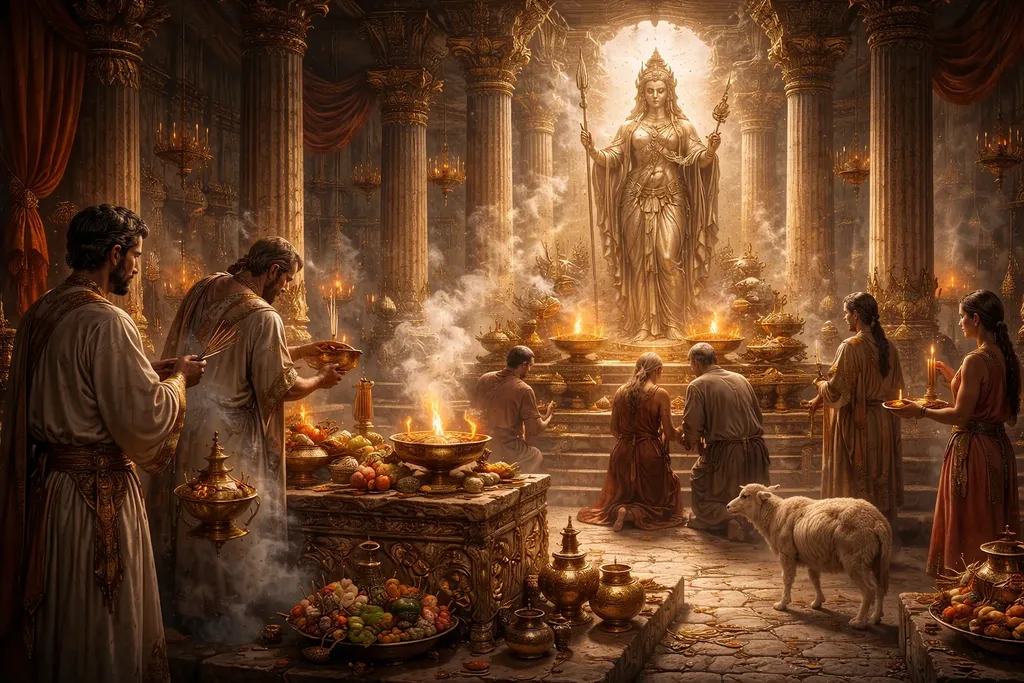
The religious work must therefore be placed back into a broader sensory experience. A statue lit by flames, surrounded by smoke, clothed in fabrics, accompanied by chants and offerings, does not produce the same effect as an isolated object in a modern display case.
What This Implies
- cult art is often multisensory;
- the object or image functions within a ritual performance;
- modern, silent, museum perception does not exhaust the meaning of the work;
- the ancient sacred is also a matter of atmosphere, rhythm, repetition, and collective presence.
Diversity of Religious Traditions
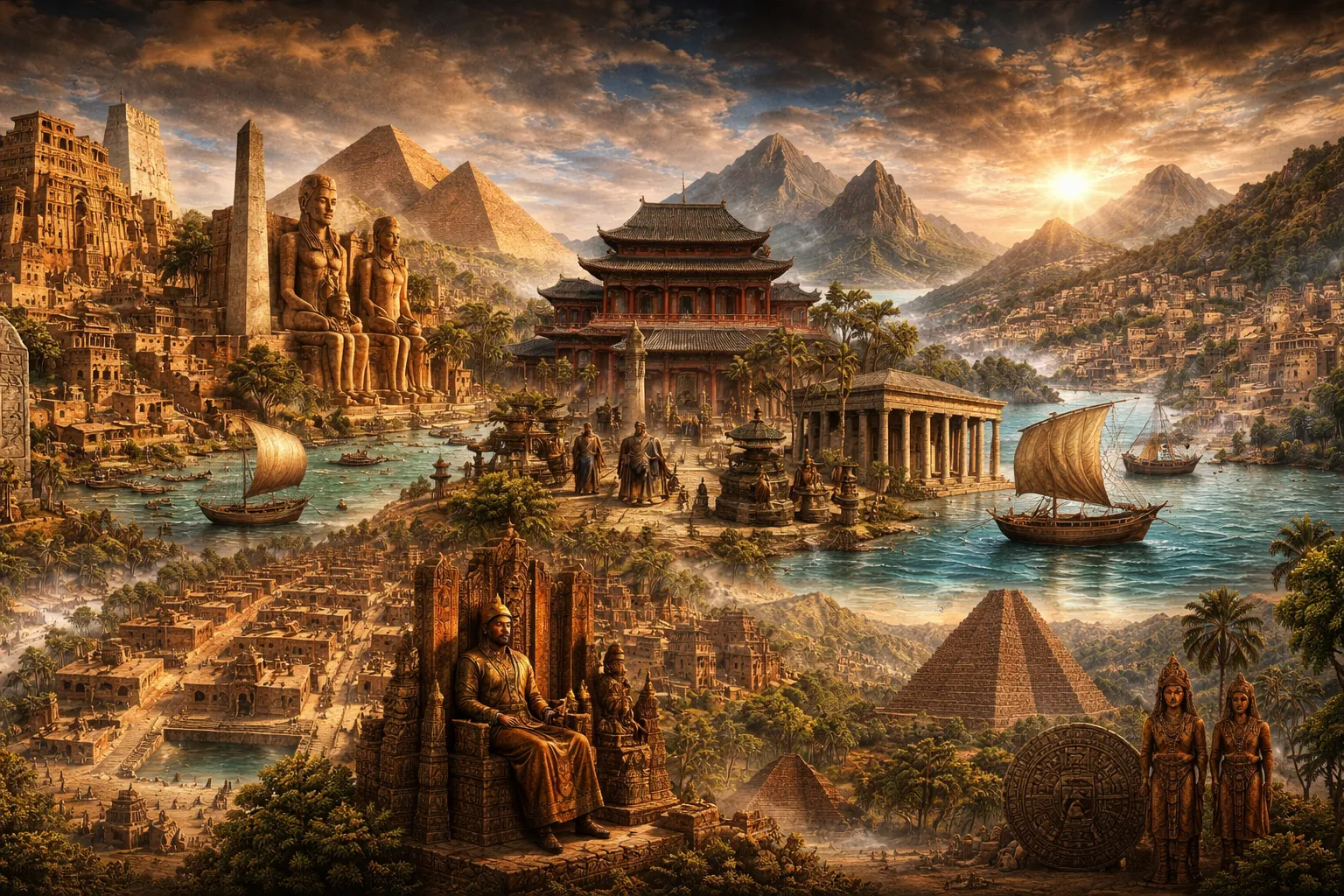
One essential point must be emphasized: there is no single ancient way of linking art and the invisible world. Mesopotamian, Egyptian, Greek, Roman, Persian, Indian, Chinese, ancient African, or ancient American traditions do not produce the same images, do not conceive the same relations between presence and representation, and do not organize the sacred in the same way.
However, comparable questions often recur:
- how to give form to the invisible;
- how to make a place sacred;
- how to inscribe rite into matter;
- how to articulate image, speech, offering, and space;
- how to distinguish the common from the consecrated;
- how to associate art with religious efficacy.
We Must Therefore Compare Without Uniformizing
- functions may resemble one another without systems of thought being identical;
- visual forms may vary greatly;
- materials and ritual gestures change according to cultures;
- the relation between image and sacred power is never universally identical in degree.
This caution makes it possible to respect the real diversity of the ancient worlds.
Why This Chapter Is Essential
This chapter is essential because it shows that ancient art cannot be understood only through taste, style, or form. It is also necessary to understand what the image does, what the object activates, what sacred space organizes, and what the rite makes possible.
Through this perspective, we better understand:
- why certain works are monumental and others manipulable;
- why divine images have such a particular status;
- why offering, tomb, sanctuary, and cult are major sites of artistic production;
- why the destruction or displacement of an image may have immense significance;
- how the ancient visible opens toward an invisible order.
To study art, cult, and the invisible world is therefore to understand that ancient religious works are not simple objects of belief, but active mediations between humans and what exceeds the ordinary world.
Essential Ideas to Remember
- in Antiquity, religious art often directly participates in the relationship with the invisible;
- the sacred image serves not only to represent, but often to make present;
- the divine statue, the ritual object, the offering, and the sanctuary form a coherent whole;
- funerary art and ancestor cult show that the invisible also concerns the dead;
- the visibility of works may be controlled, graduated, or ritualized;
- cultic experience is multisensory and cannot be reduced to sight alone;
- there is a great diversity of ancient religious traditions, which must be compared without being uniformized.
Transition to the Next Chapter
Once the role of art in cult and in the relationship to the invisible world has been understood, a new question becomes central: how do ancient works serve to stage power, grandeur, victory, and political authority?
The next chapter can therefore focus on art, power, and visual propaganda.