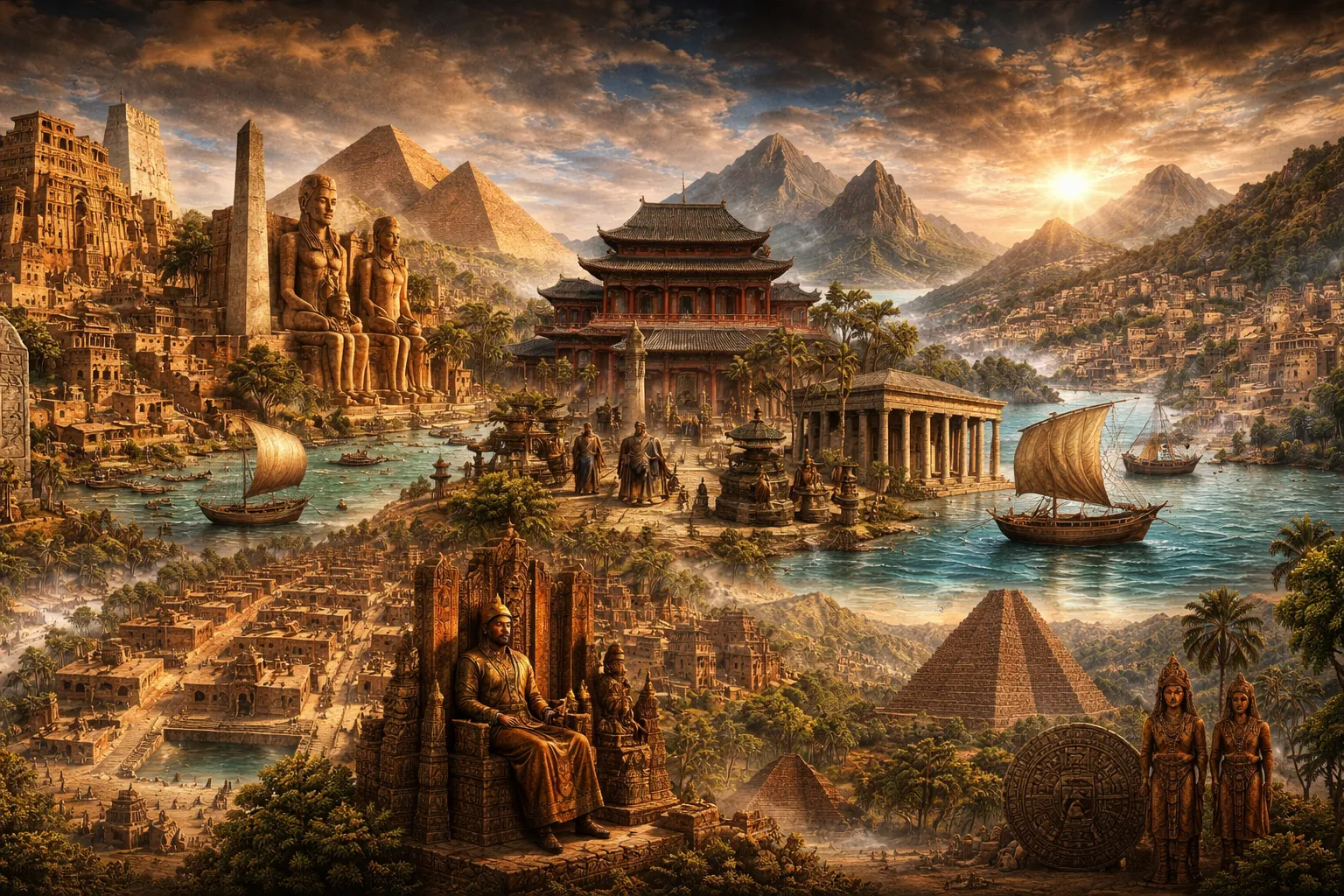
Materials, Techniques, and Major Media of Ancient Art
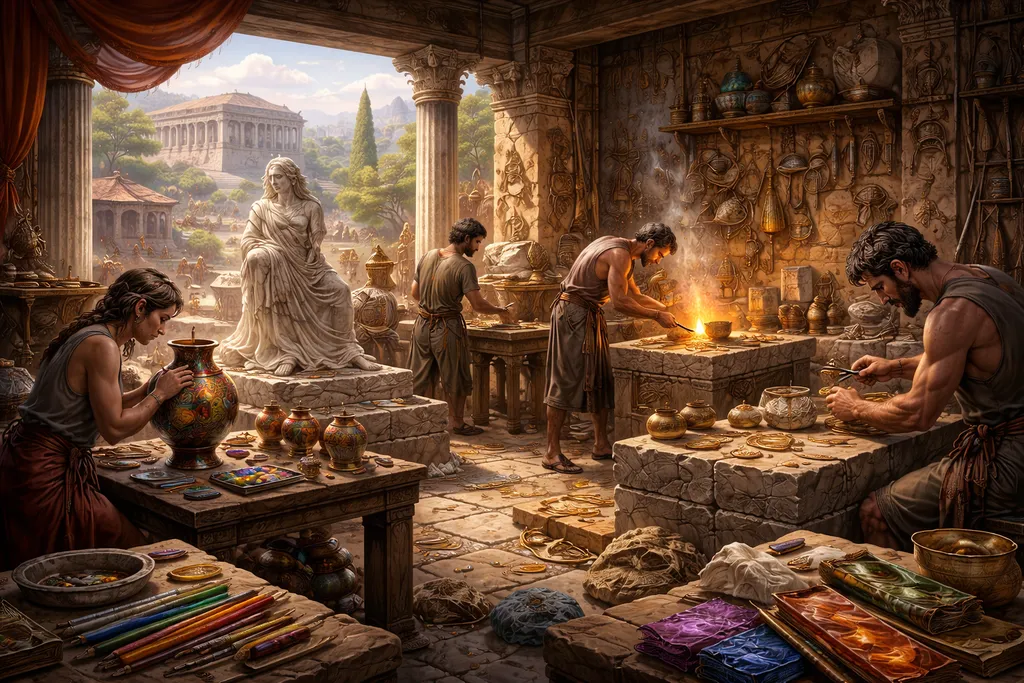
Introduction
After defining what art can mean in Antiquity, we must now enter into its concrete making. Ancient works are not only forms or images: they are also worked materials, transmitted gestures, mastered techniques, used tools, chosen supports, and overcome constraints. Any history of art that forgot this material dimension would miss the essential point, because in the ancient worlds, form always arises from a close relationship between intention, function, material, and know-how.
Studying materials and techniques makes it easier to understand why certain works have a given appearance, scale, durability, color, or symbolic value. The choice of stone, clay, wood, bronze, gold, ivory, pigments, glass, or textile is never neutral. It involves questions of cost, availability, prestige, function, commercial circulation, ritual context, and technical possibilities. In the same way, painting, modeling, casting, weaving, engraving, building, or polishing do not produce the same visual effects or the same uses.
The purpose of this chapter is therefore to show that ancient art is inseparable from its materiality. It is not simply a matter of listing materials or processes, but of understanding how each medium opens certain possibilities, imposes certain limits, and participates in the very meaning of the work. In that sense, materials and techniques do not come after art: they are a constitutive part of it.
Why Is Materiality So Important?
In ancient art, matter is not a simple passive support. It is an integral part of the work. It determines its appearance, resistance, mobility, rarity, price, symbolic value, place within a specific use, and sometimes even its religious or political effectiveness. A painted wooden statue does not act like a marble statue. A relief carved in stone does not have the same presence as an image painted on a wall. A decorated ceramic cup is not read in the same way as a vessel made of precious metal.
Materiality is important because it makes it possible to understand:
- what the society knows how to produce technically;
- which materials it values;
- which supply networks it mobilizes;
- which functions it assigns to objects;
- which hierarchies it establishes between works;
- how it articulates the durable, the precious, the useful, and the sacred.
What a Material Approach Reveals
- the level of technical mastery;
- the conditions of production;
- the social status of the object;
- the relationship between art and economy;
- the circulation of raw materials;
- the link between material and symbolism.
The history of ancient art must therefore also be a history of transformed materials.
Stone: Duration, Monumentality, Prestige
Stone occupies a major place in many ancient worlds, especially in architecture, sculpture, reliefs, stelae, sarcophagi, inscriptions, and certain forms of monumental furniture. It is often associated with durability, memory, prestige, and power.
Not all types of stone are equal. Depending on the regions and uses, people employed:
- limestone;
- sandstone;
- basalt;
- alabaster;
- granite;
- marble;
- local stones of varying hardness.
The choice depends on several factors:
- regional availability;
- ease or difficulty of carving;
- resistance;
- color;
- possible polish;
- cost of extraction and transport;
- symbolic or prestigious value.
What Stone Makes Possible
- building for the long term;
- monumentalizing a space;
- engraving texts or images;
- producing statues or reliefs;
- associating the work with an idea of permanence;
- making visible the power of a regime or a cult.
But stone also imposes constraints:
- weight;
- transport cost;
- difficulty of implementation;
- high labor time;
- dependence on quarries and specialized labor.
Stone is therefore a material of grandeur, but also of collective organization.
Clay and Ceramics: A Fundamental Medium
Clay is one of the most fundamental materials of Antiquity. Very widespread, relatively accessible, and transformable through modeling and then firing, it was used to produce a huge variety of objects:
- tableware;
- amphorae;
- bricks;
- figurines;
- writing tablets;
- decorative elements;
- votive objects;
- tiles;
- funerary urns.
Ceramics are essential because they stand at the crossroads of several dimensions:
- everyday use;
- specialized artisanal production;
- decoration and iconography;
- commercial circulation;
- archaeological memory.
In many regions, ceramics now constitute a major source for understanding styles, exchanges, workshops, and social practices, because they are often preserved better than other materials.
What Clay Makes Possible
- abundant production;
- varied forms;
- domestic, religious, or funerary uses;
- painted, incised, or modeled decorations;
- a support for writing in certain civilizations;
- broad diffusion among different social strata.
Clay shows that an accessible material can produce objects of very great formal and symbolic richness.
Wood: Strong Presence, Fragile Preservation
Wood occupied a much more important place in ancient art than the preserved remains sometimes suggest. Its fragility largely explains its low survival rate. Yet it was widely used for:
- architectural elements;
- frameworks;
- doors;
- furniture;
- statues;
- boats;
- ritual objects;
- painted supports;
- instruments;
- chests and decorative elements.
Wood has valuable qualities:
- availability in certain regions;
- relative ease of working;
- lightness;
- possibility of fine carving;
- suitability for mobile objects.
But it is also vulnerable:
- to fire;
- to humidity;
- to insects;
- to rot;
- to reuse.
What Must Be Remembered About Wood
- it was often more present than we imagine;
- its disappearance sometimes biases our vision of ancient art;
- it allowed flexible, mobile, and sometimes painted forms;
- it participated both in architecture and in sculpture and the arts of daily life.
The history of ancient art must therefore include vanished materials as much as those that have survived.
Metals: Power, Shine, and Virtuosity
Metals play a central role in ancient art, whether for weapons, tools, jewelry, vessels, statues, ritual elements, or certain monumental decorations. Bronze, gold, silver, copper, iron, electrum, or various alloys make possible different effects depending on use.
Metal is distinguished by several qualities:
- brilliance;
- economic value;
- ability to be cast or hammered;
- possible precision;
- relative strength;
- high prestige in certain contexts.
Frequent Uses of Metals
- statues;
- figurines;
- ceremonial weapons;
- ornaments;
- precious vessels;
- cult objects;
- decorative plaques;
- coins;
- seals;
- accessories of power.
Metal nevertheless requires advanced technical skills:
- extraction;
- alloying;
- melting;
- molding;
- hammering;
- chasing;
- polishing;
- sometimes gilding or inlaying.
What Metalwork Reveals
- high artisanal specialization;
- complex supply networks;
- strong prestige value;
- a link between art, wealth, and technique;
- the capacity to produce works that are both precious and visually powerful.
Ancient metal thus unites visual brilliance, symbolic value, and technical mastery.
Gold, Silver, and Precious Materials
Among metals, gold and silver occupy a special place. They do not serve only to produce beautiful objects: they mark power, wealth, proximity to the sacred, and sometimes the exceptional nature of a ritual or dynastic use. Their rarity reinforces their symbolic function.
These materials may appear in:
- crowns;
- masks;
- jewelry;
- prestige vessels;
- elements of statues;
- votive objects;
- funerary ornaments;
- temple treasures;
- emblems of power.
They are often associated with:
- light;
- incorruptibility;
- power;
- high rank;
- divine favor;
- prestigious memory.
But It Must Also Be Noted
- their possible remelting or recovery;
- their circulation as portable wealth;
- their vulnerability to plunder;
- their relative archaeological rarity compared with their past importance.
Precious materials clearly show that ancient artistic value cannot be separated from logics of prestige, economy, and sacrality.
Ivory, Bone, Mother-of-Pearl, and Rare Materials
Ancient art is not limited to great monumental materials. Many works, or parts of works, were made on a smaller scale in rarer or more precious materials:
- ivory;
- bone;
- shell;
- mother-of-pearl;
- horn;
- semi-precious stones;
- glass paste;
- various inlays.
These materials often make possible:
- fine decoration;
- luxury objects;
- precious details;
- plays of texture and color;
- combinations with other materials.
They Appear Especially In
- chests;
- furniture;
- prestige weapons;
- ornaments;
- cult objects;
- refined architectural elements;
- inlays in statues or prestigious objects.
These materials show that ancient art also values contrasts, assemblages, and effects of refinement.
Pigments, Color, and Polychromy
One of the great misunderstandings about ancient art comes from the fact that many works have reached us faded, fragmentary, or deprived of their original appearance. Yet color occupied a major place in many ancient worlds. Sculptures, architecture, reliefs, ceramics, textiles, ritual objects, and paintings were often vividly colored.
Pigments may be of:
- mineral origin;
- vegetal origin;
- animal origin;
- synthetic origin in certain ancient processes.
They are applied to different supports:
- wall;
- stone;
- wood;
- plaster;
- fabric;
- ceramic;
- prepared skin;
- various objects.
Color Serves To
- make the image more visible;
- distinguish the parts of a composition;
- reinforce the presence of the divine or of power;
- produce symbolic effects;
- enrich visual narration;
- increase luxury and brilliance.
What Must Be Remembered
- ancient art is often polychrome;
- our modern gaze sometimes underestimates this dimension;
- the loss of colors profoundly alters the perception of works;
- color is not a secondary addition, but a constitutive element of form.
Understanding ancient polychromy is essential if we want to recover the visual vitality of works.
Wall Painting: Image, Decoration, and Space
Wall painting is an important medium in several ancient civilizations. It may appear in:
- temples;
- palaces;
- tombs;
- houses;
- ceremonial buildings;
- public or private spaces.
It has several advantages:
- covering large surfaces;
- integrating image and architecture;
- producing atmospheres;
- staging narratives;
- magnifying a space;
- accompanying ritual or memory.
Techniques vary according to regions, supports, and traditions, but they often involve:
- preparation of the wall;
- application of plasters;
- drawing;
- coloring;
- organization of more or less complex compositions.
Frequent Functions of Wall Painting
- decorate;
- sacralize;
- narrate;
- honor;
- commemorate;
- hierarchize space.
Wall painting shows that the ancient work may be inseparable from an entire architectural environment.
Sculpture: In the Round, Relief, Presence
Sculpture is one of the great media of ancient art. It may be monumental or small-scale, in stone, wood, metal, clay, or composite materials. It takes varied forms:
- statue in the round;
- relief;
- sculpted stele;
- sculpted architectural element;
- votive figurine;
- funerary object;
- portrait;
- divine image.
Sculpture is distinguished by its capacity to produce a strong presence. Even when it does not seek naturalism, it occupies space, imposes a scale, marks a hierarchy, and creates a physical relationship with the viewer.
What Sculpture Makes Possible
- embodying a divine or human figure;
- monumentalizing memory;
- affirming an authority;
- materializing the sacred;
- organizing facades or pathways;
- producing a relationship between image and space.
Major Sculptural Stakes
- frontality or movement;
- idealization or individualization;
- relation to the support;
- treatment of body, clothing, and attributes;
- possible polychromy;
- relation between mass and detail.
Ancient sculpture is therefore a medium of presence, hierarchy, and memory.
Relief: Between Image and Architecture
Relief deserves particular attention because it often lies between sculpture and architectural surface. Engraved or carved on stone, metal, wood, or other supports, it makes it possible to combine:
- narration;
- visual hierarchy;
- decoration;
- inscription;
- commemorative function;
- articulation with a wall, a stele, or a monument.
Relief is particularly suited to:
- narrating a victory;
- representing a rite;
- showing a sovereign;
- depicting a procession;
- marking a tomb;
- associating text and image.
Why Relief Is So Important
- it integrates the image into architecture or the monument;
- it allows sequential reading;
- it easily hierarchizes figures;
- it combines memory, power, and decoration.
Ancient relief is therefore a first-rate narrative and political medium.
Painted Ceramics: Mobile Image and Social Object
Painted ceramics deserve to be distinguished as a major artistic medium in their own right. They are not merely a category of decorated utilitarian objects. In several ancient worlds, they constitute a major support for:
- symbolic motifs;
- mythological narratives;
- banquet scenes;
- human or animal figures;
- workshop marks;
- signs of prestige or cultural identity.
Their particularity is that they combine:
- mobility;
- concrete use;
- broad diffusion;
- iconographic richness;
- relative reproducibility;
- social value.
What Painted Ceramics Show
- the importance of workshops;
- the link between art and everyday life;
- the circulation of forms and motifs;
- the possibility of a non-monumental narrative art;
- a wider social diffusion than certain prestigious materials.
Painted ceramics remind us that the history of ancient art is not limited to great statues and great monuments.
Textile: A Major Art Too Often Underestimated
Textiles have often disappeared, but they occupied a considerable place in ancient societies. Weavings, embroideries, dyes, ceremonial garments, hangings, veils, ritual fabrics, and flexible decorations fully participated in visual culture.
Textiles are important because they combine:
- color;
- motif;
- flexibility;
- social status;
- use of the body;
- material wealth;
- mobility.
Textiles Serve To
- clothe and hierarchize;
- distinguish functions;
- accompany rites;
- decorate spaces;
- signal prestige;
- integrate color and motif into everyday life.
Why They Are Often Underestimated
- they preserve badly;
- art history long privileged stone and marble;
- their mobile or perishable character makes them less archaeologically visible.
Yet without them, we understand neither the color of ancient worlds, nor their relation to the body, nor an essential part of their visual refinement.
Glass, Mosaic, and Composite Surfaces
In certain contexts, glass and mosaic play an important role in ancient arts. Glass may be used for:
- containers;
- inlays;
- small precious objects;
- decorative elements;
- effects of translucency and color.
Mosaic, for its part, makes it possible to compose images or motifs out of assembled elements. It introduces another logic of medium:
- composition by fragments;
- strong relation to surface;
- integration into architecture;
- relative resistance;
- decorative richness.
What These Media Reveal
- the taste for effects of material and light;
- the mastery of complex assemblages;
- the link between decoration and inhabited space;
- the diversity of surface arts in Antiquity.
They show that the major ancient media are limited neither to stone nor to wall painting.
Techniques as an Intelligence of Gesture
Speaking of materials is not enough; techniques must also be understood. A technique is not merely a mechanical procedure. It is an intelligence of gesture, time, matter, tool, and intended result. Ancient artists and craftswomen or craftsmen had to know how to:
- choose;
- prepare;
- cut;
- polish;
- model;
- fire;
- melt;
- weave;
- paint;
- assemble;
- transport;
- install.
Each technique implies:
- accumulated experience;
- transmitted knowledge;
- trials and adjustments;
- adapted tools;
- sometimes a complex collective organization.
What Techniques Reveal
- the memory of workshops;
- the level of specialization;
- the relationship between body and matter;
- the temporality of making;
- practical inventiveness.
Ancient art cannot therefore be separated from the hand that produces it.
Tools, Workshops, and Production Chains
Ancient works are rarely born in complete isolation. They often involve workshops, teams, tools, and production chains. A large statue, a monument, a series of vases, a wall decoration, or a precious object may require:
- extraction or preparation of the material;
- transport;
- shaping;
- intervention of several specialists;
- finishing;
- installation or ritual placement.
Tools vary according to media:
- chisels;
- hammers;
- cutting tools;
- brushes;
- kilns;
- molds;
- spindles;
- looms;
- polishers;
- measuring instruments;
- casting and engraving tools.
What Must Be Remembered
- the ancient work is often the result of a collective process;
- technique implies a material organization;
- the workshop is a place of transmission, execution, and invention;
- the history of ancient art is also a history of labor.
Major Media and Their Own Logics
Each major medium of ancient art opens a particular relation to image, space, and audience.
Architecture
- structures space;
- organizes circulation;
- monumentalizes power or the sacred;
- acts at a collective scale.
Sculpture
- produces presence;
- hierarchizes;
- gives body to a figure;
- inscribes memory in space.
Relief
- narrates;
- orders;
- associates image and support;
- articulates decoration and power.
Painting
- colors;
- animates surfaces;
- accompanies narratives;
- transforms the atmosphere of a place.
Ceramics
- diffuses the image into everyday life;
- links use and representation;
- circulates easily.
Textile
- clothes body and space;
- introduces color and status;
- links decoration and mobility.
Metal and Precious Materials
- concentrate prestige, brilliance, and power;
- signal wealth and rarity;
- require a high level of mastery.
To understand media is therefore to understand different visual and social logics.
Materials and Techniques as Cultural Indicators
An ancient world is also recognizable through its material and technical preferences. Certain civilizations value more highly:
- monumental stone;
- brick and clay;
- precious metals;
- painted surfaces;
- refined textiles;
- mobile objects;
- great architectural complexes;
- arts of inlay or assemblage.
These choices depend on:
- the environment;
- available resources;
- religious traditions;
- political structures;
- commercial circuits;
- transmitted know-how;
- collective tastes.
What This Means
- technique is never purely neutral;
- materials tell the story of a civilization;
- favored media reveal values;
- artistic form is inseparable from the material conditions of its appearance.
Studying the materials and techniques of ancient art is therefore also reading a culture through what it knows how to make materially exist.
Why This Chapter Is Essential
This chapter is essential because it teaches us to look at works differently. It forces us no longer to see only an image or a form, but also:
- an extracted, transformed, transported material;
- a transmitted technique;
- a workshop;
- a cost;
- a function;
- a hierarchy of prestige;
- an intelligence of gesture.
Thanks to this approach, we better understand:
- why certain forms appear in certain materials and not in others;
- how technical constraints influence styles;
- why certain objects are rare, precious, or monumental;
- in what sense ancient arts are inseparable from concrete labor;
- how materiality fully participates in meaning.
To study the materials, techniques, and major media of ancient art is therefore to enter into the very thickness of artistic making.
Essential Ideas to Remember
- materials are never neutral in ancient art;
- stone, clay, wood, metal, textile, pigments, glass, and precious materials open different possibilities;
- each technique engages an intelligence of gesture, time, and matter;
- the major media of ancient art each have their own visual, social, and symbolic logics;
- polychromy and vanished materials must be taken seriously;
- the workshop, tools, and production chain are essential for understanding works;
- a civilization can also be read through the materials it values and the techniques it masters.
Transition to the Next Chapter
Once we understand with what materials and techniques ancient works were made, another question becomes central: how do these works act in the domain of the sacred, of cult, of gods, of ancestors, and of the invisible world?
The next chapter can therefore focus on art, cult, and the invisible world.