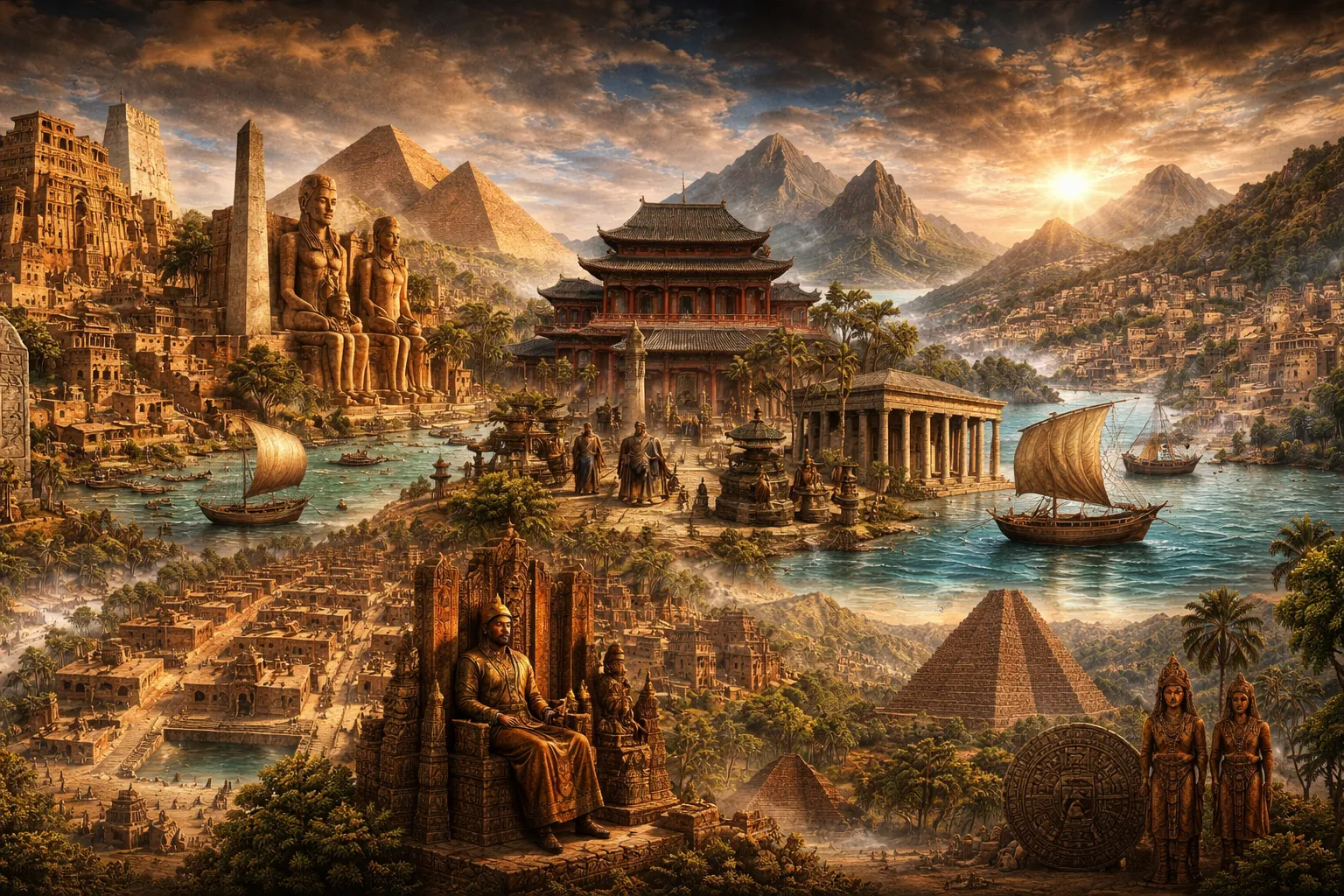
What Is Art in Antiquity?
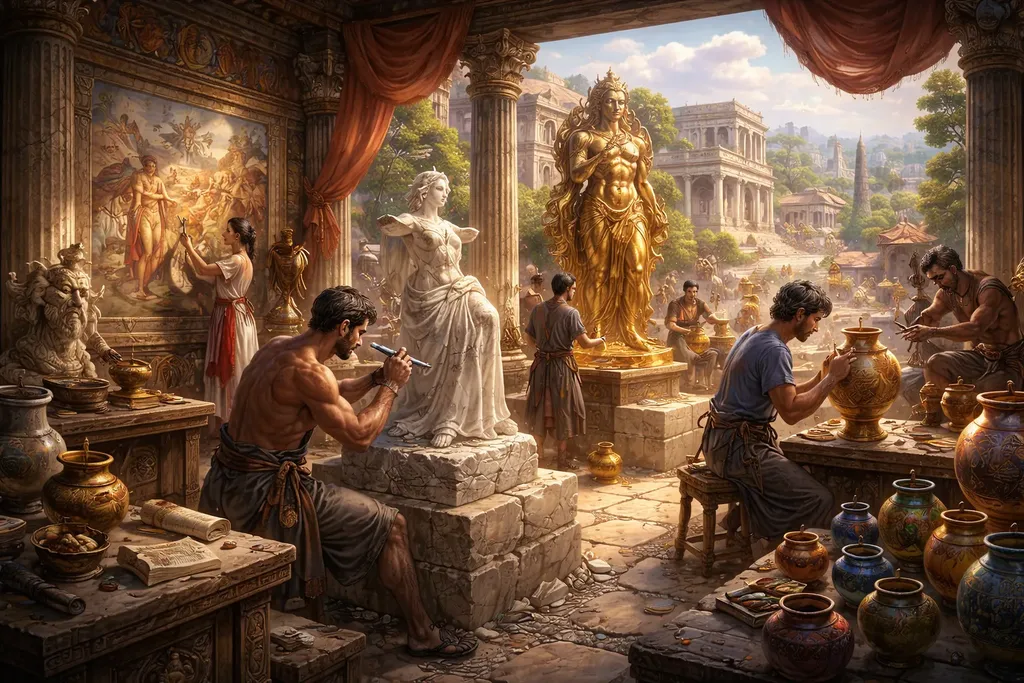
Introduction
After exploring Antiquity through the lenses of civilizations, powers, beliefs, exchanges, and knowledge, we must now enter more directly into art history. But a difficulty appears immediately: can we speak of “art” in Antiquity in the same way we do today? The answer requires caution. Ancient societies did indeed produce images, objects, monuments, decorations, forms, and remarkable works, but they did not always think about them through the same categories as ours.
In contemporary worlds, we often tend to distinguish between art, craft, architecture, religious objects, prestige objects, utilitarian objects, or visual propaganda. In Antiquity, however, these distinctions are much less clear. A statue may be at once a divine image, a ritual object, a sign of prestige, a manifestation of power, a technical feat, and a formal creation. A painted cup may be an object of use, a narrative support, a mark of refinement, and a workshop product. A temple may belong to architecture, religion, politics, decoration, and collective memory all at once.
The purpose of this chapter is therefore to establish an essential foundation for everything that follows: to understand that ancient art must not be studied only through modern categories. On the contrary, we must begin from its functions, its contexts, its uses, its patrons, its materials, its techniques, and its symbolic systems. In other words, before speaking of styles or works, we must first understand what “making art” means in the ancient worlds.
Can We Speak of “Art” in Antiquity?
The word “art” is convenient, but it can be misleading if used without caution. In many ancient societies, there is not necessarily an exact equivalent to the modern idea of an autonomous work of art, created mainly to be contemplated as such. Visual and material productions are often first linked to precise functions: honoring the gods, affirming an authority, accompanying the dead, marking rank, embellishing a place, transmitting a narrative, symbolically protecting a space, or displaying skill.
This does not mean that there is no formal research, taste, invention, or virtuosity. On the contrary, the ancient worlds show very strong attention to the quality of form, the power of images, the nobility of materials, the precision of gestures, and the effects of scale, color, rhythm, composition, and presence. But this pursuit is not necessarily isolated in an independent category called “art.”
What Must Be Avoided
- believing that ancient art is identical to modern art;
- believing that it exists only if it corresponds to our idea of beauty;
- artificially separating the work from its function;
- opposing art and craft too quickly;
- thinking that only works made to be admired “for free” belong to art.
What Must Be Remembered
- the word “art” can be used, but with caution;
- in Antiquity, form and function are often closely linked;
- a work may be religious, political, funerary, decorative, and technical at the same time;
- the history of ancient art must begin from uses as much as from appearances.
The Ancient Work Is Almost Never “Autonomous”
One of the major gaps between our modern categories and the ancient worlds lies in the question of the autonomy of the work. Today, we often value the idea of an independent work of art, displayed for itself, separated from immediate use. In Antiquity, this autonomy is much rarer or much less relevant.
An image, a relief, a statue, a vase, a jewel, a piece of furniture, a fresco, or a building is almost always inscribed within a context of use:
- a sanctuary;
- a tomb;
- a palace;
- a civic space;
- a house;
- a ceremony;
- a diplomatic exchange;
- an offering;
- a celebration of victory;
- a funerary practice.
This profoundly changes the way works must be analyzed. It is not enough to ask: “is it beautiful?” or “what is the style?” We must also ask:
- where was the object located;
- who saw it;
- in what situation;
- for what use;
- with what religious, political, or social charge;
- with what intended effect.
An Ancient Work May Be Conceived To
- be seen by the gods;
- be handled in a rite;
- accompany a dead person;
- impress a population;
- magnify a power;
- protect symbolically;
- indicate a social status;
- serve in a banquet or ceremony;
- preserve the memory of an event or a lineage.
The history of ancient art must therefore always place the object back into its world of action.
Art, Craft, Technique: A Modern Separation
In modern approaches, we often distinguish the artist from the craftswoman or craftsman, the noble work from the manufactured object, creation from technical execution. In the ancient worlds, these separations are often less rigid. Work on form is often inseparable from deep technical knowledge. Beauty, precision, the rarity of the material, symbolic effectiveness, and mastery of gesture belong to the same horizon.
To sculpt, paint, engrave, weave, cast, build, polish, ornament, or assemble requires considerable skills. Workshops are places where know-how is transmitted, models are repeated, commissions are adapted, but also where invention occurs. We must therefore not oppose creation and fabrication as if the second prevented the first.
Why This Separation Must Be Questioned
- a technically complex object may have very strong aesthetic value;
- an architectural decoration is also a work of conception;
- a painted ceramic is at once a useful object and an iconographic support;
- an ornament may be at once artisanal, symbolic, and visually elaborate;
- a workshop may produce series while still leaving room for variation and formal quality.
What Must Be Remembered
- ancient art is often inseparable from craft;
- technical virtuosity is part of the value of the work;
- ancient craftsmanship must not be treated as a minor domain;
- the categories of “fine arts” and “applied arts” are late and must not be mechanically projected backward.
Function First? Yes, but Not Only
It is often said that ancient art is primarily functional. This is true, but the formula must be handled carefully. A function does not cancel out formal research; it gives it a framework. A cult statue has a religious function, but that does not prevent work on posture, scale, materials, frontality, color, or the expression of presence. A cup used in a banquet has a practical function, but that does not prevent very rich iconographic elaboration.
Two opposite mistakes must therefore be avoided:
- reducing the ancient work to its utility;
- forgetting its function in order to see only an abstract form.
The real interest lies precisely in thinking together:
- use;
- material;
- form;
- meaning;
- context;
- produced effect.
The Same Work May Fulfill Several Functions
- religious;
- political;
- social;
- ceremonial;
- decorative;
- memorial;
- didactic;
- funerary;
- diplomatic.
Ancient art is therefore often multifunctional. It is this multiplicity that gives it a great part of its richness.
The Role of the Patron: Who Wants the Work, and Why?
In Antiquity, works are very often linked to a commission. This means that they respond to a precise expectation. The patron may be:
- a ruler;
- an elite;
- a temple;
- a civic institution;
- a family;
- a community;
- an individual offering an object to a god or to the dead.
The role of the patron is essential because it shapes:
- the subject;
- the material;
- the scale;
- the place of installation;
- the quality of execution;
- the function of the work;
- the message it must transmit.
A royal monument does not involve the same stakes as a votive figurine. An aristocratic tomb does not have the same ambitions as a domestic object. A palace decoration does not respond to the same logics as a funerary relief or a seal.
Why Commission Matters So Much
- it inscribes the work in a relation of power;
- it links the object to a precise intention;
- it shows that the work responds to a social or symbolic need;
- it helps us understand the status of the object in its society;
- it sheds light on the relationship between artistic production and hierarchies.
To study ancient art is therefore also to study the expectations that bring it into being.
The Artist in Antiquity: Creator, Specialist, Executor
The modern figure of the artist as an individual genius cannot be applied as such to all ancient worlds. This does not mean that there were no strong individualities, reputations, recognized masters, or signatures in certain contexts. But very often, production is thought of more within the framework of:
- the workshop;
- the craft;
- the commission;
- the tradition;
- technical transmission;
- collective work.
The ancient artist may be highly skilled without necessarily occupying the same symbolic status as that granted to the artist in modern societies. In some cases, the producer’s name is unknown to us. In others, on the contrary, certain figures stand out strongly. We must therefore avoid overly rapid generalizations.
What Must Be Taken Into Account
- the social status of the producer varies according to societies;
- work may be collective rather than individual;
- technical mastery is often more important than originality in the modern sense;
- tradition and model do not prevent invention;
- anonymity does not mean absence of quality or formal thought.
The history of ancient art must therefore pay as much attention to workshops and production chains as to exceptional individuals when they can be perceived.
The Major Contexts of Ancient Art
To understand what art is in Antiquity, several major contexts of production and use must be distinguished. These contexts are not airtight, but they help us read works more clearly.
1. The Religious Context
Works serve to:
- honor the gods;
- make a divine power present;
- accompany ritual;
- sacralize a space;
- materialize an offering;
- connect humans with the invisible world.
2. The Political Context
Works serve to:
- show power;
- legitimize the ruler;
- affirm the memory of a victory;
- embody the continuity of a dynasty;
- make authority visible in space.
3. The Funerary Context
Works serve to:
- accompany the dead;
- protect their passage;
- affirm their rank;
- preserve their memory;
- stage a relationship to the afterlife.
4. The Domestic and Social Context
Works serve to:
- decorate;
- signify status;
- accompany banquets, habitation, or sociability;
- enrich everyday experience;
- affirm taste or wealth.
5. The Civic Context
Works serve to:
- represent the community;
- decorate a public space;
- celebrate an event;
- establish a shared memory;
- inscribe collective values.
These contexts show that ancient art is rooted in the real life of societies.
The Material Is Not Neutral
In ancient art, the material is never a simple indifferent support. It participates in the meaning of the work. Gold, bronze, marble, clay, wood, ivory, stone, pigments, glass, or textile do not have the same cost, the same prestige, the same durability, or the same visual effects.
Choosing a material already means producing a message:
- wealth;
- permanence;
- rarity;
- proximity to the sacred;
- refinement;
- technical power;
- local or imperial identity;
- relation to visibility and light.
The Material May Indicate
- the status of the patron;
- the destination of the work;
- its degree of prestige;
- its practical or ceremonial function;
- its mobility or monumentality;
- its fragility or its vocation to endure.
Studying ancient art therefore requires constant attention to materiality. The same form does not have the same meaning depending on whether it is painted, engraved, cast, woven, or sculpted.
The Place Is Part of the Work
An ancient work is not only an isolated object: it exists in a place. That place is part of its meaning. A relief on a palace is not read like a funerary relief. A domestic painting does not produce the same effects as a cult image. A statue placed high up in a sanctuary does not have the same relationship to the viewer as an object handled in a ritual.
The place determines:
- visibility;
- viewing distance;
- light;
- circulation around the work;
- the type of public;
- the symbolic frame;
- the relation between work, architecture, and ritual.
Why Place Is Decisive
- it conditions the experience of the work;
- it links the object to a precise function;
- it inscribes the form within a larger whole;
- it often determines scale, frontality, detail, or monumentality.
Removing an ancient work from its original place, as is often done in modern museums, allows it to be preserved and studied, but profoundly changes its perception. Art history must always try to reconstruct this spatial dimension.
Representing, Making Present, Signifying
In the ancient worlds, the image does not always serve to “represent” in the modern sense, that is, to faithfully reproduce what the eye sees. It may also:
- signify;
- make present;
- protect;
- consecrate;
- hierarchize;
- teach;
- connect the visible and the invisible.
This changes the way we understand forms. An image may seem stylized or “not very realistic” according to our criteria, while being extremely effective within its own visual system. Frontality, symmetry, hierarchy of scale, fixity, idealization, or simplification may have powerful functions.
An Ancient Image May Seek To
- manifest an authority;
- impose a presence;
- distinguish the divine from the human;
- make a hierarchy legible;
- condense a narrative;
- transmit a symbolic order.
We must therefore avoid judging ancient art only according to the criterion of naturalism. A work is not “less accomplished” because it does not imitate modern optical vision. It often obeys another visual logic.
The Beautiful, the Effective, the Sacred, the Prestigious
In Antiquity, what we would call the “beautiful” cannot always be separated from the effective, the sacred, or the prestigious. A work may be admired because it is precious, because it is ritually powerful, because it is technically impressive, because it correctly honors the gods, because it manifests the greatness of a patron, or because it gives a proper form to a symbolic order.
This means that the evaluation of the work does not rest only on autonomous aesthetic pleasure. It may also rest on:
- adequacy to ritual;
- the nobility of the material;
- appropriateness to the status of the recipient;
- strength of presence;
- quality of execution;
- legibility of the message;
- the capacity to impress;
- conformity to codes.
What This Implies for Art History
- the notion of artistic value must be broadened;
- symbolic effectiveness must be taken into account;
- aesthetics and function must be connected;
- it must be accepted that other systems of taste and evaluation exist.
Ancient beauty is therefore not necessarily opposed to the useful, the sacred, or the political. On the contrary, it may be tightly interwoven with them.
Ancient Art as a Social Language
Ancient art is also a social language. It makes it possible to indicate who one is, to what group one belongs, what rank one occupies, what memory one claims, what power one serves, or what worldview one shares. Forms, materials, images, and placements speak socially.
Through art, a society may:
- hierarchize;
- distinguish;
- unite;
- exclude;
- celebrate;
- transmit;
- impose;
- protect symbolically.
Some Examples of Social Functions
- differentiating the space of power from that of ordinary people;
- marking the wealth of a house;
- making a funerary status recognizable;
- making piety visible;
- displaying political or religious loyalty;
- inscribing a community in a collective memory.
Art is therefore not only a set of remarkable objects. It is a means through which a society organizes itself, represents itself, and makes itself legible to itself.
Why This Chapter Is Essential
This chapter is fundamental because it provides the reading method for everything that follows. Without it, we would risk treating ancient art as a simple gallery of beautiful or famous images. But art history requires more. It demands that we understand:
- what the work is for;
- in what world it acts;
- who commissions it;
- who makes it;
- where it is located;
- what materials and techniques it mobilizes;
- what values it carries.
Thanks to this clarification, we can then address more precisely:
- materials and techniques;
- religious arts;
- arts of power;
- representations of the body;
- the styles proper to different civilizations;
- artistic circulations;
- funerary arts;
- and our current way of looking at ancient works.
To study what art is in Antiquity is therefore to learn not to artificially separate forms from the life, beliefs, uses, and social structures that give them meaning.
Essential Ideas to Remember
- the word “art” can be used for Antiquity, but with caution;
- the ancient work is rarely autonomous in the modern sense;
- art, craft, technique, religion, power, and use are often closely linked;
- an ancient work must be studied through its function, context, and materiality;
- the patron, the workshop, the place, and the material are essential for understanding the object;
- the ancient image does not always seek to imitate reality, but often to signify, hierarchize, or make present;
- ancient beauty is frequently linked to effectiveness, the sacred, and prestige.
Transition to the Next Chapter
Once this expanded definition of art in Antiquity has been established, the next question becomes natural: with what materials, what tools, what techniques, and what major media did ancient societies give form to their works?
The next chapter can therefore focus on materials, techniques, and the major media of ancient art.