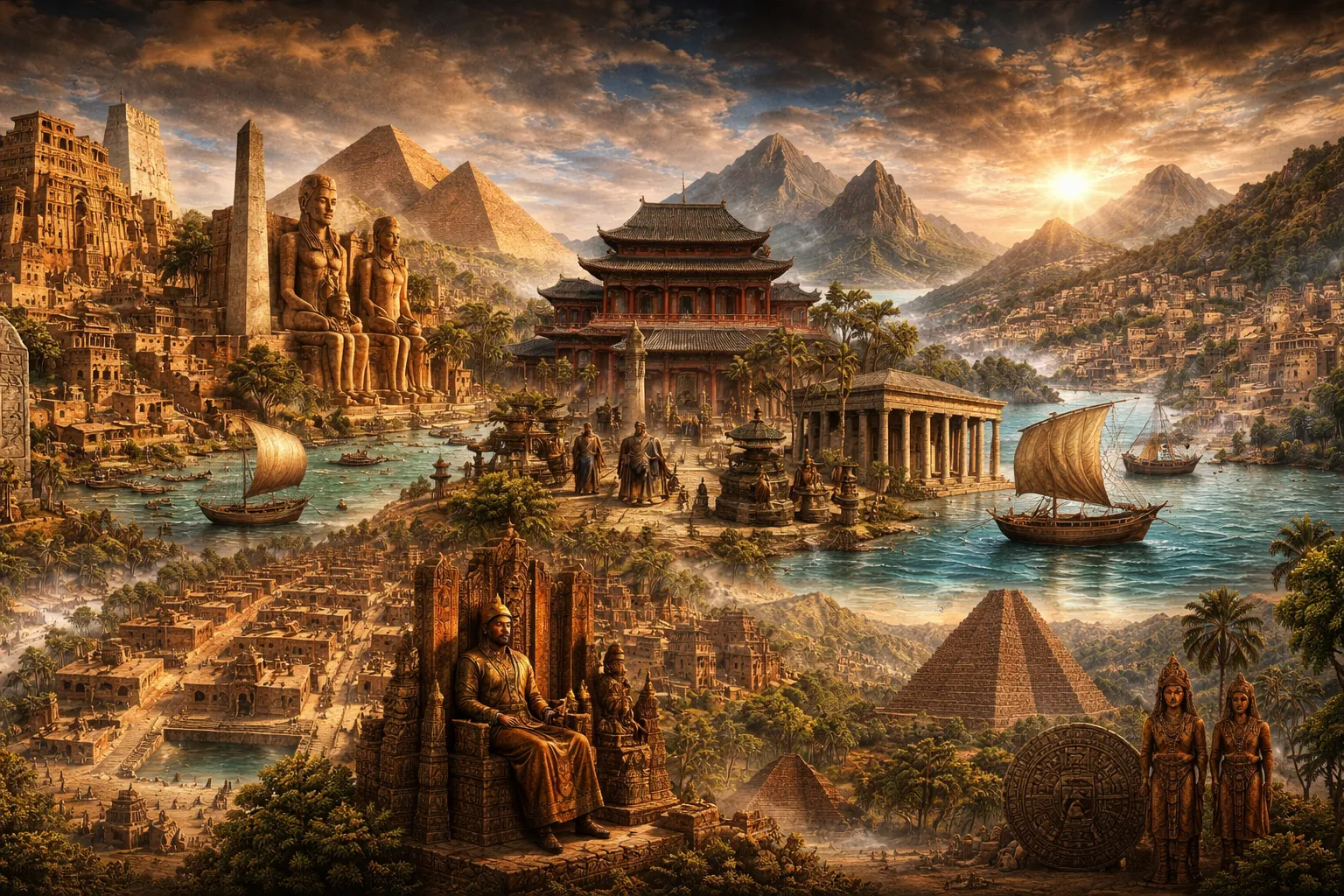
The Legacies of Antiquity
Introduction
After studying ancient arts, sciences, and knowledge, one final question becomes unavoidable: what remains of Antiquity after Antiquity? The question seems simple, but it requires great caution. It is not enough to say that the ancient world “invented everything” or that it would be the direct source of everything that followed. Such a vision would be exaggerated, Eurocentric, and historically misleading. Ancient legacies do indeed exist, but they are never transmitted in a pure, linear, or intact way.
A legacy is not only what survives. It is also what is taken up again, selected, transformed, forgotten, rediscovered, adapted, and sometimes reinvented. Later worlds do not receive Antiquity as a homogeneous block. They inherit fragments, traditions, texts, monuments, political forms, beliefs, techniques, images, and narratives that they reinterpret according to their own needs.
The purpose of this chapter is therefore to show that Antiquity left deep but multiple traces. These traces pass through law, languages, religions, the arts, knowledge, models of power, urban forms, calendars, foundational narratives, and imaginaries. To study the legacies of Antiquity is not to celebrate a fixed past: it is to understand how later societies also build themselves from what they preserve, transform, or reject.
What Is a Legacy?
The word “legacy” can give the impression of a natural and obvious transmission. Historically, however, nothing is so simple. A legacy presupposes at least three things:
- that an ancient element is preserved or transmitted;
- that it is recognized, used, or reworked later;
- that it often changes meaning as it changes context.
A legacy may be material:
- monument;
- object;
- inscription;
- technique;
- urban layout;
- work of art.
It may also be immaterial:
- language;
- myth;
- text;
- belief;
- legal norm;
- learned method;
- political form;
- symbolic representation.
A legacy is therefore not a faithful copy of the past. It is a transformed continuity.
What Must Be Remembered
- inheriting does not mean repeating identically;
- transmitting often implies selecting;
- the same legacy may be interpreted in very different ways;
- some traces survive for a long time without always being understood in the same way.
To speak of the legacies of Antiquity is therefore to speak at once of survival and transformation.
Multiple Legacies, Not a Single Thread
One of the most important precautions is to reject the idea of a single legacy of Antiquity. There is not one single Antiquity that would have handed down one single message to the world. On the contrary, there are plural legacies stemming from several civilizations, several languages, and several religious, political, artistic, and learned traditions.
One may thus speak of:
- Mesopotamian legacies;
- Egyptian legacies;
- Greek legacies;
- Roman legacies;
- Persian legacies;
- Indian legacies;
- Chinese legacies;
- ancient African legacies;
- legacies of the ancient American worlds.
Some of these legacies have been more valued or more visible in certain historical narratives than others. This depends on regions of the world, educational traditions, later cultural dominations, and the unequal preservation of sources.
Why This Plurality Is Essential
- it avoids reducing Antiquity to a single Greco-Roman axis;
- it restores the real diversity of ancient contributions;
- it shows that several centers of civilization left lasting traces;
- it allows a less Eurocentric reading of the past.
Ancient legacy is therefore a composite landscape, not a single lineage.
Languages, Writing Systems, and the Memory of Texts
Among the most visible legacies of Antiquity are languages and writing systems. Even when certain languages cease to be spoken in everyday life, they may continue to exist in texts, rites, administration, knowledge, or learned traditions. Others are transformed and give birth to new languages.
Linguistic and scriptural legacies may take several forms:
- direct transmission of a learned or religious language;
- evolution into new languages;
- reuse of an alphabet or graphic system;
- preservation of foundational texts;
- lasting influence on vocabulary, concepts, or literary forms.
Ancient writing systems play a major role because they make possible the material preservation of many forms of knowledge and many narratives. A large part of what is called “ancient legacy” depends precisely on the fact that texts were copied, translated, commented upon, taught, or rediscovered.
What This Legacy Implies
- continuity of certain literate traditions;
- lasting prestige of certain ancient languages;
- transmission of religious, legal, or learned corpora;
- the importance of translations in the survival of texts.
Without textual transmission, an immense part of Antiquity would have disappeared from the active memory of later societies.
Religious and Spiritual Legacies
Ancient religions also left deep traces, sometimes directly, sometimes in transformed ways. Some ancient beliefs disappear as dominant living systems, but continue to exist in rites, symbols, festivals, calendars, world representations, or cultural references. Other religious traditions issued from Antiquity, by contrast, continue to structure whole civilizations over a long duration.
Religious legacies may concern:
- foundational narratives;
- conceptions of time;
- ritual practices;
- forms of political sacrality;
- representations of death and the afterlife;
- holy places;
- philosophical or spiritual traditions;
- texts that became canonical.
An overly simple vision must be avoided here. A religious legacy is not always an intact continuity. It may pass through:
- doctrinal reformulations;
- syncretisms;
- ruptures;
- symbolic reinterpretations;
- partial survivals.
What Must Be Remembered
- ancient religion often continues well beyond the ancient period;
- some traditions change deeply while preserving older structures;
- spiritual legacies may be visible in practices as much as in texts.
Antiquity therefore also leaves a legacy of worldviews.
Law, Norm, and Forms of Authority
The ancient worlds also transmitted legal, administrative, and political models. This does not mean that later systems simply copied ancient ones, but rather that they took up certain principles, categories, methods of organization, or references of authority.
Legal and political legacy may concern:
- forms of codification;
- administrative traditions;
- fiscal practices;
- conceptions of citizenship or status;
- imperial models;
- ideas of law, order, and justice;
- forms of centralization or local government.
Some later political constructions even think of themselves explicitly in reference to real or idealized ancient models. But here again, inspiration must not be confused with reproduction.
Political and Legal Legacies Show
- the long duration of certain organizational categories;
- the symbolic force of certain ancient empires;
- the persistence of models of legitimacy;
- the capacity of later societies to reuse the past in order to justify themselves.
Antiquity thus continues to act in the way law, the state, and power are thought.
Cities, Territories, and Forms of Space
The legacy of Antiquity can also be read in space. Ancient cities continue to exist, sometimes transformed, displaced, rebuilt, or reorganized, yet still marked by very old layers. Roads, ports, canals, borders, sacred centers, or political centers leave durable traces in landscapes.
Spatial legacies may take the form of:
- urban plans;
- road networks;
- preserved monuments;
- hydraulic systems;
- durable religious centers;
- funerary sites;
- modes of territorial organization;
- hierarchies between center and peripheries.
Inherited space is never neutral. It directs future uses, imposes constraints, offers possibilities, and sometimes serves as a support for visible memory.
Why This Legacy Matters
- it shows that the past remains inscribed in landscapes;
- it directly connects material memory to collective life;
- it makes Antiquity a sometimes tangible presence in the contemporary world.
Antiquity therefore survives not only in books, but also in stones and territories.
Ancient Arts as Models, Repertoires, and References
Ancient works often continue to inspire later periods. This may concern architecture, sculpture, decorative motifs, proportions, visual narratives, monumental forms, or more broadly certain ideas of prestige, harmony, grandeur, or memory.
Artistic legacy does not consist only in preserving works. It also consists in:
- imitating;
- adapting;
- quoting;
- transforming;
- recomposing;
- idealizing an ancient style.
Thus, a later world may admire an ancient form without taking up exactly its initial meaning. It may also reinterpret an ancient model in order to respond to a new sensibility.
Artistic Legacies Pass Through
- preservation of monuments;
- copying of works or motifs;
- transmission of techniques;
- archaeological rediscovery;
- political uses of ancient prestige;
- formation of aesthetic canons.
Antiquity thus becomes a reservoir of forms from which other periods draw in order to represent themselves.
Ancient Knowledge and Its Transmissions
Ancient knowledge also has lasting legacies. Mathematics, medicine, astronomy, philosophy, construction techniques, administrative practices, literate traditions, or classifications of the world were often transmitted through copies, commentaries, translations, compilations, schools, and learned networks.
This transmission is never perfectly continuous. There are:
- losses;
- forgettings;
- fragments;
- reconstructions;
- rediscoveries;
- changes of interpretation.
An ancient learned text may, for example, be preserved in another language than the original one, in another cultural area, and return later in a form already transformed.
What This Shows
- the importance of mediators in transmission;
- the decisive role of translations;
- the material fragility of knowledge;
- the capacity of societies to reactivate an ancient legacy in a new context.
The learned legacy of Antiquity is therefore less a continuous line than a history of passages.
Forgettings, Losses, and Disappearances
It is essential to remember that a legacy is also defined by what has disappeared. An immense part of Antiquity has been lost. Texts were destroyed, languages died out, monuments collapsed, techniques were forgotten, and traditions ceased to be understood. What we call “legacy” is therefore also the result of an involuntary selection produced by time, catastrophes, political ruptures, religious changes, and the fragility of material supports.
One must therefore beware of a very frequent illusion: believing that what has come down to us faithfully represents the whole ancient universe. In reality, we often inherit:
- what materially resisted;
- what was judged worthy of being recopied;
- what was integrated into later dominant traditions;
- what was rediscovered later.
This Reality Imposes Several Precautions
- not to confuse preserved legacy with real importance in the past;
- not to forget the worlds that are less well documented;
- not to overestimate the traditions best transmitted;
- to keep in mind the immense share of what has been lost.
The legacy of Antiquity is therefore always partial.
Rediscovering Antiquity: Reuses and Reinventions
Antiquity does not survive only through uninterrupted transmission. It also returns through rediscoveries. Ruins are reinterpreted, forgotten texts are found again, ancient styles regain prestige, and ancient figures are reactivated in new contexts.
This rediscovery may produce:
- artistic renaissances;
- political uses of the ancient past;
- learned rereadings;
- idealized reconstructions;
- selective cultural appropriations.
It is therefore necessary to distinguish between:
- what is truly transmitted without rupture;
- what is rediscovered after being forgotten;
- what is reconstructed from fragments;
- what is invented as “ancient” without fully being so.
Why This Is Important
- because the ancient past can be used to fabricate the present;
- because no period reads Antiquity in a neutral way;
- because reinventions tell us as much about the heirs as about the legacy itself.
Antiquity is thus not only transmitted, but also constantly reinterpreted.
Legacies in Contemporary Imaginaries
Even today, Antiquity continues to nourish the imagination. It inspires novels, films, games, architecture, museums, political discourse, works of art, national symbols, and aesthetic universes. It may be perceived as an origin, a golden age, a reservoir of wisdom, a mysterious world, a model of grandeur, or a space of fascination.
These contemporary uses are not neutral. They may:
- simplify the past;
- mythify it;
- select it according to certain ideologies;
- transform it into a setting;
- or, on the contrary, question it critically.
Contemporary Antiquity May Be
- learned;
- fantasized;
- political;
- artistic;
- patrimonial;
- touristic;
- pedagogical.
This shows that a legacy does not exist only in ancient traces, but also in the present uses made of it.
Why a Non-Eurocentric Reading of Legacies Is Necessary
Finally, speaking of the legacies of Antiquity requires particular vigilance: one must not present certain legacies as universal simply because they have been more strongly valued in certain Western traditions. A non-Eurocentric reading implies recognizing that several ancient worlds left lasting traces, even if their visibility varies according to cultural contexts and dominant narratives.
This requires:
- moving beyond the exclusive privilege granted to Greece and Rome;
- restoring the contributions of Egypt, Mesopotamia, Persia, India, China, and the ancient African and American worlds;
- recognizing multiple continuities according to regions of the world;
- avoiding measuring all legacies according to a single history of the West.
This Approach Makes Possible
- a fairer vision of historical plurality;
- a better understanding of intersecting transmissions;
- a global history of ancient legacies;
- a more balanced reading of cultural continuities.
Antiquity did not hand down one single world to one single heir. It left multiple traces to many histories.
Why This Chapter Is Essential
This final chapter is essential because it gives full meaning to the study of Antiquity. To understand an ancient world is not only to describe what it was in its own time; it is also to understand how it continued to exist after itself, through transmissions, fragments, memories, forgettings, and reinventions.
Through this perspective, we better understand:
- why Antiquity remains present in languages, texts, cities, and institutions;
- how religious, political, and learned traditions cross the centuries;
- why certain works become lasting references;
- how losses and rediscoveries shape our vision of the past;
- in what sense legacy is always a historical construction.
To study the legacies of Antiquity is therefore to understand that the past never completely disappears: it changes form, place, language, meaning, and use.
Essential Ideas to Remember
- the legacy of Antiquity is multiple, partial, and transformed;
- it concerns languages, texts, religions, law, the arts, knowledge, cities, and imaginaries;
- transmitting never means preserving intact;
- an immense part of Antiquity has been lost;
- rediscoveries and reinventions play a major role;
- legacies must be thought on a world scale, not through a single Western narrative;
- Antiquity continues to exist through the uses later societies make of it.
General Conclusion of the Episode
At the scale of this whole episode, Antiquity appears as a mosaic of ancient civilizations that deeply structured human history. It is reduced neither to the Mediterranean alone, nor to a few prestigious empires, nor to a simple “origin” of the modern world. It is a vast ensemble of centers of civilization, powers, beliefs, exchanges, works, knowledge, and legacies.
Studying it from a broad and non-Eurocentric perspective makes it possible to better understand:
- the plurality of historical beginnings;
- the diversity of political and religious forms;
- the richness of artistic and learned productions;
- the importance of circulations between ancient worlds;
- the depth of the traces left down to the present day.
To understand Antiquity is ultimately to understand how human beings, very early on, gave the world durable forms of memory, power, meaning, beauty, and knowledge.