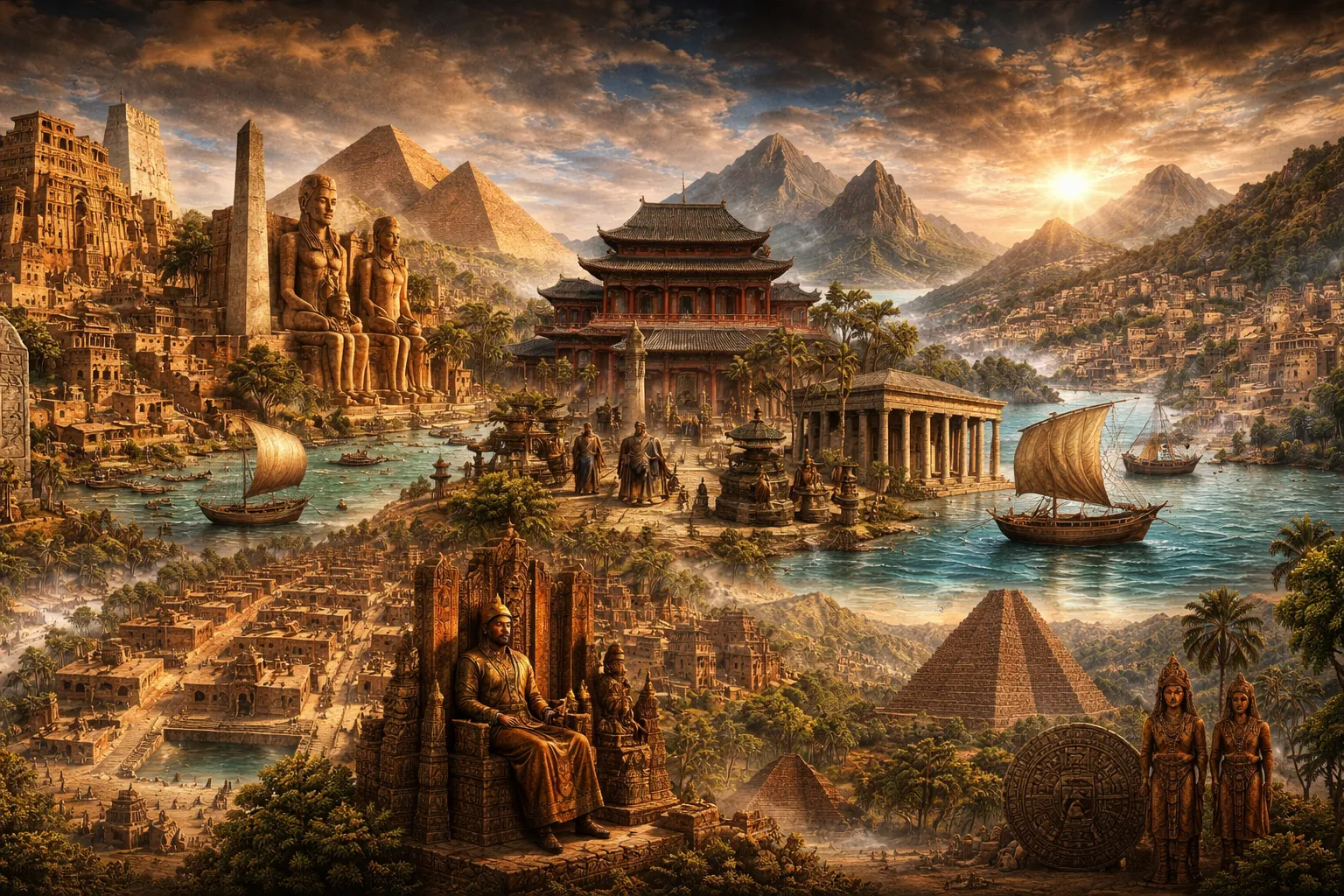
Ancient Arts, Sciences, and Knowledge

Introduction
After studying the forms of political domination, we must now look at what ancient societies produced in the fields of works, techniques, reflection, and knowledge. Antiquity is not only a time of kingdoms, empires, cults, and circulations: it is also an age of intellectual creation, technical mastery, learned inquiry, artistic invention, and the shaping of the world.
Speaking of ancient arts, sciences, and knowledge does not mean searching for the “first imperfect versions” of what would exist today in a more advanced form. Such a reading would be misleading. The ancient worlds produced forms of knowledge coherent with their own intellectual, religious, political, and technical frameworks. They elaborated monumental architecture, learned texts, mathematical systems, astronomical observations, medicines, literary works, visual arts, and complex techniques that testify to a very great intellectual and creative density.
The aim of this chapter is therefore to show that ancient societies did not merely inhabit the world: they observed it, described it, measured it, narrated it, represented it, transformed it, and gave it form. To study ancient arts, sciences, and knowledge is to understand one of the deepest dimensions of their cultural power.
Why Do the Arts and Knowledge Occupy Such an Important Place?
As soon as a society becomes more complex, builds cities, temples, palaces, exchange networks, and lasting institutions, it must also develop means to count, foresee, represent, transmit, and train. The arts and knowledge respond to these needs, but they go far beyond simple utility. They also make it possible to give meaning, express a worldview, produce prestige, fix memory, and assert a collective identity.
The arts and knowledge are important because they make it possible to:
- measure time and space;
- organize memory;
- transmit techniques;
- represent gods, rulers, ancestors, or narratives;
- construct complex buildings;
- heal, predict, calculate;
- train specialists;
- affirm the greatness of a city, a kingdom, or an empire.
They therefore do not belong to some secondary “cultural supplement.” They fully participate in the structuring of ancient societies.
Ancient Art Is Not Limited to Beauty
When one thinks of ancient art, one often imagines famous monuments, prestigious statues, or museum objects. Yet ancient art cannot be reduced to an abstract search for beauty. It is almost always linked to religious, political, commemorative, funerary, civic, or symbolic functions.
A statue may serve to:
- honor a divinity;
- affirm the power of a ruler;
- inscribe a memory;
- protect a space;
- materialize a sacred presence;
- stage a human or political ideal.
A fresco, a relief, a decorated ceramic, a jewel, a textile, a seal, or a building are not merely aesthetic productions. They are also objects of worship, prestige, use, social representation, or symbolic transmission.
What Must Be Remembered About Ancient Art
- it is often linked to the sacred;
- it participates in the representation of power;
- it is inscribed in concrete uses;
- it expresses collective codes;
- it links matter, technique, and worldview.
Ancient art is therefore at once a sensible form, a symbolic tool, and a social language.
Architecture and Monumentality
One of the most spectacular dimensions of the ancient worlds lies in their architecture. Temples, pyramids, palaces, tombs, walls, ziggurats, sanctuaries, roads, canals, theaters, squares, monumental gates, or funerary complexes all testify to a remarkable capacity to organize space, labor, and materials.
Ancient architecture reveals several things at once:
- technical mastery;
- a capacity for collective coordination;
- a hierarchy of spaces;
- a symbolism of power;
- a durable shaping of memory.
Building on a grand scale is never neutral. Monumentality serves to impress, gather, direct circulation, inscribe a divine or royal presence, and affirm the stability of an order.
Frequent Functions of Monumental Architecture
- glorifying power;
- materializing the sacred;
- protecting the city or territory;
- framing rituals;
- affirming the centrality of a place;
- inscribing a civilization in duration.
Architecture is thus one of the great languages through which ancient societies made themselves visible to themselves and to others.
Images, Objects, and Material Cultures
Ancient knowledge and sensibilities also pass through objects. Material culture is not a mere backdrop to history: it is one of its major expressions. Tableware, amulets, tools, instruments, seals, weapons, ornaments, cult objects, tablets, scrolls, stelae, coins, or figurines all tell us how societies lived, believed, exchanged, and represented themselves.
These objects make it possible to understand:
- social hierarchies;
- manufacturing techniques;
- visual tastes;
- religious practices;
- commercial circulations;
- uses of the body and of space;
- the presence of the symbolic in everyday life.
An object is never only “useful” or “beautiful.” It may at once be technical, ritual, social, economic, and political.
Ancient Material Culture Shows, in Particular
- the importance of craftsmanship;
- the variety of materials used;
- the link between form and function;
- the circulation of motifs;
- the symbolic density of everyday uses.
To study ancient arts is therefore also to learn how to read objects.
Literature, Narratives, and Written Memory
The ancient worlds also produced very rich literary and textual forms. These may be myths, epics, hymns, poems, prayers, royal texts, historical narratives, learned treatises, maxims, correspondence, dramas, or philosophical texts. The diversity is immense.
These texts fulfill several functions:
- transmitting memory;
- celebrating gods or rulers;
- narrating origins;
- instructing;
- advising;
- arguing;
- fixing doctrines;
- training literate elites.
The written text does not completely replace orality, but gives it another kind of stability. Many ancient narratives were in fact conceived to be read, recited, sung, or performed.
Major Functions of Ancient Literature
- symbolic foundation;
- education;
- historical memory;
- religious transmission;
- moral and political reflection;
- shaping human experience.
Ancient literatures show that ancient societies produced not only archives, but also works intended to think the world and transmit a vision of existence.
Mathematics, Measurement, and Calculation
Mathematics occupies an important place in several ancient civilizations. It is not always formulated as a separate abstract discipline, but it intervenes in many domains: architecture, accounting, astronomy, taxation, practical geometry, calendar-making, exchanges, division of land, construction, and administration.
Ancient societies needed to count, assess, compare, measure, and foresee. This implies numerical systems, units of measurement, methods of calculation, and sometimes very elaborate reasoning.
Mathematics Serves, in Particular, To
- calculate harvests and taxes;
- measure surfaces;
- plan constructions;
- organize calendars;
- observe the stars;
- manage exchanges;
- establish proportions;
- solve technical problems.
It must be remembered that ancient mathematics is not only practical or only theoretical: it can combine both depending on the context. Some traditions stress concrete use more, others demonstration or speculation.
Astronomy, Calendars, and Observation of the Sky
Observing the sky is essential in many ancient worlds. The stars are not merely contemplated: they are used to organize time, structure agricultural activities, mark festivals, support certain forms of divination, and think the order of the cosmos.
Ancient astronomy may be linked to:
- the calendar;
- agriculture;
- ritual;
- navigation;
- the measurement of time;
- the cosmological legitimacy of power;
- the prediction of certain phenomena.
In several civilizations, regular observation of the sky produced genuine learned traditions. The identification of cycles, the recording of movements, the interpretation of regularities, and the relationship between heaven and earth testify to a sustained attention to the natural world.
What Ancient Astronomy Reveals
- the need to order time;
- the relationship between science, religion, and power;
- the precision of certain observations;
- the importance of cycles;
- the role of the sky in worldviews.
Ancient astronomy is therefore neither mere celestial folklore nor modern science before its time: it is a field of knowledge structured according to the logics proper to ancient societies.
Medicines, Bodies, and Healing Practices
The ancient worlds also developed knowledge about the body, illness, remedies, and healing. This knowledge does not present itself everywhere in the same way. It may combine observation, experience, pharmacopoeia, technical gestures, rites, prayers, symbolic diagnosis, and learned traditions.
Ancient medicine may include:
- medicinal plants;
- surgical or technical practices;
- classifications of disorders;
- regimes of life;
- healing gestures;
- religious or cosmological interpretations of illness;
- specialists of the body and healing.
Two mistakes must be avoided here:
- believing that ancient medicine was only magical;
- believing that it was already identical to modern medicine.
It often combines several registers at once. It observes, experiments, sometimes codifies, but it also thinks the body in a world where the religious, the natural, and the social remain deeply linked.
What Healing Practices Show
- significant empirical knowledge;
- the existence of structured medical traditions;
- the place of the body in ancient thought;
- the link between health, way of life, and balance;
- the coexistence of techniques and beliefs.
Arts of Language, Music, and Performance
Ancient arts are not only visual or monumental. They are also sonic, gestural, and performative. Songs, recitations, theater, dance, ritual music, sung poetry, official proclamations, and public ceremonies all participate in cultural and political life.
These arts often have a collective dimension. They serve to:
- celebrate;
- commemorate;
- teach;
- move;
- gather;
- transmit narratives;
- affirm a common identity;
- stage the sacred or power.
Ancient texts are not always intended for silent reading. They may be spoken, sung, accompanied by music, or integrated into a ritual. Likewise, certain public performances give power dramatic visibility.
The Arts of Performance Reveal
- the importance of living memory;
- the link between art and ritual;
- the force of public speech;
- the collective dimension of many works;
- the porosity between aesthetics, politics, and religion.
Techniques, Crafts, and Practical Intelligence
Ancient knowledge is not limited to learned texts or cosmological speculations. It is also present in technical gestures, trades, worksites, workshops, and artisanal practices. Metallurgy, ceramics, weaving, stone-cutting, shipbuilding, irrigation, pigment production, glassmaking, carpentry, or hydraulic engineering all testify to a highly developed practical intelligence.
These technical forms of knowledge are often transmitted:
- through apprenticeship;
- through imitation;
- through professional specialization;
- through family or corporate traditions;
- through accumulated experience;
- sometimes through writing.
They show that ancient knowledge is also embodied in the hand, the eye, the material, and the gesture.
What Crafts Reveal
- a high level of specialization;
- fine mastery of materials;
- a close link between technique and aesthetics;
- a capacity for innovation;
- a possible circulation of processes.
Antiquity is therefore not only learned in the literate sense; it is also learned in the concrete and technical sense.
Knowledge, Power, and Institutions
Ancient knowledge does not circulate in a vacuum. It is produced, preserved, and transmitted within specific institutional frameworks. Temples, palaces, royal courts, scribal schools, libraries, sanctuaries, workshops, observatories, houses of learned people, or networks of masters play an essential role in maintaining it.
Knowledge may be supported by power because it is useful for:
- administering;
- predicting;
- legitimizing;
- building;
- healing;
- interpreting signs;
- training elites;
- maintaining religious traditions.
But knowledge may also give prestige to those who master it. It becomes an instrument of symbolic authority.
Possible Institutions of Knowledge
- scribal schools;
- libraries and archives;
- learned temples;
- literate circles;
- specialized workshops;
- royal courts;
- religious centers of transmission.
To study ancient knowledge is therefore also to study its places, its mediators, and its political uses.
Diversity of Learned Traditions
One essential point must be stressed: there is no single ancient science, nor a single ancient way of producing knowledge. Learned traditions vary according to regions, languages, institutions, cosmologies, and aims.
Some emphasize:
- recording and compilation;
- regular observation;
- demonstration;
- commentary on ancient texts;
- ritual transmission;
- practical efficiency;
- philosophical speculation;
- the memory of masters.
This diversity is essential because it prevents all civilizations from being measured against a single model. The point is not to seek “who was right before the others,” but to understand how different societies constructed regimes of knowledge coherent with their own world.
Exchanges Also Transform Knowledge
Like goods and political forms, knowledge circulates. Techniques move, artistic motifs are borrowed, instruments change region, methods of calculation travel, narratives are translated, and religious traditions are transformed through contact with other worlds.
This circulation produces:
- borrowings;
- adaptations;
- syntheses;
- reformulations;
- hybridizations;
- sometimes resistance or rejection.
Ancient arts and knowledge are therefore not enclosed within immobile blocks. They also evolve through exchanges, conquests, and mediations.
Possible Effects of Circulations
- enrichment of artistic repertoires;
- diffusion of techniques;
- transformation of styles;
- movement of texts and knowledge;
- reinterpretation of foreign traditions;
- recomposition of worldviews.
Limits and Precautions
Several mistakes must nevertheless be avoided when studying ancient arts, sciences, and knowledge.
Important Precautions
- not to reduce ancient art to a mere decoration of power;
- not to reduce ancient science to an awkward prehistory of modern science;
- not to artificially oppose technique and spirituality;
- not to believe that only texts count as knowledge;
- not to forget oral, artisanal, and practical traditions;
- not to project the same criteria of truth or beauty onto all societies;
- not to underestimate non-Greco-Roman worlds.
These precautions make it possible to restore the real richness of ancient productions.
Why This Chapter Is Essential
This chapter is essential because it shows that the ancient worlds were not only powerful militarily or politically: they were also profoundly creative. They invented forms, methods, narratives, intellectual tools, learned traditions, and works that give the human world an exceptional depth.
Through this perspective, we better understand:
- why ancient monuments continue to impress;
- why certain ancient texts remain foundational;
- how knowledge could be accumulated and transmitted;
- how the arts express a worldview;
- why technique, symbol, and thought are so often linked.
To study ancient arts, sciences, and knowledge is therefore to enter the intellectual and sensitive workshop of Antiquity.
Essential Ideas to Remember
- the ancient worlds produced highly developed arts, sciences, and knowledge;
- ancient art is often at once religious, political, symbolic, and functional;
- architecture and objects reveal a strong technical and cultural density;
- mathematics, astronomy, and medicines occupy an important place;
- knowledge also passes through gestures, trades, and institutions;
- there is a great diversity of learned traditions according to the ancient worlds;
- exchanges also transform the arts and knowledge.