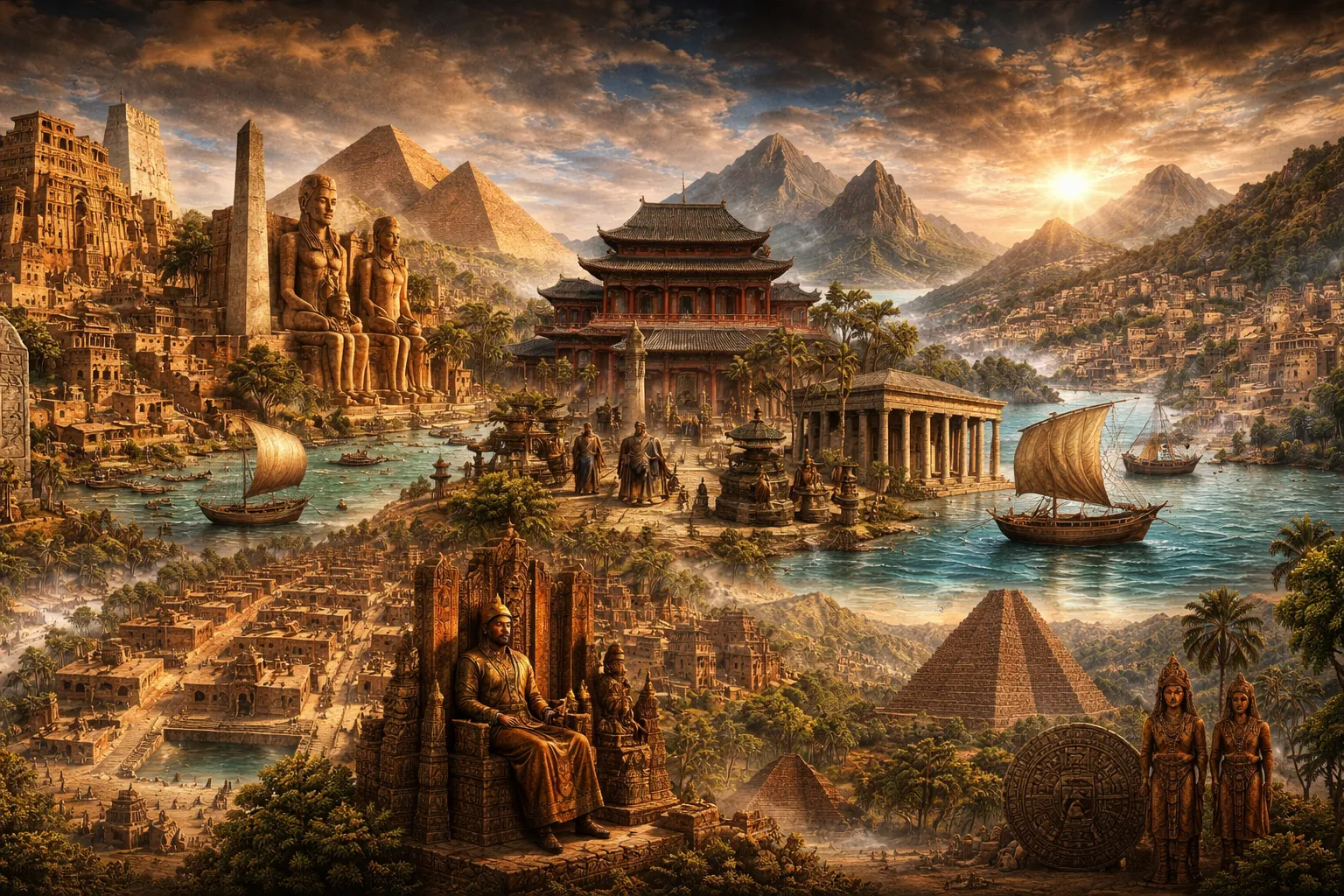
Empires, Cities, and Forms of Domination

Introduction
After studying the great exchanges of the ancient world, we must now turn to the forms of power that durably structured ancient societies. Antiquity is not only a world of beliefs, networks, and cultural productions: it is also a world of authority, command, hierarchies, and domination. Ancient societies invented, developed, and combined several forms of political organization in order to govern populations, control territories, raise resources, administer justice, wage war, and maintain order.
Speaking of domination does not mean referring only to military violence. In the ancient worlds, to dominate also means to administer, extract, classify, integrate, negotiate, impose norms, distribute privileges, and produce lasting hierarchies. Forms of domination may be brutal, symbolic, religious, economic, legal, or territorial. They do not take the same shape everywhere, and they do not all culminate in empire.
The aim of this chapter is therefore to show that Antiquity did not know a single political model. It includes cities, kingdoms, empires, confederations, networks of dependence, local powers, more or less integrative imperial dominations, and forms of sovereignty sometimes very different from our modern categories. To understand these forms of domination is to understand how ancient societies were structured, expanded, defended themselves, hierarchized themselves, and transformed.
Why Does Political Power Become So Central?
As societies grow, become denser, and more complex, it becomes necessary to stabilize forms of command. When cities develop, exchanges intensify, conflicts multiply, and resources must be organized, political power becomes a major issue. It is no longer simply a matter of managing a small group or a restricted local space, but sometimes of thousands, even millions, of people spread across vast territories.
Political power becomes central because it makes it possible to:
- establish rules;
- arbitrate conflicts;
- organize war and defense;
- levy taxes, tribute, or labor;
- control routes and resources;
- protect or regulate exchanges;
- coordinate collective works;
- assert a lasting legitimacy.
But this centrality does not mean uniformity. From one ancient world to another, power may rest more on kingship, the city, religion, local elites, the army, bureaucracy, or alliances. The variety of political forms is one of the major traits of Antiquity.
The City: A Fundamental Political Framework
The city occupies an essential place in many ancient worlds. It is not only a city in the material sense, but a political, legal, religious, and symbolic framework within which a community is organized. The city may be independent, integrated into a larger whole, dominant at a regional scale, or subjected to an external power.
The city often concentrates:
- political institutions;
- sanctuaries;
- market spaces;
- military functions;
- archives and places of memory;
- a strong collective identity.
In some cases, the city thinks of itself as a community of citizens or inhabitants politically defined. In others, it constitutes above all a center of power directed by an elite. One must therefore not project everywhere the particular model of the Greek city, even if that model has considerable importance.
What a City Often Makes Possible
- structuring a nearby territory;
- organizing local political life;
- producing a civic identity;
- concentrating resources;
- linking power, religion, and economy;
- serving as a base for expansion or resistance.
The city shows that domination can be exercised on a relatively compact scale, without immediately requiring an immense imperial structure.
Kingdoms: Personalization and Continuity of Power
The kingdom constitutes another major political form of the ancient world. It generally rests on a sovereign figure, a dynasty, a court, and a more or less strong capacity to govern a territory beyond a single city. A kingdom may be modest or very vast, stable or fragile, centralized or composite.
Royal power often relies on several elements:
- dynastic legitimacy;
- religious or sacred authority;
- military capacity;
- an aristocratic or administrative entourage;
- secondary political centers;
- forms of personal or territorial loyalty.
The kingdom makes it possible to extend power beyond the strict framework of the city. It often links several cities, countrysides, sanctuaries, and regions within a broader whole. But it frequently remains dependent on the personality of the sovereign, the efficiency of her or his relays, and the ability to maintain the loyalty of elites.
Strengths of the Royal Model
- dynastic continuity;
- visible embodiment of power;
- capacity for territorial unification;
- flexibility in integrating diverse regions;
- articulation between political authority and sacred prestige.
Possible Fragilities
- succession crises;
- revolts of elites;
- dependence on the sovereign’s figure;
- difficulty controlling the peripheries;
- instability in the event of military defeat.
The kingdom thus appears as an important intermediate form between local power and imperial domination.
Empire: Expanding, Integrating, Dominating
Empire constitutes one of the most visible forms of ancient domination, but it should not be considered the natural horizon of all ancient politics. An empire is a vast, often multiethnic, multilingual, and multicultural whole, organized around a center of power that dominates other peoples, regions, or political entities.
An empire is not defined only by existing over a large territory. It also implies:
- a capacity for expansion;
- a hierarchy between center and peripheries;
- mechanisms of extraction;
- instruments of control;
- armies;
- administrative relays;
- forms of imperial legitimation.
In the ancient worlds, empires may be more or less centralized. Some impose their administration strongly; others leave great space to local elites as long as they remain loyal. Some actively diffuse their culture; others are mainly concerned with extracting, monitoring, and arbitrating.
What Often Characterizes an Empire
- domination over several peoples or regions;
- plurality of languages and traditions;
- territorial hierarchy;
- taxation or tribute;
- a permanent or strongly structured army;
- an ideology of greatness;
- the capacity to integrate without totally uniformizing.
Empire is therefore at once a space of power, administration, and permanent tension between unity and diversity.
Not All Dominations Are Imperial
It would be misleading to reduce ancient forms of domination to the alternative between local independence and empire. Between the two, many configurations exist. Some powers dominate through a network of unequal alliances. Others control routes, ports, or strategic sanctuaries without directly administering vast territories. Others again impose tribute on neighbors without formally annexing them.
One may thus encounter:
- regional hegemonies;
- leagues dominated by one power;
- confederations;
- systems of vassalage;
- de facto protectorates;
- zones of influence;
- indirect dominations.
These forms are important because they show that ancient power is often graduated. Between full sovereignty and total submission, there are many degrees of dependence, negotiation, and integration.
What Must Be Remembered
- domination may be direct or indirect;
- it may be military, fiscal, religious, or diplomatic;
- it does not always require complete annexation;
- it often passes through local intermediaries.
The ancient world was therefore made up of complex power relations, not of perfectly homogeneous political blocks.
Governing a Territory: Center, Relays, Peripheries
One of the great political questions of Antiquity is this: how does one govern from afar? The more a power extends, the more it must find ways to make orders, taxes, information, and people circulate. This raises the problem of the link between the center and the peripheries.
To govern a vast territory, ancient powers often used:
- governors;
- integrated local elites;
- garrisons;
- routes and relay points;
- scribes and archives;
- censuses;
- regular tribute or taxes;
- oaths of loyalty;
- political marriages;
- urban or military foundations.
The center never controls everything in an absolute way. It depends on its ability to delegate, monitor, punish, reward, and have itself recognized as legitimate. The peripheries, for their part, are not merely passive: they negotiate, resist, collaborate, revolt, or adapt.
Center-Periphery Relationship
- circulation of orders from the center;
- upward movement of resources and information;
- variable margin of autonomy for local elites;
- frequent tensions around control;
- necessity of inventing reliable relays.
Ancient domination therefore rests less on perfect mastery than on a shifting balance between constraint and integration.
War, Conquest, and Power
War plays a central role in the structuring of many ancient powers. It makes it possible to defend a territory, conquer resources, control routes, impose tribute, capture populations, or affirm the prestige of the sovereign. In some cases, it even becomes a constitutive element of political legitimacy.
War often serves to:
- expand a kingdom or an empire;
- intimidate neighbors;
- obtain wealth;
- secure border zones;
- strengthen internal cohesion through victory;
- stage the power of the regime.
But conquest is not enough. A military victory must then be transformed into lasting domination. This requires:
- occupation;
- negotiation;
- administration;
- surveillance;
- extraction of resources;
- prevention of revolts;
- integration of conquered territories.
Military force is therefore fundamental, but it is only one part of domination. A power may conquer quickly and lose everything just as quickly if it fails to structure the postwar order.
Taxation, Tribute, and the Extraction of Resources
Every lasting domination requires a capacity to extract. Governing, waging war, building, maintaining a court, financing sanctuaries, or paying agents all require resources. Ancient powers therefore developed diverse forms of extraction.
Frequent Forms of Extraction
- taxes in kind;
- taxes in money in certain contexts;
- corvée labor;
- tribute;
- requisitions;
- spoils;
- obligatory gifts;
- control of monopolies or routes.
Extraction is not only economic. It is also political, because it concretely manifests domination. To make people pay a tax, demand tribute, or impose labor is to show who commands.
What Resource Extraction Makes Possible
- feeding the army;
- financing constructions;
- maintaining ruling elites;
- redistributing in order to secure loyalty;
- displaying the power of the center;
- supporting religious and administrative functions.
But taxation may also provoke tensions, resistances, and revolts if it is judged excessive or illegitimate. Power must therefore often balance extraction and acceptability.
Elites: Indispensable Relays of Domination
No ancient power governs alone. Behind the figure of the king, emperor, civic council, or victorious leader, there are always elites who serve as relays. These elites may be aristocratic, military, religious, administrative, urban, or landholding.
Their role is decisive because they make it possible to:
- apply orders;
- manage territories;
- extract resources;
- administer justice;
- supervise populations;
- relay the ideology of power;
- stabilize the peripheries.
But these elites may also become a danger. If too powerful, they challenge the center. If too marginalized, they revolt or withdraw. Ancient domination therefore often rests on an unstable compromise between centralization and sharing power with influential groups.
Types of Elites Frequently Involved
- warrior nobility;
- priestesses and priests;
- scribes and administrators;
- urban notables;
- governors;
- integrated local chiefs;
- great dynastic families.
To understand ancient forms of domination is therefore also to understand the place of these intermediaries of power.
Dominating Bodies, Statuses, and Social Hierarchies
Ancient domination is not exercised only over territories; it is also exercised over persons, groups, and statuses. Ancient societies were largely hierarchical. They distinguish between free and unfree, elites and dependents, dominants and dominated, victors and vanquished, political centers and subjected populations.
Domination may thus take the form of:
- slavery;
- war captivity;
- peasant dependencies;
- civic hierarchies;
- privileges of birth;
- legal exclusions;
- obligations imposed on certain groups;
- inequality before power and resources.
These hierarchies are not secondary: they profoundly structure the ancient worlds. Power also manifests itself through the capacity to define statuses, assign places, and maintain distinctions.
It Must Be Remembered That Domination Is Also
- social;
- legal;
- symbolic;
- economic;
- territorial;
- military.
Studying forms of domination therefore does not mean looking only at the peaks of power, but also at the way societies are organized in depth.
Law, Norm, and Order
Ancient power does not rest only on force. It also relies on rules, customs, decisions, judgments, and sometimes more formalized legal corpora. Law, in the broad sense, is a way of fixing an order and making domination intelligible, predictable, and legitimate.
Norms may concern:
- property;
- debts;
- inheritances;
- statuses;
- marriages;
- crimes;
- obligations toward power;
- relations between groups.
Ancient law varies greatly according to societies. It may be customary, royal, sacred, civic, imperial, or a mixture of several registers. But in all cases, it makes it possible to transform a simple relation of force into a more stable order.
Political Functions of Norm
- settling conflicts;
- protecting certain hierarchies;
- regulating exchanges;
- defining obligations;
- making authority visible;
- stabilizing social relations.
Law and norm therefore fully participate in forms of domination.
Symbolic Domination: Monuments, Ceremonies, Images
A lasting power does not merely act; it shows itself. Ancient worlds gave great importance to the staging of domination. Monuments, palaces, temples, statues, inscriptions, processions, court ceremonies, represented victories, royal titles, distinctive garments, and imposing architectures all served to make power visible and impressive.
This symbolic domination makes it possible to:
- inspire respect;
- affirm the greatness of the sovereign or the city;
- inscribe the memory of victories;
- naturalize hierarchies;
- connect power to the cosmic or divine order;
- recall the presence of the center in space.
Frequent Tools of Symbolic Domination
- colossal statues;
- monumental palaces and capitals;
- public inscriptions;
- court rituals;
- military ceremonies;
- royal iconography;
- civic or sacred architecture.
Ancient domination is therefore also a work on gazes, memory, and the collective imagination.
Resisting, Negotiating, Revolting
Dominated populations should never be imagined as totally passive. Ancient worlds knew multiple forms of resistance, negotiation, and revolt. Cities could rise up, provinces detach themselves, elites betray, subjected peoples refuse tribute, and peripheries take advantage of a dynastic crisis to recover their autonomy.
Resistances may be:
- military;
- fiscal;
- political;
- religious;
- symbolic;
- local or regional;
- open or discreet.
There are also forms of negotiation:
- adaptation to the demands of the center;
- conditional loyalty;
- maintenance of local customs;
- collaboration of elites in exchange for advantages;
- gradual integration into the dominant order.
Ancient domination is therefore always relational. It does not exist without the response of the dominated, whether in the form of obedience, accommodation, resistance, or rupture.
Comparing Without Uniformizing
It is important to compare cities, kingdoms, empires, and other forms of domination, but without reducing them to a single scheme. A Mesopotamian empire, a Greek city, an ancient African kingdom, a Chinese imperial structure, an Indian political formation, or a great ancient American polity do not function according to the same logics, even if they may share certain traits.
Comparison Must Make It Possible To See
- different degrees of centralization;
- varied ways of legitimizing power;
- distinct relations between center and peripheries;
- multiple forms of taxation;
- different uses of war;
- different roles given to local elites;
- contrasted conceptions of political order.
Comparison serves here to bring out families of problems, not to erase the singularity of trajectories.
Why This Chapter Is Essential
This chapter is essential because it shows that Antiquity is not only a history of works, beliefs, or exchanges, but also a history of command, hierarchies, and control. Ancient societies constantly had to answer fundamental questions: who governs? in whose name? through which relays? over what territory? by what means? with what limits?
Through this perspective, we better understand:
- why certain cities become dominant;
- how kingdoms stabilize or collapse;
- why empires must constantly integrate and monitor;
- how taxation, war, and ideology combine;
- why resistances are an integral part of ancient political history.
To study empires, cities, and forms of domination is therefore to enter into the concrete mechanics of ancient power.
Essential Ideas to Remember
- Antiquity knew several forms of domination, not a single political model;
- the city, the kingdom, and the empire are three major forms, without being the only ones;
- to dominate means at once to govern, extract, integrate, monitor, and symbolize;
- domination may be direct or indirect;
- war, taxation, elites, law, and the staging of power play a central role;
- dominated populations are never totally passive;
- a comparative approach makes it possible to understand the real diversity of ancient political forms.