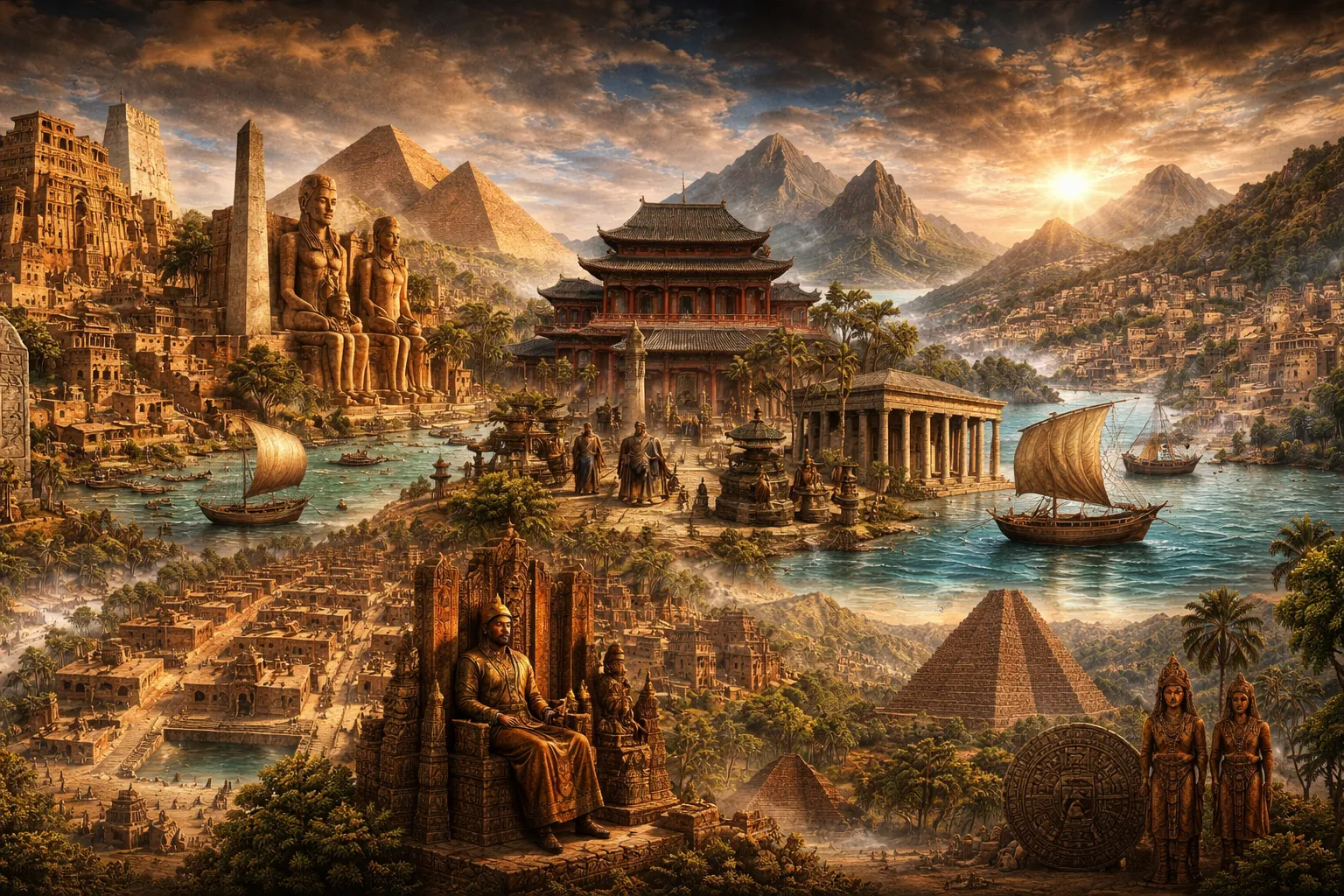
The Great Exchanges of the Ancient World

Introduction
After studying religions, myths, and sacred powers, we must now look at the ancient worlds in motion. Antiquity cannot be reduced to isolated, immobile civilizations enclosed within their borders. On the contrary, it is crossed by many circulations: goods, metals, textiles, techniques, knowledge, narratives, beliefs, artistic forms, political practices, and sometimes entire populations move from one space to another.
These exchanges do not always connect everyone to everyone else, nor in a continuous way. They are unequal, intermittent, and sometimes interrupted by wars, crises, collapses, or geographical obstacles. Yet they are no less fundamental for that. They show that the ancient worlds were also built through relations, contact, borrowing, negotiation, and sometimes conflict.
The purpose of this chapter is to understand how these exchanges were established, what they circulated, which spaces they connected, and how they transformed societies. It also aims to correct an overly static image of Antiquity by showing that the ancient world was already a world of networks.
Why Do Exchanges Occupy Such an Important Place?
Exchanges become essential as soon as societies do not live entirely within themselves. When a region lacks certain resources, seeks rare materials, wishes to acquire prestigious objects, spread its influence, form alliances, or enrich its practices, it enters into relation with other spaces. Trade is a major form of these contacts, but it is not the only one. Exchanges also take place through diplomacy, migrations, conquests, pilgrimages, marriages, learned circulations, and religious transfers.
The ancient worlds exchanged because no complex society lived in perfect self-sufficiency. Even great kingdoms and great empires often depended on supplies, commercial relays, secured routes, intermediate zones, and mediators.
What Exchanges Make Possible
- obtaining resources absent locally;
- circulating prestige goods;
- reinforcing power through control of routes;
- making techniques circulate;
- transmitting knowledge and practices;
- forming political alliances;
- transforming artistic tastes;
- linking very distant spaces.
Exchanges are therefore at once material, symbolic, political, and cultural.
Land, Maritime, and River Routes
The great exchanges of Antiquity relied on varied routes of circulation. Rivers often played a decisive role because they facilitated transport, linked production zones to centers of power, and structured entire territories. Seas, for their part, did not only separate: they connected. The Mediterranean, the Red Sea, the Indian Ocean, certain coastal zones of East Asia, and also the lacustrine and river networks of other regions served as corridors of circulation. Land routes, finally, linked oases, cities, trading posts, passes, steppes, and caravan zones.
These circulations required:
- geographical knowledge;
- techniques of navigation or caravan travel;
- halts and relay points;
- forms of armed or political protection;
- intermediaries able to translate, negotiate, transport, and resell.
Important Types of Routes
- river routes;
- coastal maritime routes;
- large maritime crossings;
- caravan routes;
- mountain corridors;
- desert passages;
- urban networks linked by stages.
The ancient world was therefore already woven together by itineraries, even if their continuity varied according to periods and regions.
What Circulated in the Ancient World?
Ancient exchanges first concerned concrete goods. But these goods often had a value that went beyond their simple material use. A rare metal, a precious stone, a fine fabric, a fragrant resin, or a decorated ceramic could be at once useful, prestigious, religious, and political.
Among the Products Often Exchanged
- metals;
- precious or semi-precious stones;
- rare woods;
- ivory;
- spices;
- incense and aromatics;
- wine, oil, cereals;
- textiles;
- ceramics;
- weapons;
- horses or other animals;
- display objects;
- pigments and dyeing materials.
But exchanges did not concern only objects. They also transported:
- artisanal techniques;
- construction methods;
- iconographic motifs;
- forms of writing or recording;
- beliefs;
- narratives;
- administrative practices;
- ways of measuring time;
- astronomical, medical, or mathematical knowledge.
Thus, circulating an object often also means circulating an idea.
Trade Is Not the Only Form of Exchange
It would be reductive to limit the great exchanges of the ancient world to merchant trade alone. An important part of circulation passed through other channels. Diplomatic gifts, for example, could play an immense role. Between queens, kings, courts, and elites, precious objects were exchanged to mark alliance, display mutual recognition, or negotiate a balance of power.
Conquests, for their part, also moved objects, artisans, soldiers, cults, languages, and forms of power. Migrations carried practices, techniques, food habits, narratives, and beliefs. Pilgrimages and religious journeys also contributed to the circulation of symbols and knowledge. Finally, marriages between dynasties or elites could connect distinct worlds and favor discreet but lasting cultural transfers.
Exchanges Could Therefore Take the Form Of
- regular trade;
- exchanges of gifts and counter-gifts;
- tribute;
- spoils of war;
- diplomatic transfers;
- migrations;
- movements of artisans or learned men and women;
- pilgrimages;
- dynastic unions;
- religious diffusion.
This plurality is important because it shows that ancient networks were both economic and political.
The Mediterranean: A Great Space of Circulation
The Mediterranean occupies a major place in the history of ancient exchanges, not because it was the only center of the ancient world, but because it constituted a particularly dense space of contacts. Ports, cities, kingdoms, and empires there exchanged goods, techniques, styles, and beliefs.
Mediterranean circulation connected:
- Egypt;
- the Levant;
- the Greek worlds;
- Rome;
- North Africa;
- certain Iberian regions;
- islands and highly active coastal zones.
In this space, products traveled, but so did alphabets, decorative motifs, religious practices, currencies, urban models, and political forms. The sea acted here as a surface of connection.
What the Mediterranean Example Shows
- the power of ports;
- the importance of maritime circulation;
- the role of merchants, sailors, and intermediaries;
- the density of cultural exchanges;
- the capacity of a maritime space to durably structure a common world without uniformizing it.
The Mediterranean therefore makes it possible to understand how a space of circulation can produce both proximity, rivalry, and hybridization.
Western Asia and the Great Land Corridors
The worlds of Western Asia played a crucial role in ancient exchanges because they stood at the crossroads of many circulations between the Mediterranean, Africa, Iran, Central Asia, and farther on, the Indian worlds. The empires, kingdoms, cities, and confederations of this vast zone controlled or crossed strategic routes.
These spaces saw the circulation of:
- metals;
- horses;
- textiles;
- luxury goods;
- administrative practices;
- cults;
- artistic styles;
- imperial forms of government.
The great land corridors were not simple lines on a map. They consisted of relay points, cities, posts, frontier zones, political agreements, tolls, conflicts, and mediations. They made long-distance circulation possible without any single actor always controlling the whole route.
Role of These Corridors
- linking several zones of civilization;
- circulating goods and information;
- allowing imperial expansion or projection;
- encouraging cultural blending;
- producing very dynamic intermediate zones.
Antiquity was therefore not made only of centers; it also depended on its in-between spaces.
The Indian Ocean: An Ancient and Major Space of Exchange
The Indian Ocean constituted another great space of circulation in the ancient world. It linked parts of East Africa, Arabia, the Indian subcontinent, and, according to the period, other Asian zones. Seasonal winds, navigation, ports, and merchant networks made large-scale exchanges possible there.
Among the things circulating in this space were:
- spices;
- aromatics;
- pearls;
- textiles;
- ivory;
- precious objects;
- religious ideas;
- navigation techniques;
- cultural and artistic forms.
The importance of this space is that it shows the existence of a widely connected ancient world beyond the Mediterranean axis alone. It also reminds us that the sea can be a place of commercial and cultural structuring of the first order.
What the Indian Ocean Reveals
- the antiquity of long-distance maritime exchange;
- the major role of ports;
- the importance of merchant intermediaries;
- the articulation between trade, religion, and mobility;
- the existence of an already connected Afro-Asian world.
This perspective greatly broadens the map of ancient exchanges.
The Indian Worlds, the Chinese Worlds, and Asian Circulations
The Indian and Chinese worlds also took part in vast circulations, direct or indirect. Objects, techniques, ideas, learned traditions, and sometimes religions traveled through land and maritime networks. One must not imagine a permanent and uniform exchange, but rather a series of variable connections, sometimes dense, sometimes distant, often mediated by several intermediaries.
These circulations contributed to the diffusion of:
- precious products;
- artistic forms;
- knowledge;
- texts and traditions;
- cosmological ideas;
- religious practices;
- models of prestige.
Important Points
- Asian exchanges cannot be reduced to a single route;
- they followed multiple circuits;
- they often passed through imperial, urban, or merchant relays;
- they transformed cultures without making them identical.
Ancient Asia must therefore be thought of as a whole crossed by flows, not as a juxtaposition of sealed worlds.
The African Worlds in the Great Exchanges
The African worlds occupied an important place in ancient exchanges, whether through circulations within the continent, Nile connections, trans-Saharan networks depending on the period, or links with the Mediterranean, the Red Sea, or the Indian Ocean. Africa must never be thought of as outside the major networks of the ancient world.
There we see the circulation of:
- gold;
- salt;
- ivory;
- luxury goods;
- techniques;
- artistic traditions;
- beliefs;
- forms of political legitimacy.
Some African regions served as zones of production, others as relay points, and still others as political and religious centers in their own right.
What Must Be Remembered
- ancient Africa fully participated in exchange networks;
- its trajectories were diverse according to region;
- it was neither peripheral nor passive;
- its worlds were productive, transformative, and mediating.
This reintegration is essential for a non-Eurocentric vision of Antiquity.
Ancient American Worlds: Internal Exchanges and Great Regional Networks
The ancient civilizations of the Americas were not connected to the Afro-Eurasian worlds of Antiquity, but they knew their own large-scale systems of exchange. Goods, motifs, religious practices, techniques, and symbols circulated between sometimes distant regions.
There we can observe:
- structured regional networks;
- ceremonial centers attracting flows;
- prestige exchanges;
- artistic and symbolic transfers;
- circulation of rare materials;
- political and religious influences.
We must therefore avoid defining ancient exchanges only from the perspective of intercontinental connections in the Old World. The ancient Americas also show that complexity is accompanied by networks, hierarchies of circulation, and zones of influence.
Intermediaries: Merchants, Sailors, Caravan Traders, Translators
Exchanges never take place by themselves. They rely on people, groups, and professions capable of transporting, negotiating, interpreting, securing, storing, converting, and redistributing. Intermediaries therefore play a central role in the functioning of ancient networks.
Among These Intermediaries
- merchants;
- sailors;
- caravan traders;
- guides;
- interpreters;
- scribes;
- diplomats;
- brokers;
- itinerant artisans;
- port or administrative officials.
These actors are not always the most visible in grand narratives, but they are essential. Without them, objects do not travel, agreements are not concluded, routes are not maintained, and influences are not diffused.
Their importance shows that exchanges rest as much on infrastructures as on human skills.
The Cultural Effects of Exchanges
The great exchanges of the ancient world did not move only goods; they transformed cultures. When an object arrived in a new context, it could be imitated, adapted, reinterpreted, or diverted. When a belief circulated, it could mix with other traditions. When an artistic style traveled, it could give birth to hybrid forms.
Frequent Effects of Exchanges
- technical borrowings;
- adoption or adaptation of artistic motifs;
- transformations in food or dress;
- diffusion of narratives and symbols;
- circulation of religious practices;
- birth of mixed cultural forms;
- redefinition of prestige and taste;
- new political balances linked to the control of routes.
Exchanges therefore produce change. They do not necessarily create uniformity, but they multiply contacts and recompositions.
Exchanges and Domination
Ancient exchanges should not, however, be idealized as if they always belonged to peaceful dialogue. Routes were also spaces of rivalry, conquest, taxation, piracy, military control, and economic dependence. Power often sought to secure or monopolize certain flows.
Controlling a route, a port, a strait, an oasis, or a crossroads could bring:
- wealth;
- a diplomatic advantage;
- a capacity to pressure other regions;
- political prestige;
- fiscal stability.
Exchanges were therefore often linked to power. They could enrich, but also subject, exploit, or destabilize.
It Must Be Remembered That Exchanges Could Be
- cooperative;
- competitive;
- hierarchical;
- violent;
- negotiated;
- interrupted or redirected.
The ancient world was a world of circulation, but also of the control of circulation.
The Limits of Ancient Networks
Even if they were extensive, ancient networks must not be exaggerated. Not all spaces were permanently connected. Not all products circulated everywhere. Not all social groups participated in the same way in exchanges. Distances, deserts, mountains, storms, wars, political crises, and institutional collapses could slow, break, or divert circulation.
Two mistakes must therefore be avoided:
- imagining a totally closed ancient world;
- imagining an ancient world already globalized in the modern sense.
The reality lies in between: networks existed, could be very vast, but remained discontinuous, costly, and vulnerable.
What Limited Exchanges
- geographical obstacles;
- insecurity;
- climatic variations;
- transport costs;
- dependence on certain relay points;
- political instability;
- closure of routes;
- collapse of centers of power.
These limits remind us that circulation is always a fragile construction.
Why This Chapter Is Essential
This chapter is essential because it transforms our image of Antiquity. It shows that ancient civilizations were not only separate blocks, but also worlds in relation. Exchanges connected centers to peripheries, producers to consumers, sanctuaries to ports, empires to intermediate zones, objects to ideas.
Through this perspective, we better understand:
- how techniques spread;
- why certain materials became prestigious;
- how artistic styles were transformed;
- why certain regions became enriched by their position;
- how beliefs and knowledge traveled;
- why contacts produced both enrichment and tensions.
Studying the great exchanges of the ancient world therefore means understanding Antiquity as a world of networks, passages, mediations, and transformations.
Essential Ideas to Remember
- the ancient worlds were neither immobile nor isolated;
- exchanges were material, cultural, political, and symbolic;
- they passed through land, maritime, and river routes;
- the Mediterranean, Western Asia, the Indian Ocean, the Asian, African, and American worlds each played an important role at their own scale;
- intermediaries were essential to the functioning of networks;
- exchanges transformed societies without uniformizing them;
- they were linked to power, but also to the fragility of routes.