Religions, Myths, and Sacred Powers
Introduction
After studying the first centers of civilization, then the invention of writing and the formation of the state, we must now understand how ancient societies thought about the order of the world and legitimized power. In most ancient worlds, religion is not a domain separate from political, social, or intellectual life. On the contrary, it runs through the whole of collective existence. Gods, ancestors, spirits, cosmic forces, rites, myths, and sanctuaries all directly shape the way societies understand themselves.
Myth should not be understood here as a “false story” in the modern sense. In Antiquity, it often functions as a foundational narrative that gives meaning to the world, explains the origin of institutions, justifies hierarchies, links humans to the sacred, and inscribes the community within a history larger than itself. As for sacred power, it does not simply mean that a religion exists: it refers to the fact that political authority often presents itself as connected to a higher, cosmic, divine, or ancestral dimension.
The aim of this chapter is therefore to show that ancient religions are not merely private beliefs. They are collective frameworks that organize time, space, memory, rites, duties, forms of legitimacy, and structures of power. To understand religions, myths, and sacred powers is to understand one of the deep structures of the ancient worlds.
Why Does Religion Occupy Such a Central Place?
In many ancient societies, the visible world and the invisible world are not thought of as radically separate. Natural phenomena, harvests, war, illness, birth, death, prosperity, and catastrophes are often interpreted through a relationship with gods, ancestors, or invisible powers. Religion thus provides a way of explaining, ordering, and making habitable a universe perceived as both structured and vulnerable.
This centrality of religion also comes from the fact that it offers answers to fundamental questions:
- where does the world come from;
- who founded the community;
- why does the social order exist;
- how can balance be maintained between humans and higher powers;
- what happens after death;
- how should fortunate or unfortunate events be interpreted.
Religion therefore does not concern only inner belief. It is a way of linking cosmic order, social order, and political order.
What Religion Often Structures
- the calendar;
- collective festivals;
- sacred places;
- rites of passage;
- the legitimacy of power;
- symbolic hierarchies;
- funerary practices;
- certain moral and legal norms;
- the relationship between the community and its territory.
Thus, in Antiquity, religion is not a “sector” of society: it often forms its symbolic framework.
Myth: Telling Origins, Giving Meaning, Founding Order
Myth occupies a central place in the ancient worlds because it makes it possible to tell what escapes immediate observation: the origin of the cosmos, the gods, human beings, kings, cities, laws, techniques, or misfortunes. These are not merely marvelous tales. Myth orders reality. It proposes a vision of the world in which everything finds its place.
Myths may tell:
- the creation of the world;
- the separation of sky and earth;
- the appearance of human beings;
- the invention of agriculture, fire, writing, or rites;
- the deeds of gods or heroes;
- original faults and their consequences;
- royal or civic foundations;
- the relationship between the living, the dead, and the ancestors.
These narratives are not merely decorative. They give sacred depth to the present. They explain why rites must be performed, why a dynasty may govern, why a city exists, and why certain symbolic boundaries must be respected.
Major Functions of Myth
- explaining the world;
- providing a framework of meaning;
- transmitting a founding memory;
- justifying certain institutions;
- establishing symbolic genealogies;
- linking humans to the divine;
- inscribing power within a sacred continuity.
Myth is therefore at once narrative, memory, interpretation, and foundation.
Ancient Religions: A Plurality of Forms and Beliefs
There is no single ancient way of thinking about the divine. The ancient worlds knew extremely varied religious systems. Some are polytheistic, others give more place to cosmic principles, ancestors, impersonal forces, or complex combinations of divinities, rites, and world order.
Any excessive simplification must therefore be avoided. Ancient religions may combine:
- numerous pantheons;
- gods linked to cities, functions, or natural elements;
- divinized or venerated ancestors;
- royal cults;
- elaborate funerary rites;
- divinatory practices;
- sacrifices, offerings, processions, and festivals;
- sacred or semi-sacred texts;
- temples, sanctuaries, altars, or consecrated natural spaces.
Some religious traditions are organized around a powerful clergy; others rely more on the household, the lineage, the local sanctuary, or the authority of the ruler. Some emphasize a contractual relationship with the gods, others cosmic harmony, ritual purity, ancestral memory, or divine justice.
What Must Be Remembered
- ancient religions are multiple;
- they cannot be reduced to a simple opposition between “polytheism” and “monotheism”;
- they often articulate cosmology, rite, power, territory, and memory;
- they vary greatly according to regions, periods, and institutions.
Understanding Antiquity therefore requires thinking about religions in the plural.
Rite: Making the Order of the World Exist
In the ancient worlds, believing is not enough: one must also act. Rite plays a fundamental role because it puts into action the relationship between humans and higher powers. It makes it possible to maintain order, seek protection, repair a fault, mark a transition, honor a god, consecrate a place, legitimize a power, or accompany the dead.
Rite can take very diverse forms:
- animal or vegetal sacrifice;
- offerings of food, incense, wine, oil, or precious objects;
- codified prayer;
- procession;
- purification;
- consecration;
- seasonal festival;
- funerary ceremony;
- royal ritual;
- divinatory consultation.
Rite is essential because it gives religion its concrete, repeated, and collective dimension. It inscribes the community into a rhythm. It transforms ordinary time into sacred time and ordinary places into set-apart places.
Rite Often Serves To
- maintain the relationship with the divine;
- ensure prosperity and protection;
- ward off danger;
- recognize important transitions;
- produce collective unity;
- stage power;
- reaffirm a shared memory.
Ancient religion is therefore not only a matter of doctrine; it is deeply ritual.
Sanctuary, Temple, and Sacred Space
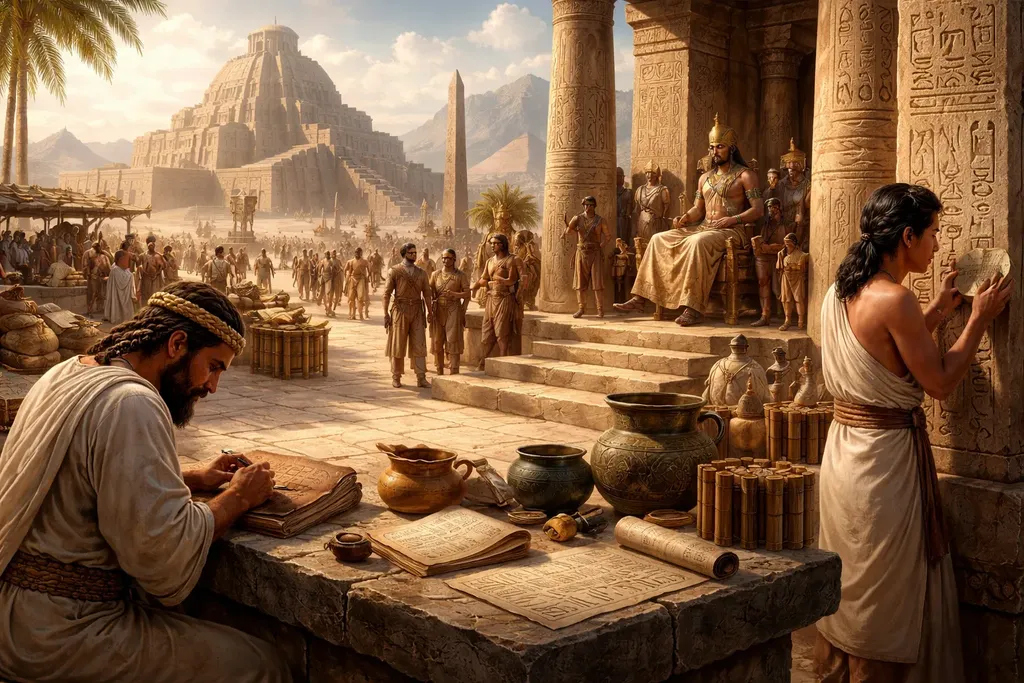
Ancient religions are also inscribed in places. The sacred needs consecrated, distinguished, protected, and organized spaces. These may be monumental temples, urban sanctuaries, sacred mountains, necropolises, springs, groves, altars, or palaces invested with a religious function.
These places are not mere scenery. They structure social and political space. A temple may be at once:
- a place of worship;
- an economic center;
- an archive space;
- a symbol of prestige;
- an anchor point of collective memory;
- a place of mediation between human power and divine order.
In some regions, temples play a major role in managing wealth, personnel, offerings, and land. Elsewhere, they are above all ritual and symbolic centers. But in all cases, they help materialize the sacred.
What Sacred Space Produces
- a separation between the ordinary and the extraordinary;
- a hierarchy of places;
- symbolic centrality;
- visibility of religious power;
- memory inscribed in stone, image, or rite;
- a territorial anchoring of the community.
Sacred space is therefore a way of making the invisible visible.
Political Power and Sacred Legitimacy
One of the major traits of many ancient worlds is that power does not present itself as purely human. The queen or king may be considered chosen by the gods, descended from a sacred lineage, a mediator between heaven and earth, the guarantor of cosmic order, or sometimes even endowed with a divine character.
This sacred legitimation fulfills several functions:
- it strengthens the authority of power;
- it inscribes government within a higher order;
- it turns political disorder into a cosmic threat;
- it gives obedience a religious dimension;
- it links the stability of the kingdom to the balance of the world.
Royal or imperial power may thus be accompanied by specific rituals, sacred coronations, religious titles, commemorative monuments, victory inscriptions, cultic foundations, or mythical genealogies.
Possible Forms of Sacred Power
- divine or semi-divine kingship;
- ruler as guarantor of cosmic order;
- alliance between throne and clergy;
- power founded on prestigious ancestors;
- heavenly mandate or sign of divine favor;
- sacralization of the dynasty;
- ritual function of the king or queen.
One should not imagine that all ancient worlds functioned in the same way, but it must be remembered that the modern separation between politics and religion is often much less clear there.
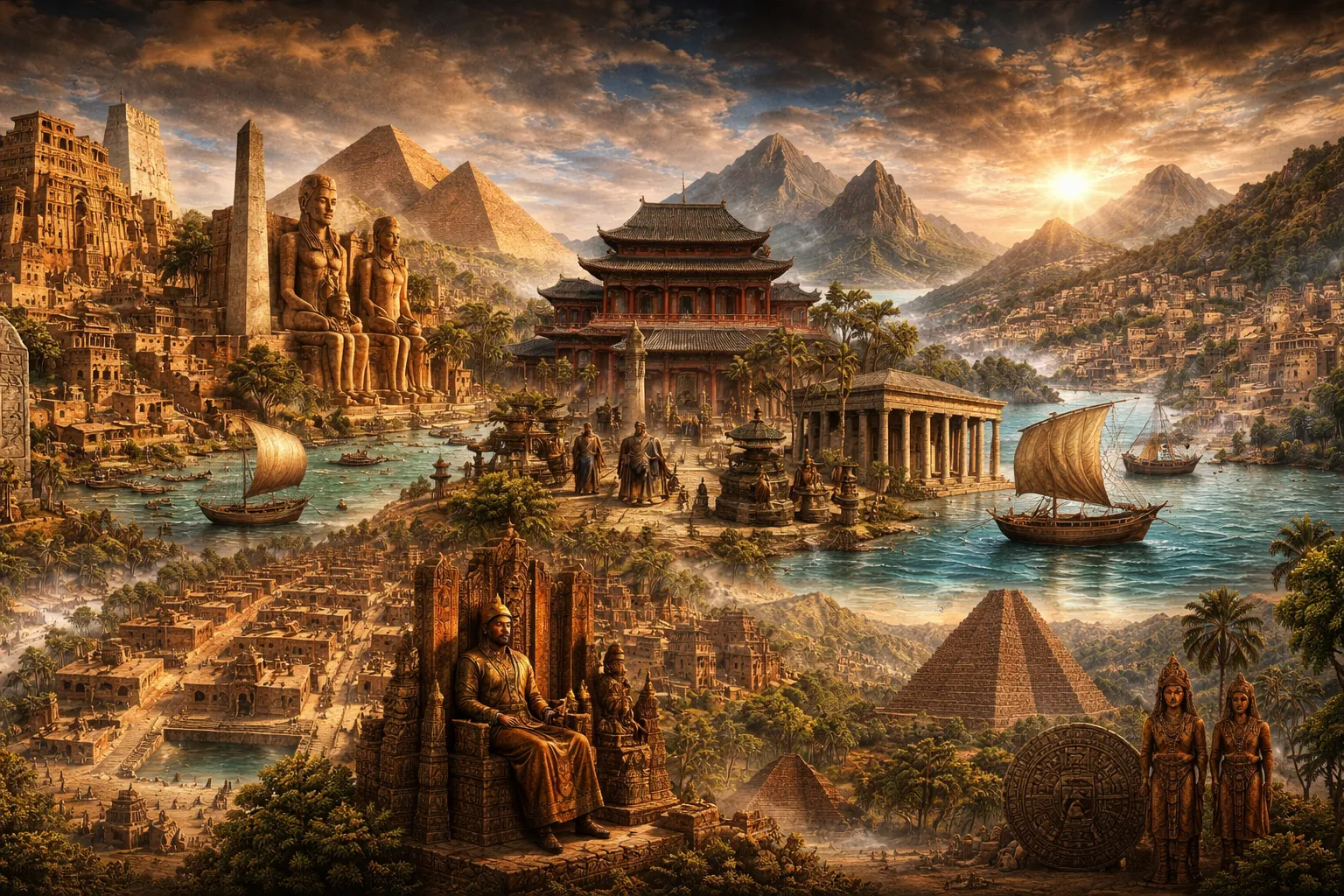
Examples of Religious Configurations in the Ancient Worlds
To better understand this diversity, it is useful to recall a few major configurations without reducing them to caricatures.
Mesopotamia
In the Mesopotamian worlds, gods are linked to cities, cosmological functions, kingship, natural forces, and the order of the world. Temples play a major role, and kings often present themselves as protected, chosen, or mandated by the gods. Myth, divination, offering, and royal inscription all participate in the organization of power.
Important Points
- complex pantheons;
- strong link between temple, city, and power;
- role of divination;
- royal inscriptions of legitimation;
- myths of creation and order.
Ancient Egypt
In Egypt, religion deeply permeates kingship, death, monumentality, and the very conception of world order. The pharaoh is not only a political ruler: she or he is also linked to cosmic stability. Temples, tombs, funerary rites, and representations of the passage into the afterlife occupy an immense place.
Important Points
- sacred kingship;
- centrality of cosmic order;
- weight of funerary rites;
- religious monumentality;
- articulation between eternity, memory, and power.
Ancient China
In ancient China, the relationship to ancestors, rites, heavenly order, and legitimacy plays a central role. Power is understood not only through force, but also through its ability to conform to a broader order. Political rites, ancestral cults, and conceptions of harmony strongly structure authority.
Important Points
- ancestor worship;
- weight of ritual;
- link between authority and heavenly order;
- legitimacy conceived within a cosmological framework;
- continuity between government and moral order.
Ancient Indian Worlds
The ancient Indian worlds also show a strong articulation between cosmology, rite, social order, and power. Their religious traditions are diverse and evolving, but they play a major role in defining time, world order, duties, hierarchies, and spiritual paths.
Important Points
- richness of religious traditions;
- importance of rites and texts;
- articulation between cosmic order and social order;
- philosophical and ritual depth;
- structuring role of sacred narratives and practices.
Ancient American Worlds
In several ancient civilizations of the Americas, cosmologies, ritual calendars, sacrifices, ceremonial spaces, and sacred forms of power occupy a decisive place. Religion strongly structures time, urban space, hierarchies, and the relationship to the cosmos.
Important Points
- strong cosmological dimension;
- importance of ceremonial centers;
- link between calendar, power, and rites;
- sacred monumentality;
- articulation between political order and cosmic order.
These examples show that there are several ways of articulating religion, myth, and power, and that none of them alone can serve as a universal norm.
Priestesses, Priests, Diviners, and Intermediaries of the Sacred
Ancient religion often presupposes specialists. These may be priestesses, priests, diviners, oracle keepers, sacred scribes, guardians of worship, interpreters of signs, astrologers, chanters, or ritual officials. Their role varies according to societies, but their existence shows that the relationship to the sacred often requires recognized skills.
These intermediaries may:
- perform rites;
- maintain sanctuaries;
- interpret omens;
- preserve traditions;
- manage liturgical calendars;
- supervise offerings;
- advise power;
- connect the political and the religious.
In some cases, these specialists form powerful institutions. In others, their role remains more local or more diffuse. But they almost always participate in structuring the sacred within collective life.
Divination, Omens, and the Interpretation of the World
In many ancient worlds, the future is not considered totally opaque. It can be questioned through signs. The flight of birds, sacrificial entrails, dreams, the stars, certain natural phenomena, oracles, and other forms of consultation make it possible to interpret divine will or the hidden structure of events.
Divination is not a marginal detail. It may intervene in:
- war;
- the founding of a city;
- political decision-making;
- the choice of a ritual date;
- the reading of a crisis;
- the interpretation of a catastrophe;
- the legitimation of a reign;
- the search for balance with invisible powers.
It shows that the ancient worlds do not clearly separate practical decision-making from consultation of the sacred. Governing, fighting, building, traveling, or judging may require a reading of the invisible world.
Death, Ancestors, and the Afterlife
Ancient religions give immense importance to death, because it does not simply mark a biological end. It often opens onto another condition, another world, another form of existence, or another kind of memory. Funerary practices, tombs, offerings to the dead, ancestral cults, and representations of the afterlife therefore play a structuring role.
Ancient societies may believe:
- in the survival of the soul or of a component of the person;
- in a realm of the dead;
- in a judgment;
- in a transformation of being;
- in the continued presence of ancestors;
- in the need to nourish or honor the dead;
- in a link between family order, memory, and the power of the deceased.
These beliefs give funerary rites major importance. Honoring the dead is not merely expressing emotion: it is maintaining a necessary relationship between generations, memory, and the order of the world.
Religion as a Political, Moral, and Symbolic Framework
One essential point must be stressed: in Antiquity, religion does not only serve to explain the universe or to console in the face of death. It also organizes obligations, belongings, prohibitions, hierarchies, and representations of what is just.
Religion may thus:
- legitimize authority;
- define duties;
- regulate behaviors;
- sacralize alliances;
- protect certain spaces or objects;
- establish collective times;
- rank functions;
- distinguish the pure from the impure;
- give form to a common memory.
This does not mean that everything is homogeneous or stable. Ancient religions also know tensions, transformations, rivalries of cults, reforms, syncretisms, and conflicts of interpretation. But even through change, religion remains a structuring force.
Limits and Precautions
Several mistakes must nevertheless be avoided when studying religions, myths, and sacred powers in Antiquity.
Important Precautions
- not to reduce myth to a naive fiction;
- not to believe that all ancient religions resemble one another;
- not to project onto Antiquity the modern separation between private and public;
- not to suppose that religion excludes all rationality;
- not to reduce sacred power to a mere manipulation;
- not to forget social, regional, and chronological variations;
- not to confuse lived religion, official religion, and the discourse of power.
These precautions make it possible to better understand the richness and complexity of the ancient worlds without caricaturing them.
Why This Chapter Is Essential
This chapter is essential because it shows that the ancient worlds cannot be understood only through economy, war, cities, or institutions. They also rest on great symbolic architectures. Religion, myth, and sacred power give coherence to the world, connect the community to an origin, inscribe the present within a cosmic order, and give power a depth greater than the merely human.
Through this perspective, we better understand:
- why kings build temples;
- why origin narratives are so important;
- why rites structure collective time;
- why death and ancestors occupy a central place;
- why power so often seeks to present itself as willed, chosen, or guaranteed by the sacred.
Studying religions, myths, and sacred powers is therefore entering into the symbolic heart of Antiquity.
Essential Ideas to Remember
- in Antiquity, religion often structures the whole of collective life;
- myth is a foundational narrative, not a simple fable;
- rites make concrete the relationship between humans and higher powers;
- political power is often legitimized by the sacred;
- ancient religions are multiple and highly diverse;
- death, ancestors, and the afterlife occupy a central place;
- any simplistic or homogenizing reading of ancient religion must be avoided.