
The Invention of Writing and the State
Introduction
After identifying the first great centers of civilization, we must now understand how these societies were able to organize memory, authority, exchange, and collective life in a lasting way. Two phenomena play a decisive role here: the invention of writing and the formation of the state. These two dynamics did not arise everywhere at the same moment, nor in the same forms, but they profoundly transformed ancient societies.
Writing makes it possible to record, preserve, transmit, and order. The state, for its part, makes it possible to govern, coordinate, extract, protect, dominate, and give stable form to power. The two are not the same thing, but they often reinforce one another. Writing makes administration more durable and more precise; the state gives writing institutional, political, fiscal, religious, and legal uses.
This chapter therefore does not seek to tell the story of a single invention that would then spread everywhere in the same way. Rather, it aims to understand how, in several regions of the ancient world, societies developed tools of memory and structures of power capable of going beyond the scale of the simple village, lineage, or local chiefdom.
Why Does Writing Constitute a Major Break?
Writing is often presented as one of the great thresholds in human history. This idea is correct, provided we understand clearly what it means. Writing does not suddenly replace every earlier form of memory, nor does it make orality, rites, images, or symbolic objects useless. But it introduces a new possibility: that of fixing certain contents in a more stable way, reproducing them, archiving them, and mobilizing them across time and space.
Thanks to writing, a decision no longer depends only on the immediate presence of the one who speaks or the one who commands. A rule can be recorded, an account can be checked, a narrative can be transmitted, an offering can be registered, a debt can be recalled, a power can assert itself through inscription. Writing therefore allows an extension of social memory.
What Writing Makes Possible
- preserving information more durably;
- recording transactions;
- fixing names, titles, and functions;
- formalizing certain political decisions;
- transmitting religious or mythical narratives;
- accumulating archives;
- organizing specialized knowledge;
- symbolically asserting authority.
The importance of writing therefore comes less from the simple fact of “tracing signs” than from its capacity to restructure the functioning of societies.
Writing Does Not Appear Everywhere in the Same Way
There is no single origin of writing valid for all humanity. Several regions of the world produced, at different moments, graphic systems responding to their own needs and their own cultural logics. This prevents us from thinking of writing as a single invention followed by a simple universal copy.
In some cases, the earliest signs seem linked to accounting, storage, exchange, or administration. In others, writing is also closely associated with ritual, the legitimacy of power, divination, or religious memory. It therefore does not have everywhere the same starting point, nor the same dominant function.
A Few Major Cases to Remember
- Mesopotamia: early development of cuneiform writing, first linked to administrative and economic uses, then extended to other domains;
- ancient Egypt: hieroglyphs associated with power, the sacred, monumental inscription, and administrative uses;
- ancient China: early development of written forms in a ritual, political, and divinatory framework;
- the Indus Valley: presence of signs or of a system not yet fully deciphered;
- ancient American worlds: existence of inscription and notation systems in certain civilizations, according to their own logics.
It must therefore be remembered that writing is plural in its forms, its supports, its functions, and its meanings.
Before and Around Writing: The Power of Orality
Emphasizing the importance of writing must never lead us to look down on oral-tradition societies or to believe that they were “less historical.” Long before writing, and often for a long time alongside it, human societies preserved and transmitted a very rich memory.
Genealogies, founding narratives, poems, ritual formulas, songs, memorized laws, technical gestures, and cosmological knowledge could circulate without written support. Orality is not the absence of memory: it is another way of organizing memory, often more performative, more relational, and more collective.
Orality Makes It Possible, in Particular, to
- transmit origin narratives;
- preserve community rules;
- learn techniques;
- memorize lineages and alliances;
- perform ritual recitations;
- diffuse knowledge through repetition and performance.
Writing therefore transforms memory without abolishing other forms of transmission. In many ancient worlds, orality and writing coexist, complement one another, and sometimes compete for authority.
Why Does the State Emerge?
The state appears when power becomes more durable, more centralized, or more structured than before, and when it equips itself with regular means of administering a territory, governing a population, extracting resources, imposing norms, and organizing collective functions. Here again, there is no single model. There are diverse forms of state, more or less centralized, more or less bureaucratic, more or less sacred.
The emergence of the state generally responds to the increase of social complexity. When populations grow, cities expand, exchange develops, conflicts multiply, or collective works become more important, it becomes necessary—or possible—to establish more stable structures of command and coordination.
Frequent Factors in the Formation of the State
- demographic growth;
- urban concentration;
- need to organize irrigation or major works;
- military protection or warlike expansion;
- management of agricultural surpluses;
- increased social hierarchy;
- assertion of political or priestly elites;
- desire to stabilize order and levies.
The state is therefore not just an abstract “political invention.” It forms in concrete contexts where it responds to organizational needs, while in return producing new forms of domination.
Writing and the State: A Close Relationship
One of the essential points of this chapter is understanding that writing and the state often maintain a relationship of mutual reinforcement. The state needs memory, accounting, lists, categories, orders, traces, and legitimation. Writing provides precisely these tools. Conversely, when a structured power exists, it offers writing regular frameworks of use: administration, taxation, worship, law, propaganda, diplomacy.
This articulation is neither automatic nor total, but it is very frequent. Writing becomes an instrument of government as much as a support of culture.
Areas in Which Writing Serves the State
- censuses;
- taxes and levies;
- inventories of goods;
- palace or temple archives;
- laws and decrees;
- official correspondence;
- prestige inscriptions;
- treaties and agreements;
- dynastic memory;
- organization of worship.
This is why the history of writing is not only that of literature or knowledge; it is also that of administration, power, and the ordering of the social world.
The Mesopotamian Case: Administering, Counting, Governing
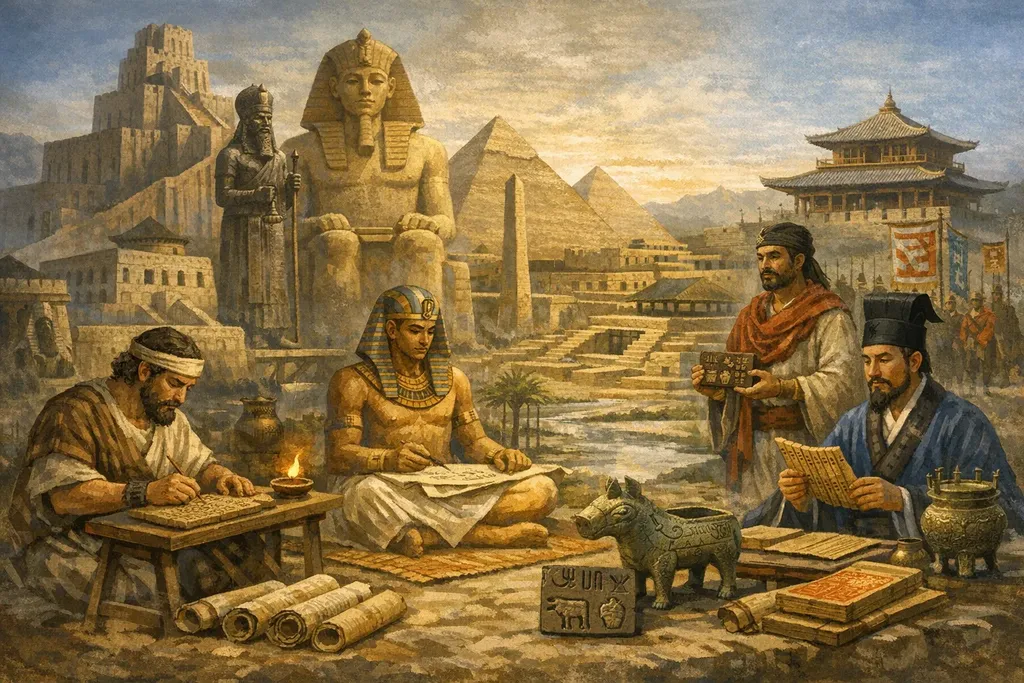
Mesopotamia offers a particularly illuminating example of the articulation between writing and power. The first forms of notation appeared there in contexts linked to the management of goods, stocks, exchanges, and institutions. Over time, cuneiform writing became a much broader tool, used for administration, narratives, learned knowledge, political correspondence, and legal texts.
In Mesopotamian cities and later kingdoms, writing participated in the construction of a governable space. It made it possible to record resources, identify obligations, fix certain norms, and archive decisions. It therefore enabled an administration more durable than the simple immediate memory of individuals.
What the Mesopotamian Case Shows
- the strong initial link between writing and management;
- the role of temples and palaces in documentary production;
- the gradual extension of the uses of writing;
- the formation of a specialized scribal culture;
- the relation established between power, archive, and legitimacy.
Mesopotamia thus shows that writing was not born only to “tell stories,” but also to count, classify, control, and administer.
The Egyptian Case: Writing to Govern and to Sacralize
In ancient Egypt, writing is not limited to a utilitarian function. It also participates in the monumentality of power, the sacralization of authority, and the durable inscription of a cosmic and political order. Hieroglyphs appear on monuments, in tombs, in spaces of worship, but also in more administrative uses through other forms of writing.
Pharaonic power relies on an administration, on scribes, on archives, and on practices of recording that make the management of territory and resources possible. But Egyptian writing also has a very strong visual and symbolic dimension. To write is not only to note down; it is also to make present, to consecrate, to perpetuate.
The Egyptian Case Highlights
- the articulation between writing and sacred kingship;
- the role of scribes in the organization of the state;
- the coexistence of monumental, religious, and administrative functions;
- the symbolic power of inscription;
- the relation between funerary memory and political permanence.
The Egyptian example reminds us that writing is not everywhere primarily accounting-based: it can be just as much political, religious, and cosmological.
The Chinese Case: Writing, Ritual, and Legitimacy
In ancient China, the earliest known forms of writing are linked to ritual, divinatory, and political practices. This shows that writing can emerge not only in order to manage goods, but also to question the order of the world, inscribe the relationship between power and cosmos, and formalize legitimacy.
Over time, writing also becomes a central tool of administration, government, and literate culture. It contributes to structuring the state, but also to producing a durable intellectual and political tradition.
The Chinese Case Emphasizes
- the link between writing and ritual;
- the importance of cosmological legitimacy;
- the gradual integration of writing into government;
- the birth of influential literate traditions;
- the relation between political form and written culture.
This case is valuable because it shows that writing does not have a single functional origin. It can emerge in a universe where governing, interpreting signs, and maintaining ritual order are closely linked.
The State Is Not Identical Everywhere
Speaking of the “state” in the singular can be useful, but it must immediately be recalled that there are very different forms of political structuring. Some states are strongly centralized, others more fragmented. Some rely on a developed bureaucracy, others on local intermediaries. Some present themselves as sacred, while others place greater emphasis on war, lineage, or law.
We must therefore avoid imagining a single trajectory that would lead all societies from clan to city and then to empire according to the same pattern. The forms of the ancient state are multiple.
Possible Variations
- degree of centralization;
- weight of the administration;
- role of religious elites;
- importance of the army;
- place of the dynasty;
- relation between center and peripheries;
- level of legal unification;
- capacity for archiving and recording.
The value of a comparative approach lies precisely in recognizing these differences without denying the common points.
Writing as Symbolic Power
Writing is not only useful; it is also prestigious. In many ancient worlds, knowing how to write, mastering signs, reading archives, or producing inscriptions distinguishes certain categories of the population. This creates new mediations between power and the rest of society.
Scribes, literate men and women, priestesses and priests, administrators, or archive specialists may thus occupy an important place. Writing then becomes a power of naming, classifying, interpreting, and sometimes excluding.
Writing Can Be a Power Because It Allows
- officially defining things;
- fixing obligations;
- authenticating decisions;
- transmitting orders at a distance;
- monopolizing certain forms of knowledge;
- distinguishing specialists from non-specialists;
- inscribing official memory.
Thus, the invention of writing also transforms social hierarchies and relationships to authority.
Limits and Precautions
It would, however, be misleading to think that writing and the state alone are sufficient to define the complexity of a society. Some highly elaborate societies rest largely on other forms of organization. Others possess writing without forming centralized states comparable to those of the great empires. Conversely, some forms of power may be strong without relying on an abundance of preserved documents.
Several precautions must therefore be kept in mind.
Important Precautions
- not to confuse the absence of preserved writing with the absence of history;
- not to confuse state and civilization;
- not to make bureaucracy the sole criterion of complexity;
- not to imagine an identical universal progression;
- always to place institutions back into their cultural context.
These precautions help avoid an overly mechanical or overly hierarchical vision of the past.
Why This Chapter Is Essential
This chapter is central because it shows how ancient societies became capable of lasting, remembering, governing, and representing themselves on a large scale. Writing expands social memory; the state structures authority. Together, they make possible a new historical density.
Thanks to them, societies can:
- stabilize decisions;
- archive relationships;
- organize resources;
- affirm dynastic continuity;
- inscribe beliefs;
- transmit knowledge more broadly;
- administer larger territories.
To understand the invention of writing and the state is therefore to understand how the ancient worlds gave themselves durable forms of memory and power.
Essential Ideas to Remember
- writing is a major break, but it does not completely replace orality;
- it appears in diverse forms depending on the region;
- the state emerges with the growing complexity of societies and the need for coordination;
- writing and the state often mutually reinforce one another;
- Mesopotamia, Egypt, and China offer major examples of this articulation;
- writing is also a symbolic power, not only a technical tool;
- there is no single universal model of the ancient state.
Transition to the Next Chapter
Once the invention of writing and the formation of the state have been understood, a new question appears: how did ancient societies connect human power to the order of the world, to the sacred, to the gods, to the ancestors, and to invisible forces?
The next chapter can therefore focus on religions, myths, and sacred powers.