The First Centers of Civilization
Introduction
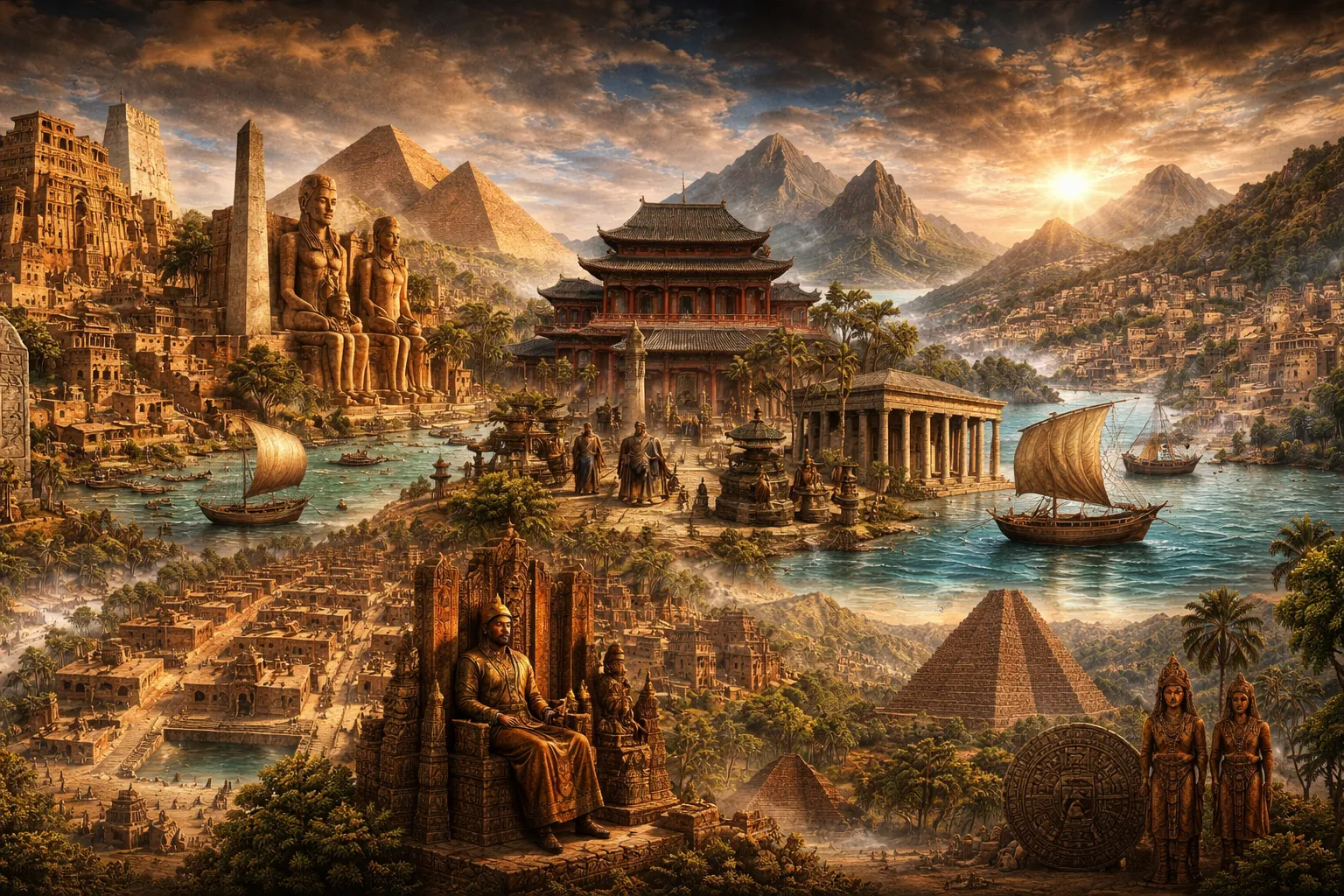
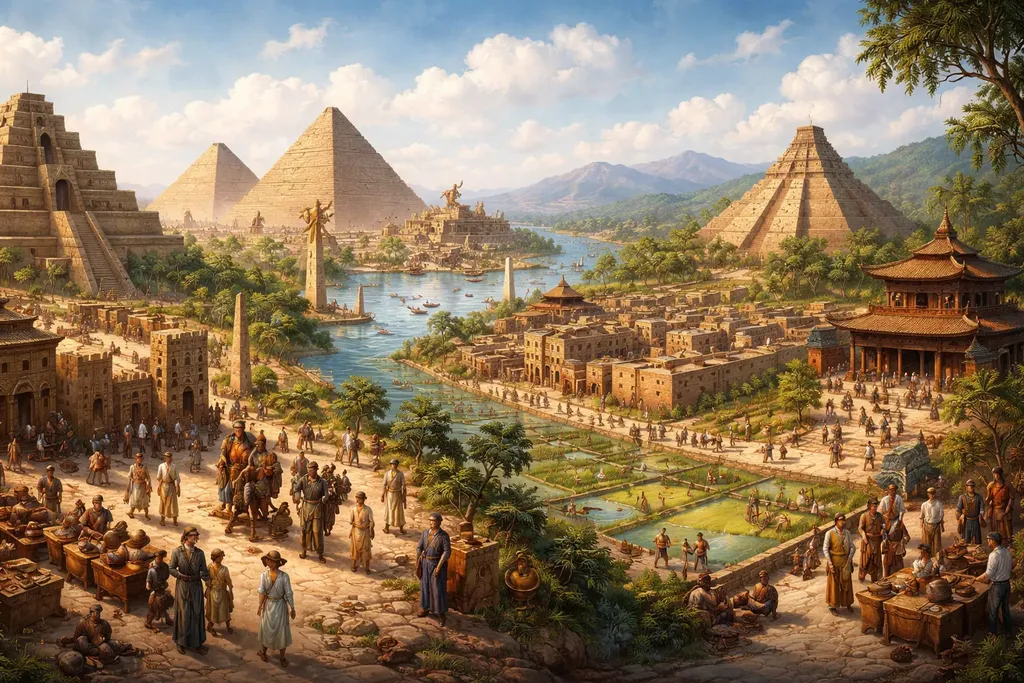
After defining Antiquity as a major period in the structuring of human societies, we must now ask where the first great centers of civilization appeared. The answer is not limited to a single place, nor to a single historical path. Several regions of the world saw the emergence, at different rhythms, of lasting forms of urban life, organized power, social specialization, monumentality, institutionalized beliefs, and sometimes writing. These centers were not identical, but they shared the fact that they produced increasingly complex collective frameworks, capable of organizing vast populations and leaving deep traces in history.
Speaking of “centers of civilization” does not mean that there were “civilized” peoples as opposed to others who were not. Here, the expression refers to spaces where certain forms of historical structuring became concentrated early on: lasting cities, exchange networks, centralized or hierarchical powers, learned traditions, major symbolic systems, and important artistic productions. This notion must therefore be used with care, as an analytical tool, not as a hierarchy of value between human societies.
The purpose of this chapter is to present the main centers of the ancient world, to show their specificities, and to identify the major common points that help explain why they occupy such a central place in the history of Antiquity.
What Is a Center of Civilization?
A center of civilization is a space in which several fundamental dimensions of large-scale collective life develop early and durably. It is not simply an ancient place or a large population, but a setting in which relatively complex forms of human organization take shape.
Several recurring features can be identified
- development of permanent urban centers;
- intensification of agriculture and management of resources;
- more visible social hierarchies;
- emergence of structured political powers;
- specialization of activities;
- regional or long-distance exchanges;
- monumental architecture;
- strong religious or ritual institutions;
- organized collective memory, sometimes supported by writing.
These criteria should not be used as a rigid framework. Not all centers bring together exactly the same elements at the same moment, nor in the same form. The main value of the notion is comparative: it makes it possible to identify regions where human organization reached a high degree of historical density.
Why Do These Centers Appear in Certain Regions?
The first centers of civilization did not emerge by chance. They appeared in contexts where several factors combined. Their birth must never be reduced to a simple “natural cause,” but the geographical setting often played an important role.
Frequently present factors
- river valleys favorable to agriculture;
- relatively stable water resources;
- fertile lands allowing surpluses;
- possibilities for movement and exchange;
- gradual concentration of populations;
- need to organize collective labor;
- assertion of powers capable of coordinating or dominating.
Great rivers often occupy a central place, because they enable agricultural production, transport, communication, and sometimes the symbolic unification of a territory. But rivers do not explain everything. Societies also actively transformed their environment through irrigation, dikes, roads, agricultural calendars, religious constructions, and political institutions. Centers of civilization therefore arose at the intersection of environmental conditions and organized human responses.
Mesopotamia: A Very Ancient Center of Cities, States, and Writing
Mesopotamia, located between the Tigris and the Euphrates, is often considered one of the oldest great centers of civilization. In this region, important cities, powerful temples, structured political authorities, and early forms of writing developed very early. It thus offers a major example of an ancient urban society.
Mesopotamian cities were not simple clusters of dwellings. They were political, economic, religious, and symbolic centers. Cities such as Uruk, Ur, Lagash, and Babylon show the existence of societies capable of organizing agricultural production, redistribution, cults, administration, and sometimes warfare on a large scale. Temples and palaces played a fundamental role in the concentration of wealth and power.
What Mesopotamia contributed to ancient history
- rise of great urban cities;
- emergence of kingdoms and then empires;
- development of cuneiform writing;
- elaborate legal and administrative traditions;
- influential cosmologies, myths, and learned knowledge;
- religious and political monumentality.
Mesopotamia is essential not because it would be “the absolute beginning” of all civilization, but because it shows very early on a particularly visible combination of city, power, religion, administration, and written memory.
Ancient Egypt: Continuity, Centralization, and Monumentality
Ancient Egypt constitutes another fundamental major center. Structured around the Nile Valley, it displays remarkable political and religious continuity over a very long duration. The Nile played a vital role: it fertilized the land, set the rhythm of agriculture, and connected the different parts of the territory. But here again, the environment does not explain everything. Egypt built strong political centralization, a powerful royal imagination, and exceptional monumentality.
Pharaonic power embodied this articulation between political authority, the sacred, and cosmic order. The Egyptian state developed impressive organizational capacities, visible in great constructions, administration, funerary cults, and territorial management. Pyramids, temples, painted tombs, and colossal statues were not simple aesthetic demonstrations: they expressed a conception of the world, of power, and of permanence.
Major traits of the Egyptian center
- strong relationship to the Nile and its cycles;
- lasting political centralization;
- sacred kingship;
- hieroglyphic writing and scribal traditions;
- major monumental achievements;
- deep religious and funerary continuity.
Ancient Egypt shows that a center of civilization can be characterized not only by innovation, but also by a strong capacity to preserve and reformulate symbolic and political structures over the long term.
The Indus Valley: Urbanism, Organization, and a Relative Enigma
The civilization of the Indus Valley, often less present in classical narratives, nonetheless constitutes a major center of early Antiquity. It developed across a vast region corresponding to part of the northwestern Indian subcontinent. Sites such as Mohenjo-daro and Harappa reveal remarkably organized cities, with regular plans, drainage systems, coherent built spaces, and advanced urban management.
This civilization is especially fascinating because it shows a high degree of organization even though we still do not possess a secure reading of its written signs. An important part of its political, religious, and social functioning therefore remains difficult to reconstruct. Yet its urban planning, craftsmanship, exchanges, and the standardization of certain objects testify to a remarkable level of structuring.
Characteristic elements of the Indus Valley
- planned cities;
- mastery of circulation and water management;
- developed craftsmanship;
- regional and long-distance exchange;
- forms of writing or signs not yet fully deciphered;
- collective organization visible in the urban fabric.
This center reminds us of something essential: our knowledge of the past also depends on the sources available. A civilization can be major even if it remains partly silent to us.
Ancient China: State, Ritual, and Long Civilizational Continuity
Ancient China represents a major center because of the depth of its political, ritual, and intellectual continuities. The first state dynamics took shape there within a framework in which power, rites, kinship, warfare, and writing were closely articulated. Very early on, centers of power, court traditions, refined ritual objects, and a body of thought organized around order, legitimacy, and the relationship between heaven, earth, and authority developed there.
The ancient history of China should not be reduced to a single dynasty or a single political form. What matters here is the early establishment of a civilization endowed with institutions, literate practices, powerful ritual frameworks, and a great capacity for continuity and transformation.
Important traits of the ancient Chinese center
- assertion of structured political centers;
- major role of rites;
- early development of writing;
- production of elaborate ritual and artistic objects;
- close relationships between power, cosmology, and social order;
- very marked civilizational continuity despite transformations.
Ancient China shows that the first centers of civilization were not only places of urban emergence, but also durable frameworks of thought, government, and transmission.
Ancient African Worlds: A Plurality of Paths
Ancient Africa cannot be reduced to Egypt, even though Egypt fully belongs to it. The African continent followed very diverse paths, with kingdoms, commercial centers, political formations, and varied artistic cultures. One of the major challenges of a non-Eurocentric approach lies precisely in restoring this diversity, which is often underrepresented in traditional narratives.
Some regions saw the early development of forms of centralization, long-distance exchange, artisanal and metallurgical traditions, as well as strong symbolic constructions. Others organized collective life differently, without being any less complex. It is therefore preferable to speak of ancient African worlds in the plural.
Key points to remember
- great regional diversity;
- importance of trans-Saharan and regional exchanges depending on the period;
- existence of varied kingdoms and centers of power;
- rich artistic, technical, and religious traditions;
- need to avoid a homogenizing vision of the continent.
Fully including the African worlds among the first centers of civilization helps correct a long historiographical marginalization and truly broadens the map of Antiquity.
Ancient American Worlds: Civilizations Beyond the Mediterranean Narrative
The ancient civilizations of the Americas should not be thought of as a distant appendage to the ancient narrative, but as historical centers in their own right. They developed their own urban centers, their own cosmologies, their own forms of power, their own monumental arts, and their own knowledge systems. Even if their timelines do not always exactly overlap with Mediterranean periodizations, their inclusion is essential in an overall view of the ancient world.
Mesoamerican and Andean societies, among others, testify to powerful capacities for organization, symbolic construction, observation of the world, and political hierarchy. They show that there are several ways of reaching a high level of social, religious, and artistic complexity.
What their study brings
- decentering of the classical ancient narrative;
- a more global understanding of forms of civilization;
- highlighting other relationships to time, the cosmos, and power;
- recognition of major urban and monumental traditions.
Their place in the study of Antiquity reminds us that no map of the ancient world is complete if it forgets the Americas.
Connected or Parallel Centers?
Not all the first centers of civilization were in direct contact from the beginning. Some developed in connected ways, others more in parallel. Two excesses must therefore be avoided:
- imagining an ancient world totally isolated in separate blocks;
- imagining instead an immediate and total connection between all centers.
Reality is more nuanced. Exchanges existed very early between certain nearby or gradually connected regions. Other centers evolved largely according to their own internal logics for long periods. What matters is understanding both:
- the existence of original local dynamics;
- the possibility of gradual circulations;
- the role of contacts in historical transformations;
- the intrinsic value of each trajectory, even without direct contact.
This perspective makes it possible to avoid measuring all civilizations against a single diffusing center.
Common Points Between the First Centers
Despite their diversity, the first centers of civilization share several common points that make comparison possible without confusing them.
Frequent common points
- strong territorial anchoring;
- sustained agricultural organization;
- growth of urban centers;
- relative concentration of power;
- important religious institutions;
- more visible social hierarchies;
- development of monumental or codified arts;
- structuring of collective memory;
- capacity for large-scale coordination.
But also strong differences
- varying pace of development;
- different place of writing;
- varying degree of centralization;
- distinct types of belief;
- diverse political forms;
- different relationships between city, countryside, power, and the sacred.
Comparison should therefore never lead to uniformity. Here, comparison serves to bring out both convergences and singularities more clearly.
Why This Chapter Is Essential
Studying the first centers of civilization helps us understand that Antiquity does not begin with a single people, nor with a single region. It is born in several spaces of the world, according to their own logics, but around often comparable questions: how can collective life be organized on a large scale? how should power be distributed? how can human beings, gods, the earth, and time be connected? how can memory be transmitted? how can lasting forms be built?
This chapter is therefore central, because it offers the basic map for everything that follows. The following chapters will be able to deepen:
- writing and memory;
- powers and religions;
- exchanges;
- the arts and knowledge;
- legacies.
Essential Ideas to Remember
- the first centers of civilization appeared in several regions of the world;
- they do not form a single model;
- Mesopotamia, Egypt, the Indus Valley, ancient China, several African worlds, and the ancient American worlds occupy a major place;
- a center of civilization is recognized by strong collective structuring, not by any supposed superiority;
- these centers are both comparable and profoundly different;
- a non-Eurocentric approach makes it possible to better understand the true plurality of the beginnings of Antiquity.
Transition to the Next Chapter
Once the first great centers of civilization have been identified, another question naturally arises: how did these societies preserve, organize, and transmit memory, power, beliefs, and knowledge?
The next chapter can therefore focus on the invention of writing and the state.