Defining Antiquity
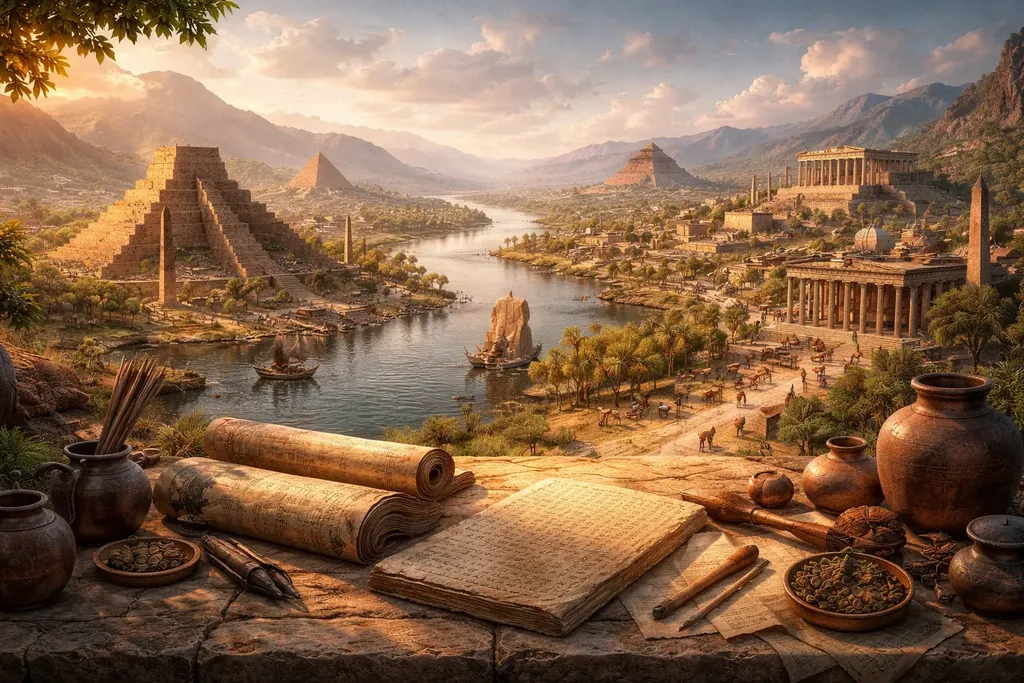
What Do We Mean by “Antiquity”?
Antiquity is a major period in human history which, in a broad definition, corresponds to the rise of the first complex civilizations and the emergence of societies organized around cities, structured forms of power, institutionalized beliefs, large-scale exchanges, and, in several regions, systems of writing. It therefore does not simply refer to a very ancient past: it points to a moment when human societies changed scale, became more enduring in their institutions, broader in their networks, and more visible in the traces they left behind.
In classical European teaching, Antiquity is often framed between the invention of writing in the Near East and the fall of the Western Roman Empire in 476. This definition long served as a practical reference point, but it has an important limitation: it is based above all on the rhythm of Mediterranean and European history. Yet on a global scale, historical timelines do not perfectly coincide. Some ancient civilizations developed before, during, or after these boundaries, according to their own dynamics. Defining Antiquity therefore requires going beyond a simple framework inherited from European history.
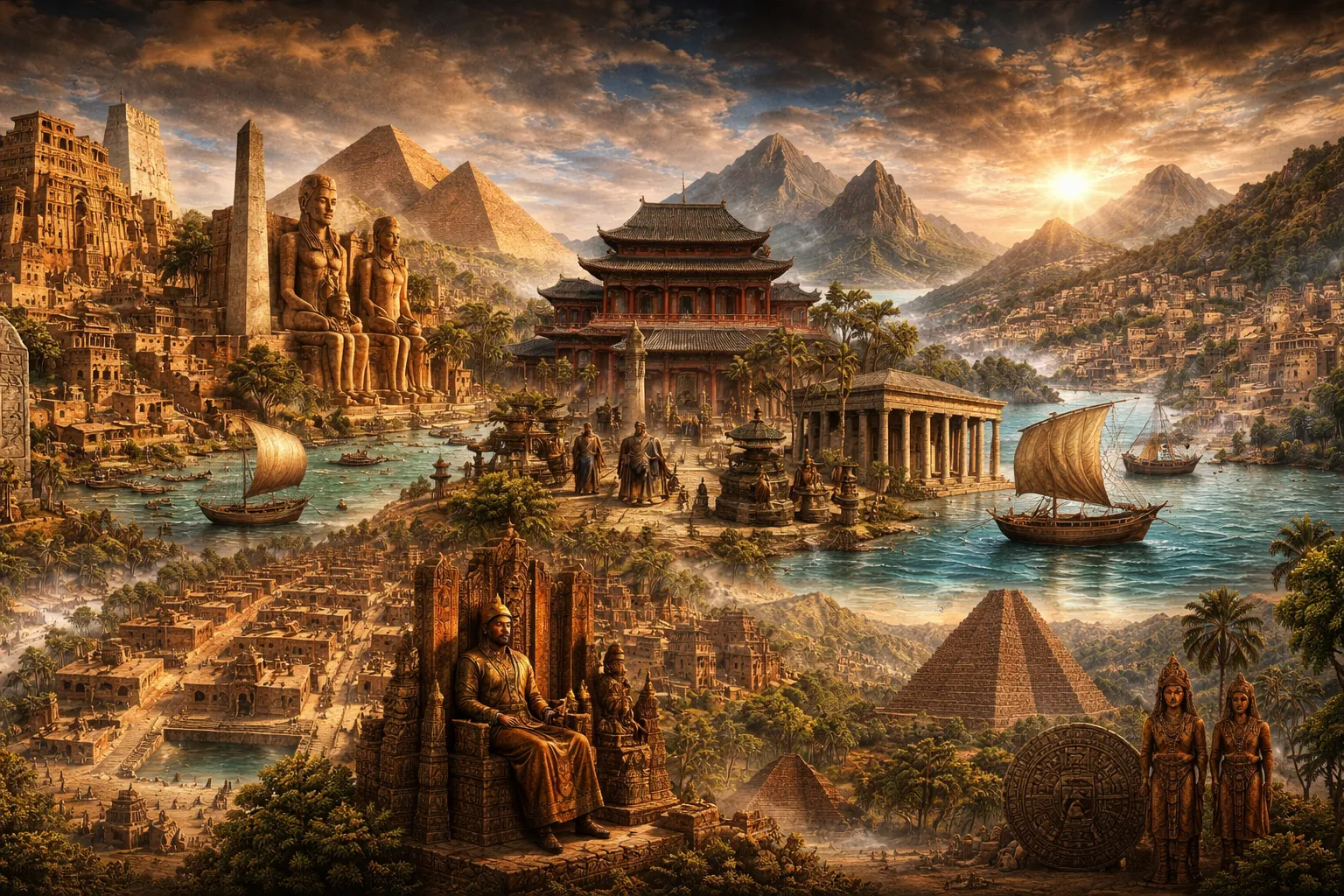
Antiquity can thus be understood as a period of formation, consolidation, and expansion of the great ancient worlds, marked by the emergence of lasting political structures, powerful religious traditions, elaborate artistic forms, extensive exchange networks, and organized bodies of knowledge. This broader definition makes it possible to include several centers of civilization without reducing the era to a single space.
A Period, but Not a Universal Date
One of the first things to understand is that there is no single universal date that would bring all humanity into Antiquity at the same moment. Human societies did not evolve everywhere at the same pace, nor in the same forms. Some regions saw the very early appearance of great cities, centralized states, or written traditions. Others experienced different types of organization, equally rich, but following different trajectories.
It is therefore necessary to distinguish between two ways of speaking about Antiquity:
- Antiquity in the classical school sense, mainly based on the ancient Mediterranean;
- Antiquity in a comparative and global sense, referring to the age of the great ancient civilizations in several regions of the world.
This nuance is essential, because it prevents a local chronology from being turned into a universal norm. It also helps us better understand that ancient worlds were not “behind” or “ahead” of one another: they responded to different historical, geographical, and cultural conditions.
General Chronological Markers
Here is a simple way to situate Antiquity without confining it to a single framework:
- approximate beginning: the appearance of the first writing systems and the first major state formations in certain regions;
- core period: the development of cities, kingdoms, empires, sanctuaries, trade networks, and learned knowledge;
- variable ending depending on the region: political, religious, and cultural transformations that open onto other historical periods.
In other words, Antiquity is not a closed box identical everywhere, but a broad historical phase with flexible boundaries, more clearly defined in some areas than in others.
Why Writing Often Serves as a Marker
Writing is often used to mark the beginning of Antiquity because it allows societies to leave behind more durable and more numerous traces. Thanks to it, we have laws, narratives, inscriptions, accounts, correspondence, and religious, administrative, or commercial archives. It therefore makes history better documented.
But two mistakes must be avoided:
- believing that history begins with writing;
- believing that a society without writing would be less complex or less important.
Human history obviously exists before writing. Many societies transmitted their knowledge, beliefs, memory, and social structures through oral tradition, rites, images, monuments, objects, landscapes, and collective practices. Writing is a major threshold for the historian because it multiplies the available sources, but it is not the only criterion of civilizational richness.
Why This Marker Still Remains Useful
Writing nevertheless remains an important landmark because it often accompanies:
- the management of harvests and taxes;
- the organization of power;
- the preservation of laws;
- the transmission of religious traditions;
- the production of specialized knowledge;
- the symbolic affirmation of political prestige.
It is therefore not simply a technical tool: it transforms memory, administration, and the representation of power.
Antiquity Cannot Be Reduced to the Mediterranean
For a long time, Antiquity was told mainly through a sequence centered on Mesopotamia, Egypt, Greece, and Rome, with a special place given to the Greco-Roman world. This narrative has its own internal coherence, but it becomes reductive when it claims to summarize the entire period by itself.
A fairer definition of Antiquity must include several major centers:
- Mesopotamia, with its cities, kingdoms, empires, and learned and legal traditions;
- ancient Egypt, with its long political, religious, and monumental continuity;
- the Persian worlds, vast and structurally important on the scale of Western Asia;
- ancient India, with its urban, religious, philosophical, and political traditions;
- ancient China, marked by powerful state, ritual, and intellectual dynamics;
- ancient African kingdoms and formations, highly diverse depending on the region;
- the ancient civilizations of the Americas, with their own urban centers, cosmologies, and forms of power;
- the Greek and Roman Mediterranean, major but not exclusive.
To define Antiquity today is therefore to move beyond a vision in which a single space would serve as the natural center of all ancient history.
An Era of Large-Scale Early Structuring
What profoundly characterizes Antiquity is not only its antiquity in the chronological sense, but the fact that many societies reached a high degree of structuring. They organized territory, production, power, cults, knowledge, and sometimes warfare on a very large scale in lasting ways.
Several recurring features can be identified, without requiring that they be present everywhere in exactly the same form:
- development of lasting cities;
- appearance or consolidation of states and kingdoms;
- more visible social hierarchies;
- increased specialization of functions;
- sanctuaries, palaces, administrations, or learned courts;
- extensive trade networks;
- monumental or codified artistic productions;
- more strongly institutionalized collective memory.
These elements do not form an absolute checklist, but they help explain why Antiquity corresponds to a profound change in the way human beings live together, represent the world, and transmit their works.
A Useful Concept, but One to Handle with Care
The word “Antiquity” is useful because it makes it possible to designate a very large historical whole. But like any broad category, it simplifies. And that simplification can become misleading if we forget how extremely diverse the realities it covers actually are.
What the Concept Makes Possible
It helps to:
- group the great ancient civilizations into one broad overview;
- compare forms of power, art, religion, and knowledge;
- understand shared or parallel legacies;
- distinguish this era from other major periods such as Prehistory, the Middle Ages, or the modern era.
What It Risks Erasing
It can also:
- hide regional differences;
- impose an overly European chronology;
- suggest a unity of the ancient world that did not really exist;
- underestimate societies that do not match the most famous models;
- reduce ancient history to a few prestigious empires.
The notion of Antiquity should therefore be used as a tool for understanding, not as a rigid box.
The Major Boundaries of Antiquity
Even if they do not apply everywhere in the same way, chronological boundaries remain useful for building an overall view.
Beginning
The beginning of Antiquity is often associated with:
- the first writing systems;
- the rise of the first great cities;
- the formation of structured states;
- the appearance of more stable administrations and institutional memories.
End
The end of Antiquity is not a brutal disappearance of the ancient world, but a transformation. Depending on the region, it may correspond to:
- the fall or recomposition of great empires;
- the rise of new dominant religions;
- the transformation of trade networks;
- the redefinition of forms of power;
- the gradual transition toward other historical periods.
In Western Europe, the fall of the Western Roman Empire often serves as a symbolic marker. But elsewhere, continuities and ruptures followed other rhythms. It is therefore more accurate to speak of ends of Antiquity, or of transitions out of Antiquity, rather than of a single universal closure.
Defining Antiquity for Chronicles of the Arts
Within the framework of Chronicles of the Arts, we may retain a clear, broad, and non-Eurocentric definition:
Antiquity is the great period of organized ancient civilizations, during which several centers across the world developed cities, lasting forms of power, structured beliefs, elaborate knowledge, significant artistic works, and large-scale networks of exchange.
This definition has several advantages:
- it does not erase the Mediterranean, but neither does it place it alone at the center;
- it emphasizes structures, works, and dynamics;
- it allows for a comparative approach between several regions;
- it leaves room for differences of rhythm and form;
- it naturally prepares the following chapters on centers of civilization, writing, power, exchanges, the arts, and legacies.
Essential Ideas to Remember
To conclude this chapter, here are the most important points:
- Antiquity is not a strictly universal period in its dates;
- it cannot be reduced to Greece and Rome;
- it corresponds to the rise of great ancient civilizations in several regions of the world;
- writing is a useful marker, but not an exclusive one;
- political, religious, artistic, and learned forms become especially structured within it;
- the notion of Antiquity must be used in a flexible and comparative way;
- a non-Eurocentric approach makes it possible to better understand the true plurality of the ancient world.
Transition to the Next Chapter
Once Antiquity has been defined, the next question becomes natural: where and how do the first great centers of civilization appear?
The next chapter will therefore explore the spaces in which the first major forms of urban life, organized power, writing, monumentality, and knowledge developed.