Antiquities of the World
Antiquity — What to Remember
Antiquity is a mosaic of civilizations, not a single world
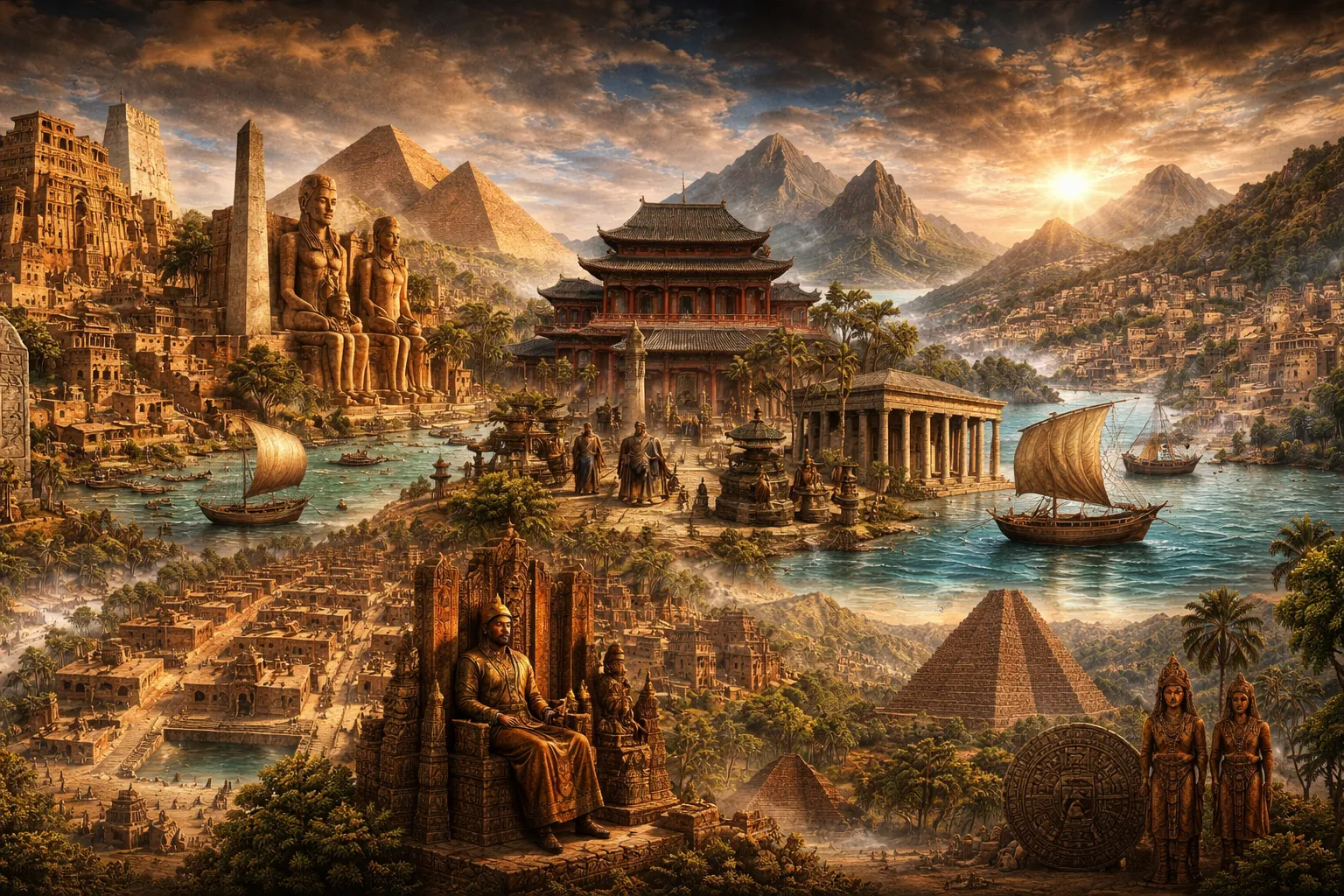
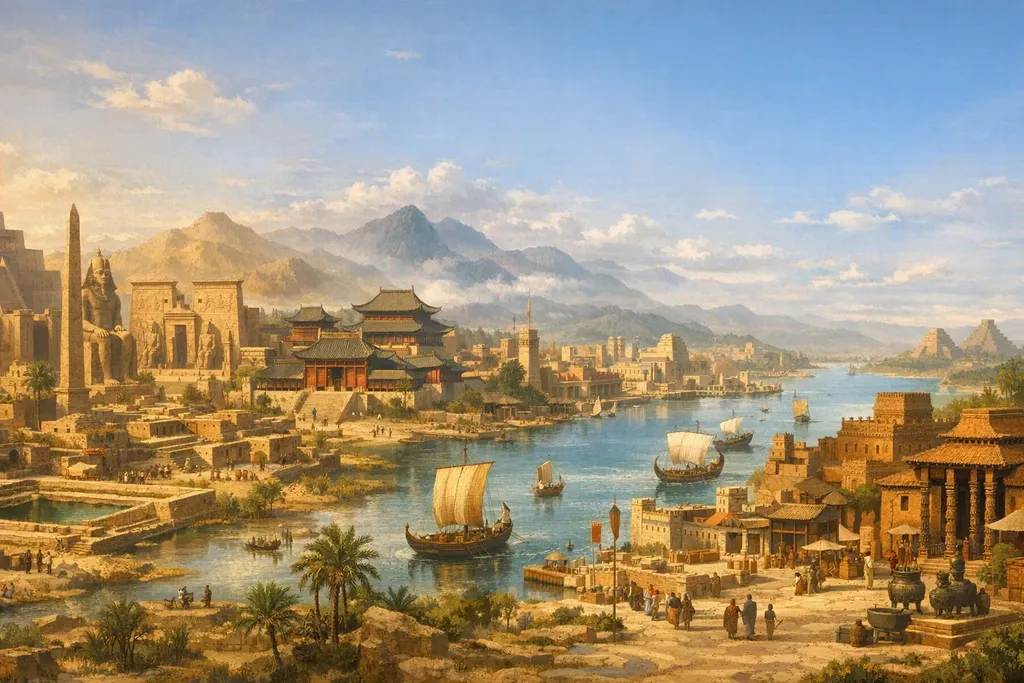
When Antiquity is mentioned, people often think first of Greece and Rome. Yet this period includes far more than that. It brings together many civilizations that developed at different rhythms, in very different spaces, with their own languages, religions, forms of power, arts, and systems of knowledge. Mesopotamia, ancient Egypt, the Persian worlds, ancient India, ancient China, several African kingdoms, and the ancient civilizations of the Americas all belong to this vast history. What must be remembered, then, is that Antiquity is not a single story centered on Europe, but a set of parallel human trajectories, sometimes connected, sometimes independent, each of which helped shape world history.
The first great organized societies take shape
Antiquity corresponds to a major stage in the organization of human societies. In several regions of the world, agricultural communities gradually became large structured societies, with cities, administrations, ruling elites, temples, armies, and common rules. This does not mean that everything began suddenly, but rather that a threshold was crossed: societies became capable of administering vast territories, managing large populations, and establishing lasting institutions. This shift toward more complex structures profoundly transformed human life, because it made possible the centralization of power, the construction of great monuments, the organization of collective labor, and the development of political identities broader than the simple village or clan.
Writing becomes a decisive turning point
One of the major markers of Antiquity is the development of writing in several regions of the world. Writing makes it possible to preserve information, record exchanges, draft laws, transmit myths, note observations, and assert power. Thanks to it, societies no longer depend solely on oral memory to preserve their knowledge. This changes the way people govern, trade, and pass on knowledge. However, it must also be remembered that writing did not appear everywhere at the same time or in the same forms, and that some important societies long relied mainly on orality. Writing is therefore a major tool, but it alone does not summarize the richness of the ancient worlds.
Great rivers and natural environments shape civilizations
Many ancient civilizations developed in regions where natural conditions favored agriculture and human concentration. The valleys of the Nile, the Tigris and Euphrates, the Indus, and the Yellow River played an essential role, because they provided water, fertile land, and routes of circulation. But the natural environment does not determine everything mechanically: it imposes constraints and offers possibilities, to which societies respond through techniques, beliefs, and forms of organization. Irrigation systems, agricultural calendars, flood management, and land planning all show how central the relationship between human beings and their environment was in Antiquity. To understand this period is therefore also to understand how ancient societies adapted to their landscapes and transformed them.
Power, the sacred, and knowledge are often intertwined
In many ancient worlds, political power is not clearly separated from religion. Queens, kings, priestesses, priests, and learned men and women often exercise authority that is at once political, spiritual, and intellectual. Power may be presented as divine in origin, supported by the gods, or charged with maintaining the order of the world. Temples, sanctuaries, and royal courts thus also become places of knowledge, archives, calculation, observation, and transmission. This does not mean that all ancient civilizations functioned in the same way, but it must be remembered that the modern distinction between religion, politics, and science does not always apply to the ancient world. Structures of thought are often more deeply interwoven there, and it is precisely this interweaving that gives many ancient societies their coherence.
Exchanges already connect very distant worlds
Antiquity is neither an immobile world nor an isolated one. Even if means of transport remained slow compared with modern times, long-distance exchanges did indeed exist. Goods, metals, textiles, spices, ideas, beliefs, techniques, and artistic styles circulated between regions that were sometimes very far apart. Land, sea, and river routes gradually connected distinct cultural spaces. These contacts could take the form of trade, diplomacy, migrations, conquests, or pilgrimages. They produced reciprocal influences, local adaptations, and sometimes genuine cultural blending. What must be remembered, then, is that Antiquity was already preparing a world of connections, even if those connections remained unequal, fragile, and dependent on political and geographical conditions.
Empires are important, but they do not define the whole period
The image of Antiquity is often dominated by great empires. They do indeed play a considerable role: they spread languages, administrations, armies, legal models, and cultural practices across vast territories. Yet Antiquity cannot be reduced to empire alone. It also includes autonomous cities, regional kingdoms, confederations, mobile peoples, merchant societies, and more fragmented forms of power. Some regions experienced strong centralization, while others did not. Some were dominated by great political entities, while others remained composed of multiple local authorities. This political diversity is essential, because it shows that there is no single model of ancient civilization. The ancient world was made of shifting balances between centralization and dispersion, conquest and autonomy, stability and recomposition.
Ancient arts, sciences, and knowledge are already highly developed
Antiquity should not be seen as a merely primitive or preparatory period. Ancient civilizations produced refined artistic forms, monumental architecture, complex systems of thought, and often impressive technical knowledge. They developed mathematics, astronomy, medicine, philosophy, literature, engineering, cartography, sculpture, mural painting, and the arts of storytelling. This knowledge was not distributed everywhere in the same way, nor preserved with the same visibility in the sources, but it bears witness to a remarkable level of inventiveness. What must be remembered is that the ancient worlds are not only ancient: they are also intellectually and artistically dense, and they formulated fundamental questions about the cosmos, justice, power, memory, and the place of the human being in the universe.
Antiquity left lasting but multiple legacies
Many dimensions of the modern world still bear the mark of Antiquity. One may think of law, urban planning, founding narratives, religious traditions, forms of the state, alphabets, calendars, learned languages, exchange networks, artistic canons, or certain great philosophical ideas. However, these legacies are neither simple nor uniform. They have been transmitted, transformed, forgotten, rediscovered, or reinterpreted according to periods and regions. We should therefore not imagine an Antiquity extending directly into our present without rupture. Its influence passes through many mediations. Remembering this helps avoid a fixed vision of the past and makes it possible to understand that Antiquity continues to act above all as a reservoir of forms, narratives, and references that are constantly reworked.
A non-Eurocentric overall view is necessary
Finally, the most important point for studying Antiquity today is probably this: it must be viewed on the scale of the world. This does not mean erasing Greece or Rome, but placing them among other major centers. A non-Eurocentric approach makes it possible to better understand the plurality of human experiences, to avoid artificial hierarchies between civilizations, and to recognize that ancient history has several centers, several rhythms, and several forms of achievement. It invites us to compare without reducing, to connect without confusing, and to restore each ancient world to its own logic. This overall view provides a fairer, richer, and more balanced understanding of the period, making it the best entry point for developing the major chapters of the episode afterward.